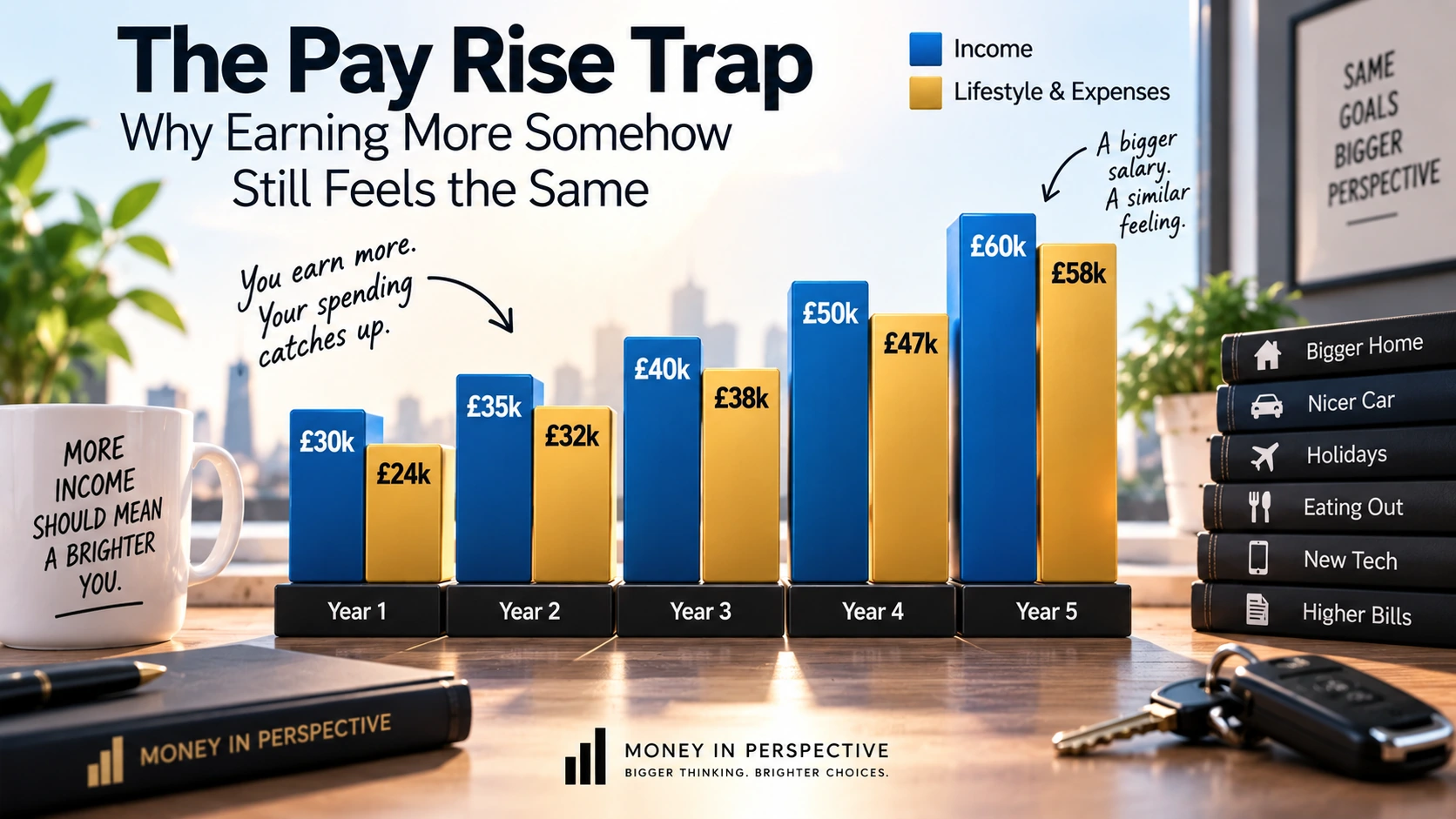
One of the strangest things about earning more money is how quickly the new income can stop feeling new.
At first, the pay rise creates space.
The account balance is healthier.
Saving feels easier.
A few purchases that once required thought become comfortable.
Then something changes quietly.
The nicer car becomes normal.
The larger home becomes normal.
More expensive restaurants become normal.
The premium version of things becomes normal.
A year later, the income is higher but the sense of financial pressure can feel remarkably similar.
This is lifestyle expansion.
As income rises, spending often rises with it.
That is not automatically a problem.
Improving your life is one of the reasons to earn more.
A higher salary that never produces any additional comfort, experience or enjoyment would be a strange kind of success.
The problem is when lifestyle expands automatically rather than intentionally.
The increase is absorbed by new commitments before you decide which improvements actually matter.
Imagine take-home pay rises by £400 a month.
That feels significant.
Then a car upgrade adds £120.
A more expensive gym adds £40.
Eating out grows by £80.
A phone and subscription bundle adds £60.
A larger holiday budget absorbs another £100.
The entire £400 has disappeared without one decision feeling reckless.
This is why lifestyle inflation is difficult to notice.
It rarely arrives as one enormous purchase.
It arrives as a series of reasonable upgrades.
The word “reasonable” changes with income.
A £50 meal may feel expensive when money is tight.
Later, it becomes ordinary.
A £300 monthly car payment feels large until colleagues and friends regularly pay £500.
A holiday budget that once felt luxurious becomes the new baseline.
The brain adapts.
This adaptation is one of the reasons money can buy comfort without permanently buying the feeling of being richer.
What once felt like an upgrade becomes normal surprisingly quickly.
Economists and psychologists often talk about hedonic adaptation — the tendency for people to get used to improvements.
You do not need the term to recognise the effect.
The first week in a better car feels special.
Six months later, it is simply the car.
The first few nights in a larger home feel exciting.
A year later, the extra space is part of normal life.
The spending remains.
The novelty fades.
This does not mean upgrades are pointless.
Some improvements continue delivering real value long after they stop feeling exciting.
A shorter commute.
A more comfortable mattress.
A safer neighbourhood.
Better childcare.
More reliable transport.
The important question is whether the upgrade improves life in a durable way or mainly raises the standard you now expect.
Fixed costs are where lifestyle expansion becomes most powerful.
An occasional expensive dinner ends that evening.
A higher mortgage, rent or finance payment follows you every month.
This is why large recurring commitments deserve more thought than one-off treats.
If a pay rise adds £300 of monthly income and you immediately add £250 of fixed costs, most of the new flexibility has disappeared.
The salary improved.
The household's ability to adapt barely changed.
This is the difference between a higher lifestyle and greater financial margin.
Margin is the space between income and committed spending.
It can be used for saving, emergencies, career changes, travel or spontaneous opportunities.
A larger lifestyle uses the same income to make day-to-day life more expensive.
Both can be valid choices.
The danger is assuming they are the same thing.
Cars are a classic example because monthly finance allows lifestyle to rise smoothly with salary.
A person earns more.
The old £250 payment becomes a £400 payment.
The difference is only £150.
Against the higher salary, it feels affordable.
Across four years, that difference is £7,200 before considering insurance, fuel or depreciation.
Again, perhaps the nicer car is worth it.
The useful question is whether the car was one of the things you actually wanted the pay rise to improve.
Housing has even larger consequences.
A salary increase can support a larger mortgage or more expensive rent.
Housing can provide enormous quality-of-life value.
Space.
Location.
Schools.
Shorter commute.
Garden.
Privacy.
But because housing is such a large fixed cost, increasing it can absorb years of future income.
A larger home can make someone earning more feel no richer because the additional salary is already committed to the additional property.
There is no rule saying that is a bad choice.
The point is that it is a trade.
Lifestyle expansion also happens through convenience.
As income rises, people may become less willing to tolerate inconvenience.
Taxi instead of bus.
Delivery instead of collection.
Prepared food instead of cooking.
Premium shipping.
Cleaner.
Paid parking.
These services buy time and can be excellent value.
But convenience is easy to stack.
A household can gradually pay to remove dozens of small inconveniences without ever deciding to create a more expensive lifestyle.
The result is a higher monthly cost base that is difficult to identify because each convenience is individually sensible.
Food spending changes too.
You stop checking prices as closely.
Premium brands enter the basket.
Takeaway becomes more frequent.
Lunch out becomes routine.
Again, this may improve life.
But if the goal of earning more was to feel less financially pressured, allowing every category to rise may defeat that goal.
There is also social influence.
Higher income can move you into new workplaces, neighbourhoods and social groups with different spending norms.
Colleagues drive different cars.
Friends choose different restaurants.
Holidays become more ambitious.
What feels normal is partly shaped by what people around you do.
This means lifestyle expansion can happen without conscious comparison.
You simply absorb the standard.
One of the best protections is deciding what you care about before income rises.
Perhaps travel is important to you.
Perhaps housing is.
Perhaps food.
Perhaps you love cars.
Spend more in those categories when you can.
Let others remain ordinary.
This is much more satisfying than upgrading everything slightly.
A person can have a premium version of a few things they love without turning every part of life into a premium subscription.
Another useful strategy is to split pay rises.
Suppose take-home income increases by £300.
You might direct £150 toward current lifestyle and £150 toward saving, investing or debt repayment.
There is nothing magical about half.
The value is protecting some of the increase before spending adapts to it.
Automating the future portion helps because the money never becomes part of ordinary spending.
Increase the savings standing order on the same day the higher pay begins.
Increase pension contributions where appropriate.
Increase debt overpayments.
Now lifestyle can still improve, but financial strength improves too.
Waiting before increasing fixed costs can also be powerful.
Let the higher income exist for several months.
See the actual after-tax difference.
Understand any new job-related costs.
Then decide which upgrades deserve a permanent claim on the salary.
This is especially useful after promotions because higher pay can come with higher commuting, childcare or convenience costs.
The gross increase may look much larger than the practical gain.
A delay prevents commitments from being built around an optimistic number.
Bonuses and irregular income deserve even more caution.
A one-off bonus can make a household feel temporarily richer.
Using it to fund a one-off experience or build savings is straightforward.
Using it as justification for a permanent monthly payment is riskier.
Temporary income should not automatically create permanent lifestyle.
This is one reason people can feel trapped after several years of rising earnings.
The salary is high.
So are the commitments.
Mortgage.
Cars.
School fees perhaps.
Memberships.
Subscriptions.
Travel expectations.
The household needs the high income simply to remain where it is.
That reduces freedom.
Leaving a stressful job becomes harder.
Taking a career break becomes harder.
Reducing hours becomes harder.
The lifestyle has consumed the options that higher income could have created.
This is not an argument for living like a student forever.
It is an argument for allowing some income growth to buy freedom instead of only buying things.
Freedom can look like an emergency fund.
Low debt.
A large gap between income and bills.
The ability to take unpaid leave.
The ability to change jobs.
The ability to help family.
These benefits are less visible than a new car but can have much larger effects on daily stress.
There is also a useful concept in deliberately keeping some categories “good enough.”
Your phone works well.
Keep it.
Your car is reliable.
Keep it.
Your home is comfortable.
Do not assume every pay rise requires more square footage.
This creates financial asymmetry: income rises while certain costs stay flat.
That is one of the fastest ways to feel genuinely better off.
If earnings increase 20% and major costs remain similar, margin expands.
If earnings increase 20% and everything else also rises 20%, the lifestyle changed but the financial feeling may not.
A periodic lifestyle audit can make this visible.
Look at spending from two or three years ago if records are available.
Which categories grew?
Did the increase improve life?
Which expenses are now normal but would once have seemed excessive?
This is not an exercise in guilt.
It is a way of seeing adaptation.
Perhaps the larger home is worth every pound.
Perhaps the expensive gym is rarely used.
Perhaps restaurant spending doubled without creating more memorable experiences.
That information helps decide what should remain.
Downgrading can be emotionally difficult because reductions feel like loss.
Once you become used to a certain standard, choosing a cheaper option can feel like going backward even if the original version was perfectly adequate.
This is why preventing automatic lifestyle inflation is easier than reversing it later.
It is much easier not to take on the £500 car payment than to give up the car after becoming attached to it.
That does not mean lifestyle can never shrink.
People adapt in both directions too.
A household that reduces a recurring cost may feel the loss strongly for a few weeks and barely notice it months later.
Knowing this can make intentional reductions easier.
There is also no universal correct lifestyle for a given salary.
Someone earning £80,000 does not have to drive a particular car or live in a particular house.
Someone earning £40,000 does not have to avoid every luxury.
Income is a resource, not a dress code.
The strongest financial decisions come from personal priorities rather than the spending level associated with an income bracket.
This matters because comparison can make under-spending feel like failure.
If peers upgrade, keeping the older version can feel as though you are not progressing.
But invisible progress is still progress.
Savings.
Investments.
Debt reduction.
Pension.
Cash reserves.
These do not photograph well.
They can dramatically change the future.
One practical rule is to make at least one part of every pay rise invisible.
Before you upgrade anything, move a portion to a future goal.
Then enjoy the rest.
This creates a habit where earning more automatically increases both lifestyle and security.
It prevents the entire raise from disappearing into more expensive normality.
Another rule is to ask whether an upgrade creates continuing value after the novelty fades.
Shorter commute?
Probably.
Better mattress?
Likely.
More reliable car?
Maybe.
Premium trim level mainly because it looks newer?
Depends on how much you care.
The answer is personal.
The question is what matters.
There is no problem with treating yourself after success.
Celebrate.
Buy something.
Travel.
Life should improve.
The problem is when celebration becomes infrastructure.
A one-off dinner does not trap future income.
A finance agreement does.
The distinction between temporary enjoyment and permanent commitment is one of the most useful in lifestyle planning.
Ultimately, lifestyle expands because humans adapt to what they can afford.
That is natural.
The goal is not to stop adaptation entirely.
It is to make sure income rises faster than the minimum cost of being you.
If every salary increase immediately becomes another fixed payment, the bank balance may grow while your sense of choice does not.
If some of each increase remains uncommitted, something different happens.
You start to feel richer not because everything is more expensive, but because more options remain available.
That is the version of lifestyle inflation worth aiming for.
Let life improve.
Just do not let every extra pound acquire a monthly direct debit before you have decided what the money was meant to do.