A pay rise should make life feel easier.
You earn more.
The payslip improves.
There is more money available each month.
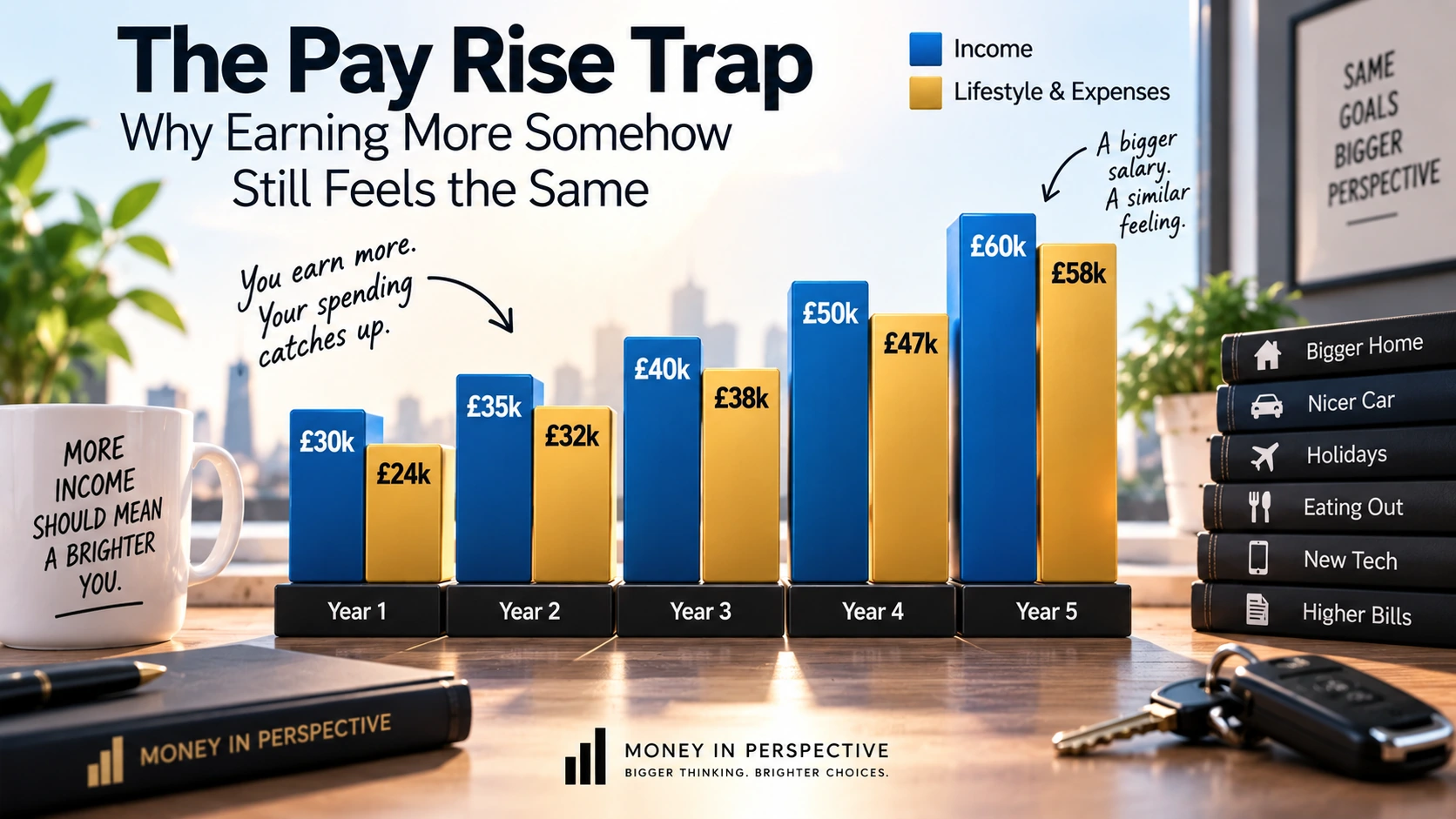
Yet many people reach a new salary and are surprised by how quickly the improvement becomes normal. A few months later, the extra income seems to have disappeared into ordinary life and the financial pressure feels strangely familiar.
This is the pay rise trap.
It does not happen because pay rises are useless. Higher income can transform finances. It can make saving easier, reduce debt faster, improve housing choices and create more security.
The problem is that spending often rises alongside income.
The increase becomes absorbed before it has a chance to create a lasting difference.
Suppose your take-home pay rises by £300 a month.
At first, that £300 feels significant.
Then the car is upgraded and costs £80 more.
You start eating out slightly more often.
A few subscriptions appear.
You choose the nicer hotel on the next holiday.
Groceries become less price-sensitive.
The extra money has not vanished.
It has been converted into a more expensive version of normal life.
This is lifestyle inflation.
It is not automatically bad.
One reason people work hard to earn more is so life can improve.
If every pay rise had to be saved entirely, earning more would feel oddly unrewarding.
The issue is not allowing spending to rise.
It is allowing it to rise by the full amount without deciding whether that is what you actually want.
A pay rise can be divided between three broad uses:
improving life now,
improving financial security,
and improving future options.
All three matter.
If the entire increase goes to the first category, the salary rises but financial resilience may remain unchanged.
If the entire increase goes to the future, life today may feel unnecessarily restricted.
A balanced approach allows both versions of you to benefit.
One simple method is to decide in advance what percentage of a pay rise you will keep.
Perhaps half of the additional take-home pay goes toward savings, pension contributions, investments or debt repayment.
The other half can improve your current lifestyle.
There is nothing special about 50%.
The point is making the decision before spending expands automatically.
This works because lifestyle inflation often happens through many small upgrades rather than one obvious event.
Coffee becomes more frequent.
You stop comparing supermarket prices.
Takeaways become easier to justify.
The phone contract becomes more expensive.
You use taxis more often.
Each change feels affordable because it is.
The pay rise created room.
The problem is that ten affordable changes can consume the entire room.
Fixed costs are especially important.
A one-off celebration has a temporary effect.
A larger car payment, more expensive rent or new subscription changes the monthly baseline.
Once the pay rise is committed to fixed costs, it becomes difficult to redirect later.
This is why it can be useful to wait before increasing major commitments.
Let the higher salary exist for three or six months.
See what the actual take-home difference is.
Build some savings.
Then decide which lifestyle upgrades are worth making permanent.
This delay creates information.
A gross salary increase does not equal the same increase in spendable income.
Income tax, National Insurance and other deductions affect the result.
Depending on circumstances, pension contributions, student loan repayments or benefit interactions may change too.
The relevant number for lifestyle decisions is the additional take-home pay, not the headline increase.
If your salary rises by £5,000 but the practical monthly difference is around £250, committing £200 of new monthly expenses leaves very little improvement.
This is another reason pay rises can feel underwhelming.
Expectations are built around the gross number.
Life experiences the net number.
Work costs can rise with salary too.
A promotion may mean more office days.
Longer commuting.
More expensive clothing.
Client entertainment.
Additional childcare.
Less time to cook.
A new role can therefore create spending that partially offsets the higher pay.
This does not mean the promotion is poor value.
It means the pay rise should be compared with the whole change in working life.
Imagine a new role adds £350 a month after deductions.
The commute costs £100 more.
Childcare increases £70.
Bought lunches and convenience spending add another £50.
The household is around £130 better off before any other changes.
Still positive.
Just not the £350 improvement the payslip initially suggested.
The psychological effect of higher income also matters.
People often use salary as a signal for what they should be able to afford.
“I earn £60,000 now. Surely I can have a better car.”
“I got promoted. We can afford the nicer holiday.”
These statements may be completely correct.
The danger is using salary level rather than financial position to justify spending.
Income is only one part of affordability.
Savings.
Debt.
Housing costs.
Dependants.
Goals.
Job security.
All matter.
Two people earning the same salary can have very different capacity to spend.
This is why copying the lifestyle associated with an income bracket can be expensive.
There is no official lifestyle attached to £40,000, £60,000 or £100,000.
You do not unlock a mandatory car at a certain salary.
A pay rise can be used in ways that are almost invisible but extremely powerful.
Increasing an emergency fund.
Paying down expensive debt.
Raising pension contributions.
Building a house deposit.
Creating a buffer so monthly bills feel easier.
None looks impressive from outside.
That is partly why lifestyle spending wins so easily.
The visible reward arrives now.
Financial resilience is quiet.
But quiet progress can change your life more deeply.
An emergency fund may allow you to leave a bad job.
A deposit may create housing options.
A pension contribution compounds for years.
Debt repayment frees future cash flow.
These benefits do not provide the immediate excitement of a new purchase, but they can create much more lasting freedom.
One useful way to think about a pay rise is as new margin.
Before the increase, perhaps income was £3,000 and essential plus normal spending was £2,800.
You had £200 of monthly margin.
The pay rise takes income to £3,300.
If spending remains at £2,800, margin becomes £500.
That is a dramatic improvement.
If spending immediately rises to £3,100, margin remains £200.
Life may look nicer, but the underlying financial flexibility has not changed.
This is the heart of the pay rise trap.
You are objectively earning more without becoming much more financially secure.
Margin matters because it gives you options.
It allows saving without stress.
Absorbs unexpected bills.
Makes career changes easier.
Reduces dependence on credit.
A pay rise is one of the easiest moments to increase margin because the higher income arrives before you have fully adjusted to it.
Once the new lifestyle is established, cutting back feels like losing something.
That is why automatic allocation helps.
If the pay rise adds £250 a month, increase a standing order by £100 or £150 immediately.
You never become accustomed to spending the full increase.
The rest remains available to enjoy.
This technique uses the same psychology that makes workplace pension contributions effective: money redirected before becoming part of everyday spending is often easier to keep redirected.
Debt repayment can work similarly.
Suppose you have a credit card payment of £200 a month.
A pay rise allows you to add another £150.
The debt disappears much faster.
When it is gone, you now have £350 of monthly cash flow to redirect.
The pay rise has created a second pay rise by removing a liability.
This can be more powerful than immediately using the extra income for new expenses.
Pay rises also create an opportunity to review financial goals.
Maybe the previous savings target was built around lower income.
Now it can increase.
Perhaps retirement contributions can rise.
Perhaps the house deposit timeline can shorten.
Perhaps you can work toward reducing hours later.
Higher income can buy future time, not only present consumption.
This is especially valuable because earning more often requires giving more to work.
Promotion may bring responsibility and stress.
If the financial benefit is immediately consumed by lifestyle inflation, you can end up working harder simply to fund a more expensive routine.
Directing some of the increase toward freedom helps balance that trade.
There is another trap: celebrating the pay rise with permanent spending before the first higher payslip arrives.
New car.
More expensive home.
Finance agreement.
These decisions may be based on the gross salary rather than the actual net income.
Wait until you see the real number.
Better still, wait several months.
A new role may have costs you did not anticipate.
Commuting.
Parking.
Travel.
Professional clothing.
Social expectations.
Understand the new financial pattern before adding more fixed commitments.
Bonuses deserve separate treatment.
A one-off bonus can feel like evidence that income has permanently risen.
It has not necessarily.
Using a temporary payment to fund a permanent monthly cost creates risk.
A bonus can be excellent for one-off goals:
debt repayment,
savings,
travel,
large purchases.
If it supports lifestyle, keep the spending one-off too unless base income can comfortably carry the commitment.
There is also a social effect to earning more.
Promotions may put you around people with higher salaries and more expensive habits.
Restaurants.
Cars.
Holidays.
Clothes.
Your comparison group changes.
This can accelerate lifestyle inflation because the new spending feels normal within the new environment.
Remember that you do not know other people's full finances.
A colleague's car does not tell you their debt.
Their holiday does not tell you their savings.
Your pay rise does not need to make your lifestyle resemble theirs.
Use your own priorities.
It can help to decide what you genuinely wanted before the pay rise.
Perhaps you have wanted to travel more for years.
Use some of the increase for that.
Perhaps the current car is fine.
Do not upgrade it simply because the salary now makes the finance payment look smaller.
Intentional lifestyle inflation is completely different from automatic lifestyle inflation.
One is a choice.
The other is drift.
Pay rises can also improve quality of life without increasing spending very much.
You might use the financial margin to work fewer overtime shifts.
Build enough savings to take a career break.
Move to a role with better hours later.
Create a buffer that reduces money anxiety.
These are not obvious lifestyle upgrades, but they can be far more valuable than possessions.
A good pay rise plan can therefore be extremely simple.
First, calculate the actual additional take-home pay.
Second, decide what proportion should improve life now.
Third, decide what proportion should strengthen the future.
Fourth, automate the future portion.
Fifth, review after a few months.
This prevents the whole increase from disappearing into the general account and becoming impossible to trace.
There is no need to optimise every pound.
You are allowed to feel richer after earning more.
Buy the nicer meal.
Take the trip.
Upgrade something you genuinely care about.
The point is to make sure the pay rise creates more than a temporary spending upgrade.
If you earn £300 more and save £150 of it, you are both living better and becoming stronger financially.
That is a very different outcome from earning £300 more and immediately adding £300 of recurring costs.
There is also a useful question to ask a year after a pay rise:
What has this extra income actually changed?
If the answer is better savings, lower debt, more enjoyable experiences and some improved day-to-day comfort, the increase has done several jobs well.
If the answer is “I'm not really sure, but everything costs more now,” lifestyle inflation probably absorbed it.
That does not require guilt.
It requires adjustment.
You can still redirect part of the income going forward.
The pay rise trap is not permanent.
The biggest advantage of earning more is not that you can spend more.
It is that you have more choices.
You can spend more.
Save more.
Invest more.
Work toward freedom.
Or combine all of them.
The trap happens when the first option quietly consumes the others before you notice.
A pay rise should not only make the numbers larger.
Ideally, it should make your financial life wider.
More margin.
More resilience.
More room to enjoy today without sacrificing tomorrow.
If earning more somehow feels exactly the same, look at what changed after the salary changed.
The money probably did not disappear.
It may simply have upgraded your lifestyle at exactly the same speed as it upgraded your income.