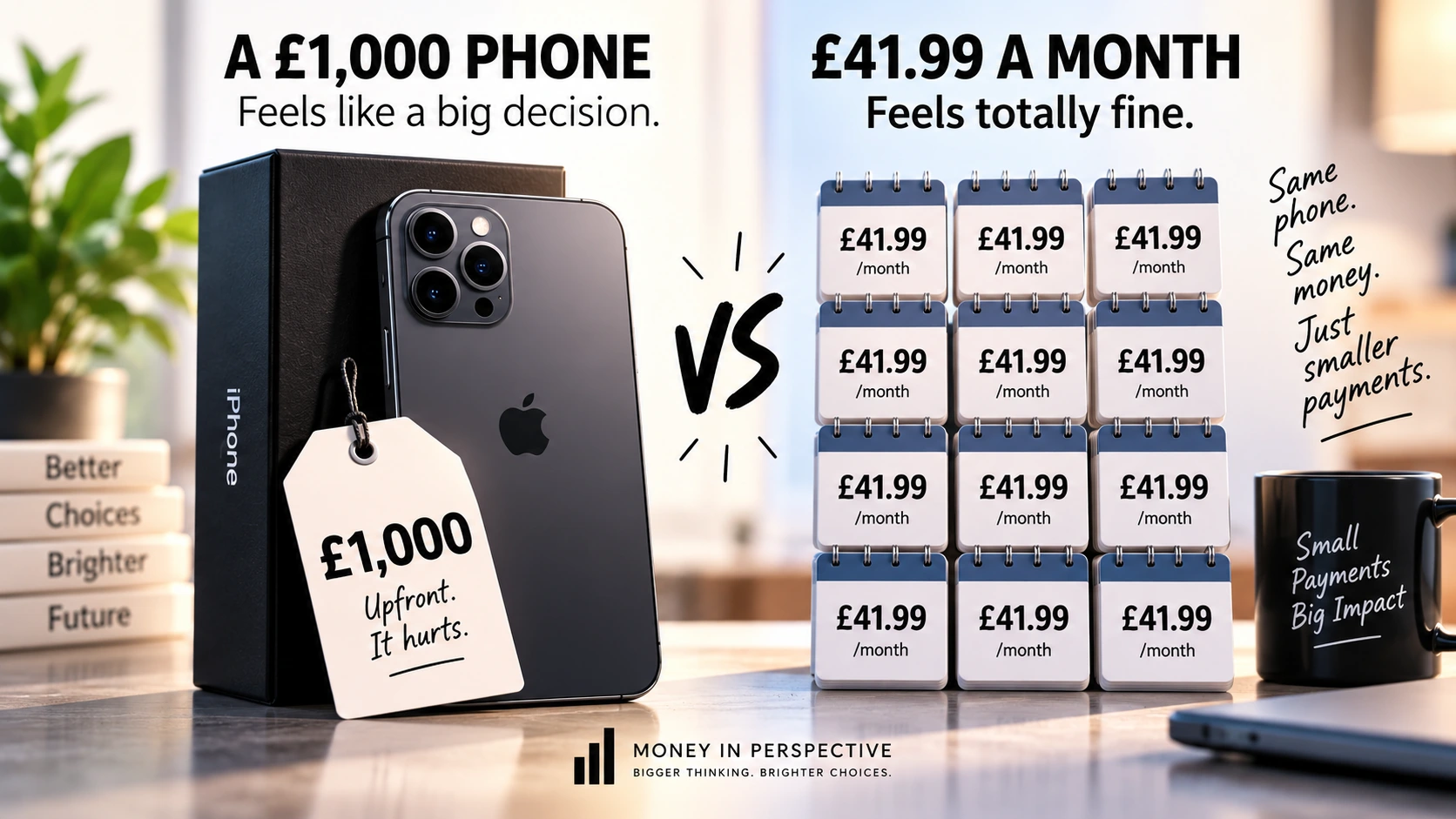
A £1,000 phone sounds expensive.
£41.99 a month sounds ordinary.
That difference is not created by the phone. It is created by the way the price is presented.
Monthly pricing changes how expensive products feel because most people manage life monthly. Salary arrives monthly. Rent leaves monthly. Direct debits leave monthly. When a large purchase is translated into the same language, it starts competing with other monthly bills rather than with the full amount sitting in your savings account.
This is why a £1,000 device can feel strangely affordable when the payment is £41.99.
The total cost has not disappeared. It has been divided into smaller pieces.
That can be genuinely useful. Not everyone wants to spend £1,000 upfront, and spreading a necessary purchase can protect cash flow. Interest-free finance can be a sensible payment method when the total price is clear and the monthly commitment fits comfortably.
The danger appears when the monthly number becomes the only number you think about.
Imagine two phones.
Phone A costs £700.
Phone B costs £1,000.
The difference is £300.
That sounds meaningful.
Now spread both across twenty-four months.
Phone A is roughly £29 a month.
Phone B is roughly £42.
The difference becomes about £13.
That sounds much smaller.
The products did not move closer in price. The framing changed.
This is one reason premium upgrades are easier to sell through monthly payments.
More storage is only £4 extra.
The better camera model is another £6.
Insurance is another £9.
A smartwatch bundle is another £12.
Each decision is judged as a small monthly step.
By the end, the original £30 plan can become £70 or £80 without one moment where you consciously chose to spend hundreds more.
Retailers understand this well. Monthly pricing reduces sticker shock.
It also shifts attention toward affordability rather than value.
Affordability asks: can I make this payment each month?
Value asks: is this product worth the total amount I am committing?
Those questions are related but not identical.
You can comfortably afford £42 a month and still decide a £1,000 phone is poor value for your needs.
Likewise, you can find £1,000 expensive and still decide the phone is excellent value because you use it several hours every day for four years.
The monthly figure alone cannot answer that.
This is why translating monthly payments back into totals is so useful.
£41.99 for twenty-four months is just over £1,000.
Add an £11 monthly insurance plan and the two-year total increases by another £264.
Add a service plan that is higher than you actually need and the complete ownership cost moves again.
The point is not to make every purchase look frightening. It is to compare the right numbers.
Phones are especially good examples because device cost and service cost are often bundled.
A £55 monthly phone bill might include hardware finance, data, calls, insurance and perhaps extras.
When the contract ends, many people immediately upgrade because the monthly payment feels normal.
This can create a permanent technology payment.
The phone changes every few years.
The direct debit never disappears.
One of the biggest savings available to someone with a good phone is simply keeping it after the hardware has been paid off.
If a combined plan costs £55 and an appropriate SIM-only plan costs £15, the difference is £40 per month.
That is £480 across one year.
Keep the device for another two years and the saving approaches £1,000 before considering resale changes.
This is why the decision to delay an upgrade can matter more than finding a £50 discount on the new model.
Trade-in offers can make monthly pricing even more persuasive.
“Get £350 for your current device” sounds like a discount.
It is also the value of something you already own.
If a new phone costs £1,100 and your old one is worth £350, the upgrade still requires roughly £750 of value.
A retailer may then divide that £750 across monthly payments.
Now the decision becomes £31.25 a month instead of “Would I spend £750 to move from my current phone to this one?”
The second question is usually more useful.
That does not mean trade-ins are bad. They are convenient and can reduce net cost.
The trick is to recognise that the old device is part of the payment.
The same principle applies to cars, laptops, furniture and any other expensive product sold through instalments.
Monthly pricing often turns an ownership decision into a cash-flow decision.
Sometimes that helps.
Sometimes it encourages people to buy the higher specification because the difference looks too small to matter.
Consider storage.
A phone with 256GB might be £8 a month cheaper than the 1TB version.
£8 sounds trivial.
Across a three-year term, it is £288.
If you only use 100GB, the extra storage is not really costing £8. It is costing £288 for capacity that may remain empty.
Perhaps you still want it for future flexibility. Fine.
At least the decision is based on the total.
This is why “only £X more per month” is such a powerful phrase.
It focuses attention on the increment rather than the commitment.
Businesses use it because it works.
Consumers can simply reverse the framing.
Multiply the difference by the contract length.
Now decide again.
The effect becomes even stronger when several financed products overlap.
Phone.
Watch.
Tablet.
Laptop.
Headphones.
Each payment may look manageable.
Together they can create a large recurring technology budget.
Suppose the phone is £42, watch £18, tablet £25 and laptop £45.
That is £130 per month.
Across a year, £1,560.
Across two years, £3,120.
Those products may all be worthwhile.
The important thing is seeing the category as one financial commitment rather than four harmless monthly amounts.
This is also where fixed costs affect flexibility.
A person with £500 of monthly finance commitments has £500 less room every month for unexpected bills, saving or changing priorities.
The payments may all be affordable while income is stable.
They can feel very different after job loss, parental leave or a rise in housing costs.
This is why affordability should include resilience.
Could you comfortably carry the payment if income fell temporarily?
Do you have savings?
How many other monthly commitments already exist?
The answer does not have to be perfect.
It simply prevents “I can pay it this month” from becoming the only test.
There is another psychological issue: once a monthly payment is normal, its disappearance can feel like spare money that should be replaced.
A phone contract ends.
The £42 payment could now become savings.
Instead, the new phone launch appears and the payment continues.
This is a form of payment inertia.
You are used to spending the money, so keeping the spending level feels painless.
The same thing happens when car finance ends or a loan is repaid.
One of the strongest financial habits is allowing a completed payment to stay completed for a while.
Redirect some or all of it toward savings, debt or another goal.
Experience what the lower fixed-cost month feels like before adding a replacement commitment.
Phones also have unusually strong upgrade marketing because technology improves every year.
Better cameras.
Faster processors.
Longer battery life.
Brighter displays.
New materials.
These improvements are real.
The question is how much they improve your life compared with the device already in your hand.
A new camera might matter enormously to a creator or parent who takes thousands of photos.
It might matter very little to someone who mainly messages, browses and watches video.
The £41.99 payment makes both users feel the same affordability.
Their value is completely different.
This is why a useful upgrade test is to identify specific problems before looking at the new model.
What does your current phone fail to do?
Battery?
Storage?
Camera?
Software support?
Damage?
Performance?
If you cannot identify a meaningful limitation, the new phone is mainly a discretionary upgrade.
That is allowed.
You do not need to pretend it is essential.
Calling the purchase a want rather than a need can actually make the decision easier.
If you love phones and can afford the hobby, the £1,000 may be good value to you.
If you are upgrading mainly because £41.99 feels too small to refuse, that is weaker.
There is also cost per year to consider.
A £1,000 phone kept for four years costs £250 per year before resale and repairs.
The same phone replaced after two years costs £500 per year before resale.
Longer ownership can dramatically improve value.
This is why software support and battery replacement matter so much.
A device that remains secure and useful for years gives you the option to leave the monthly-payment cycle.
Keeping technology longer does not mean rejecting innovation.
It means deciding when the improvement is worth paying for.
The strongest way to shop for monthly products is to set a total budget first.
If you are willing to spend £800 on a phone, compare phones around £800.
Then decide whether to pay cash or monthly.
Now financing is merely a payment method.
Without a total budget, monthly pricing can become the budget.
That gives the seller much more influence over what “affordable” means.
Another useful habit is to write the total commitment beside any monthly offer.
£41.99 x 24 = about £1,008.
£12 x 24 insurance = £288.
Service plan = whatever the actual contract costs.
Seeing the full numbers does not prevent you buying.
It simply restores perspective.
There is no financial prize for always paying cash.
There is also no prize for avoiding every premium device.
The goal is to understand the exchange.
How much money are you committing?
What do you receive?
How long will you use it?
What else could the same money do?
Monthly pricing is convenient because life is monthly.
It becomes dangerous only when it makes the total invisible.
A £1,000 phone is not secretly cheap because the payment is £41.99.
It is still a £1,000 phone.
And that may be completely fine.
The decision becomes much better once you remember both numbers at the same time.
There is one final reason monthly prices feel easier: they compete with income before they compete with wealth.
If you earn £3,000 a month, £42 feels like a small percentage of salary. But a £1,000 purchase may be a meaningful percentage of your savings.
Both perspectives matter.
Income tells you whether you can service the commitment.
Savings and other goals tell you what the opportunity cost is.
Perhaps £1,000 could fund a holiday, reduce debt or remain as emergency cash. Perhaps the phone provides more value than any of those alternatives.
That is a personal choice.
The point is that monthly finance should not hide the trade.
You are not deciding whether £41.99 is small.
You are deciding whether this product deserves £41.99 of your income every month until the contract ends.
It also helps to compare the monthly payment with the month after the contract ends.
If you kept the device and the £41.99 hardware element disappeared, what would you do with that money?
Across a year, another £500 of breathing room can become surprisingly valuable.
That future saving is part of the cost of upgrading early.
You are not only paying for the new device; you are giving up the period when the old device could have become cheap to own.
Sometimes the upgrade is worth that sacrifice.
Sometimes the financially strongest move is simply reaching the end of the contract and doing nothing.