Personal finance has a strange obsession with coffee.
Skip the latte.
Make it at home.
Stop buying lunch.
Cancel the small pleasures.
The logic is easy to understand. Small purchases happen often, so they are visible and emotionally satisfying to cut. Saving £4 feels concrete in a way renegotiating insurance or moving house does not.
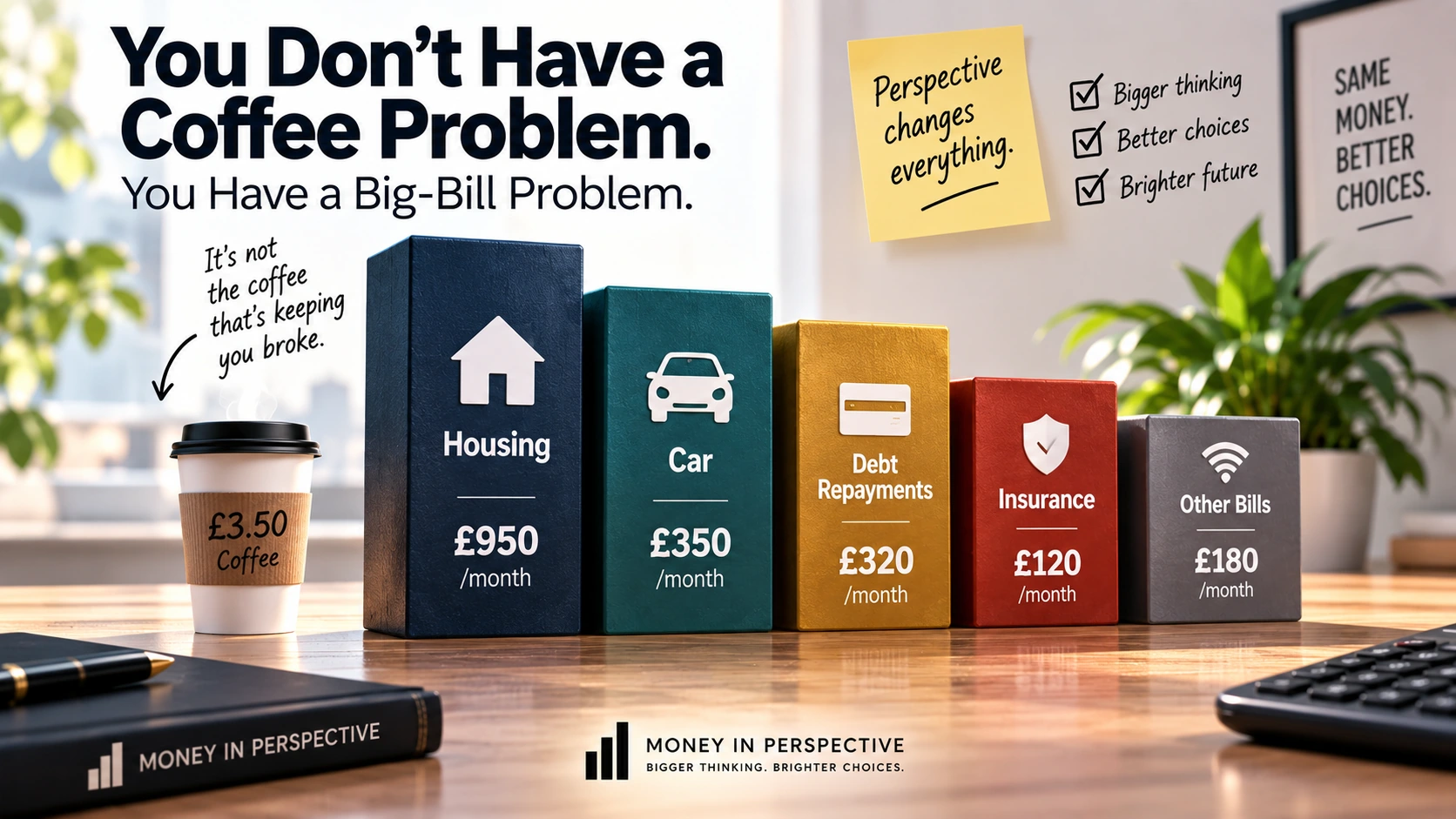
But for many households, coffee is not the reason money feels tight.
The bigger problem is usually the big bills.
Housing.
Car finance.
Childcare.
Debt repayments.
Energy.
Insurance.
Subscriptions that became permanent.
A household can remove every coffee and still feel squeezed because the financial structure underneath has not changed.
This is not an argument for ignoring small spending. Repeated small purchases do add up. If £5 disappears every day, that is more than £1,800 a year.
The point is scale.
If your monthly mortgage is £1,500, car payments are £500, childcare is £900 and debt repayments are £400, the financial pressure is being created mainly by thousands of pounds of fixed commitments.
A £4 coffee is not carrying the same weight.
This matters because people often direct enormous attention toward the smallest expenses while treating large fixed costs as untouchable.
Small costs are easy to change immediately.
Large costs feel complicated.
You can skip coffee tomorrow.
You cannot sell a car, change nursery arrangements or move home by Tuesday.
That makes small spending a tempting target even when it is not the main problem.
Housing is the largest example for many people.
Rent and mortgage payments consume a significant part of income.
Add council tax, utilities, insurance, maintenance and furnishing and the real cost of housing is larger again.
There may be perfectly good reasons for paying it. Location, space, schools, family needs and quality of life matter.
But if the household is under financial pressure, housing deserves at least the same scrutiny as takeaway coffee.
That does not mean “just move somewhere cheaper.” Moving can be expensive, disruptive and impossible in the short term.
It means recognising the size of the category.
If reducing housing costs by £150 a month becomes possible at renewal, refinancing, relocation or another life change, that one decision is equivalent to skipping dozens of coffees every month.
Cars can create a similar pattern.
The monthly finance payment is easy to normalise because it leaves automatically.
Then there is insurance, fuel, tax, maintenance, tyres, parking and depreciation.
A car advertised at £399 a month can easily cost much more than £399 to own and operate.
Again, perhaps the vehicle is worth it.
The point is that a single large car decision can affect finances more than hundreds of small purchases.
This is why upgrading a car because the payment is “only £80 more” deserves attention.
£80 a month is £960 a year before any differences in insurance, fuel or maintenance.
That is a lot of coffee.
Childcare is another large expense that cannot be solved with simplistic budgeting advice.
For many families, it is necessary to work.
The cost can be substantial and temporary, changing as children grow and arrangements change.
Telling parents to cut snacks while childcare absorbs hundreds or thousands of pounds misses the structure of the household.
The useful response may involve checking available support, changing working patterns, sharing care differently or simply planning around a genuinely expensive stage of life.
Sometimes there is no easy reduction.
That is important too.
Not every large bill can be cut.
Personal finance should not pretend otherwise.
Debt repayments are another category where scale matters.
High-interest credit-card balances can consume monthly cash flow and keep doing so long after the purchases are forgotten.
Paying £200 or £300 toward debt every month can make someone feel as though their salary disappears before life begins.
Reducing small spending may help free money for repayment.
But the strategic target is the debt, not the coffee.
If expensive borrowing can be reduced faster, refinanced appropriately or prevented from growing, the long-term improvement can be much larger than eliminating small pleasures permanently.
Interest is especially important because it creates a cost without improving current life.
A meal out provides an experience.
Interest on old spending provides no new benefit.
That is why high-interest debt often deserves priority.
Insurance and utilities are less exciting but can contain meaningful savings too.
People may keep the same provider for years because switching feels tedious.
A £20 monthly saving on broadband, mobile service, energy-related costs or insurance is £240 a year.
Find two or three large recurring savings and the effect can exceed an entire campaign against coffee.
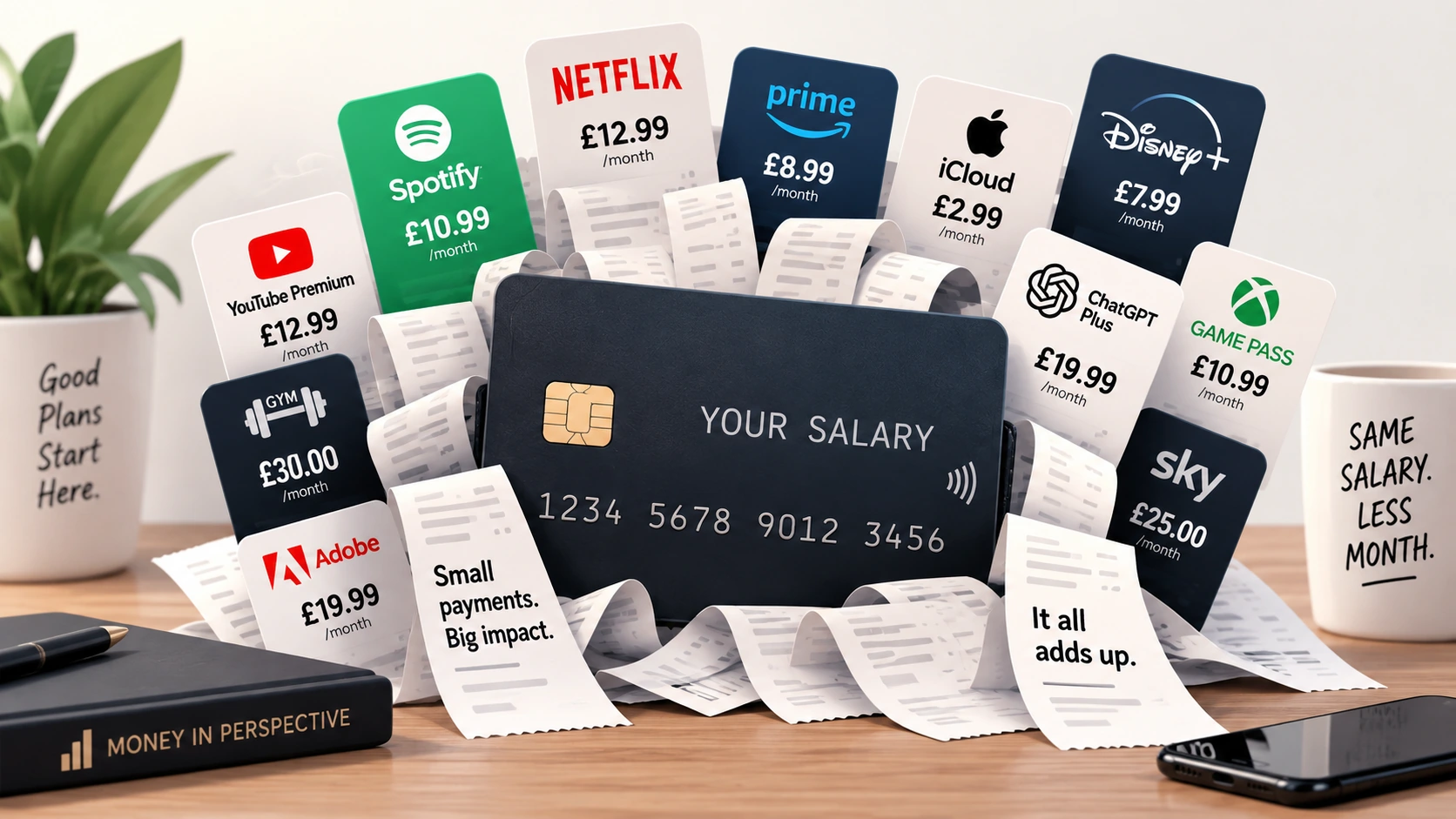
Subscriptions sit somewhere between small and large expenses.
One £8 service is small.
Ten subscriptions can become a major monthly bill.
The important distinction is not transaction size but recurring commitment.
A recurring £30 cost deserves more attention than a one-off £30 purchase because it repeats until somebody stops it.
This is why an annual review of fixed costs can be more powerful than constant monitoring of daily spending.
Once or twice a year, look at every regular payment.
Mortgage or rent.
Car.
Insurance.
Utilities.
Phone.
Broadband.
Subscriptions.
Memberships.
Debt.
Ask whether each is still necessary, competitive and appropriately sized.
You may find nothing to change.
That is still useful.
It confirms the large bills are deliberate.
The problem with coffee-focused advice is also psychological.
It can make people feel that financial difficulty is caused by ordinary human enjoyment.
You are struggling because you bought lunch.
You cannot buy a house because you bought coffee.
You are behind because you went out with friends.
This can create guilt without providing a realistic path to improvement.
For somebody spending £300 a month on café drinks, yes, coffee may genuinely be a major category.
For somebody spending £25, it probably is not the reason the deposit is missing.
Numbers matter more than slogans.
This does not mean small spending is irrelevant.
Small costs have two useful roles in a financial plan.
First, they can be adjusted quickly.
If you need to free £100 this month, reducing eating out, coffee or discretionary shopping may be the fastest option.
Second, small habits can become large when frequent.
The right approach is proportionality.
Do not spend three hours worrying about a £4 coffee while ignoring a £600 car payment you no longer value.
Do not cancel a £10 hobby subscription that you use every day while allowing a £70 service you barely notice to renew.
Focus first on the largest amounts with the weakest value.
This idea can be turned into a simple exercise.
List your monthly spending from largest to smallest.
Not by what annoys you.
By amount.
Now look at the top ten items.
Which are essential?
Which are fixed temporarily?
Which could change at renewal?
Which are optional?
Which provide enough value to justify their size?
This often reveals the true shape of the budget.
A person may discover that 70% of income goes to housing, transport, childcare and debt before discretionary spending begins.
That tells a very different story from “I need to stop buying coffee.”
At that point, the solution may involve larger life decisions rather than better self-control in cafés.
Increasing income belongs in the discussion too.
There is a limit to how much anyone can cut.
A household with essential costs close to income may need more earnings, not endlessly smaller pleasures.
Promotion.
Additional hours.
Changing jobs.
Training.
Business income.
Benefits or support where eligible.
These options are not easy or guaranteed.
But income is one side of the equation, and personal finance advice sometimes focuses almost entirely on spending because it is easier to tell someone what to stop buying.
Sometimes the strongest financial move is earning £500 more, not finding another £50 to cut.
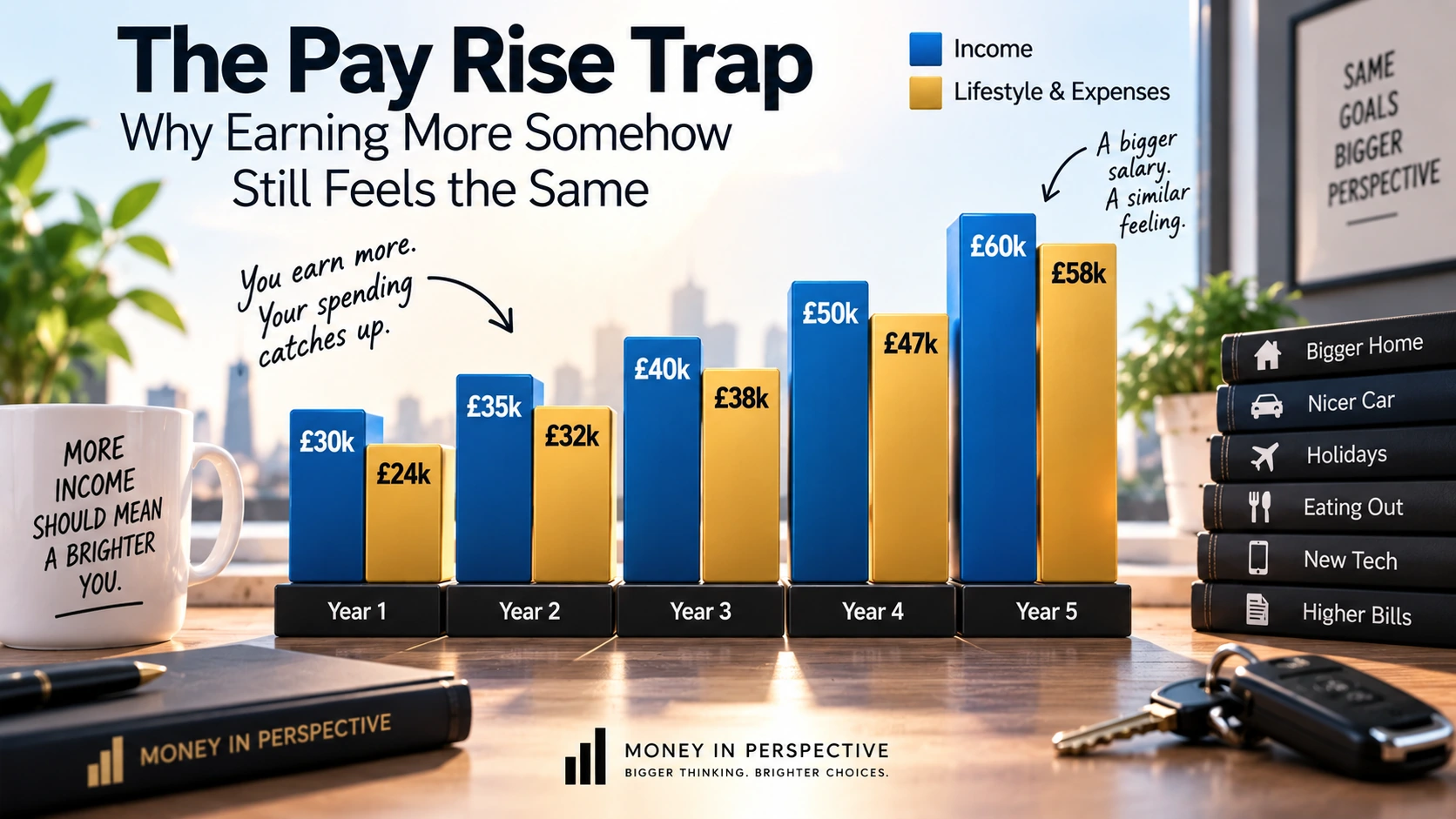
Of course, higher income can disappear into larger fixed costs too.
That is why pay rises should be handled deliberately.
If income increases and the car, housing and subscriptions immediately expand to match, financial pressure can remain almost unchanged.
Protecting some of the increase creates margin.
Margin is what makes money feel easier.
The gap between what comes in and what must go out.
A household with £4,000 income and £3,900 of fixed commitments can feel poorer than one with £3,000 income and £2,200 of commitments because the second has more flexibility.
This is why fixed costs matter so much.
They reduce choice before the month starts.
A coffee is optional each morning.
A finance agreement is due whether you feel like paying it or not.
That makes large recurring commitments more important to get right.
There is also a timing issue.
Small spending is visible immediately.
Large financial choices may have been made years ago.
The car was financed eighteen months ago.
The mortgage was agreed three years ago.
The mobile plan renewed last summer.
Because the decision is old, the payment can feel inevitable.
It is worth remembering that many fixed costs become changeable eventually.
Contracts end.
Renewals arrive.
Children grow.
Jobs change.
Mortgages can be reviewed.
Cars can be replaced with cheaper options.
You may not be able to change the bill today, but you can plan for the decision point.
This is a much more useful form of budgeting than repeatedly blaming small purchases for structural costs.
One practical method is to maintain a “next renewal” list.
Insurance date.
Phone contract.
Broadband.
Car finance end date.
Mortgage deal end date where relevant.
Membership renewals.
This creates opportunities to make big decisions before inertia makes them for you.
A £300 annual saving achieved at one renewal continues quietly without daily effort.
That is one of the advantages of fixed-cost optimisation.
You make the decision once and benefit repeatedly.
Compare that with saving £3 on coffee.
You must make the decision again every morning.
Both can work.
One requires much more ongoing willpower.
This is why financial systems are often stronger than financial discipline.
Automate savings.
Reduce poor-value fixed costs.
Create sensible limits for discretionary spending.
Then allow yourself to enjoy the money that remains.
The aim is not perfect efficiency.
A household can deliberately choose expensive housing because location matters.
It can keep a premium car because driving is a major interest.
It can spend heavily on childcare because the arrangement works for the family.
Big does not mean bad.
It means important.
Large expenses deserve conscious decisions because they have large consequences.
Small spending deserves attention when it is frequent or low-value, not simply because it is easy to criticise.
There is also a fairness issue in how financial advice is discussed.
Telling someone on a tight income to remove every small pleasure can make budgeting sound like punishment.
If the numbers genuinely require cuts, difficult choices may be unavoidable.
But the analysis should start with reality, not a cliché.
How much comes in?
What are the largest commitments?
Which can change?
What support exists?
What income opportunities are realistic?
Then look at smaller spending.
Coffee may be part of the answer.
It should not automatically be the headline.
A good budget is not a competition to see who can tolerate the least enjoyment.
It is a way to direct money toward what matters while maintaining enough margin for the future.
If coffee is one of the things you genuinely enjoy and it fits comfortably, buy it.
If you discover you are spending £150 a month on drinks you barely care about, reduce it.
The decision should come from your numbers.
And if money feels tight despite sensible small spending, stop assuming you are failing because of minor purchases.
Look up.
The biggest numbers are usually where the biggest explanation lives.
You may not have a coffee problem.
You may have a big-bill problem.