There has probably never been a time when it was easier to know what everyone else appears to own.
You can see other people’s homes, cars, holidays, clothes, restaurants, phones and celebrations before you have even left bed in the morning.
The effect is subtle.
Nobody has to say:
You should have this too.
Repeated exposure does the work.
A certain type of car begins to look normal.
A particular holiday becomes standard.
A kitchen renovation that once looked luxurious starts to feel like the sort of thing people simply do.
The trouble is that you can see the lifestyle.
You cannot see the finances behind it.
Comparison gives you only half the information
Imagine seeing someone with a £60,000 car.
There are many possible financial stories.
They paid cash comfortably.
It represents a small fraction of their wealth.
It is financed at a significant monthly cost.
It is a company car.
It belongs to someone else.
You do not know.
From the outside, every scenario looks almost identical.
This makes lifestyle comparison financially dangerous because we compare visible outcomes while missing the circumstances that created them.
Social media widens the comparison group
Historically, most people compared themselves primarily with family, friends, neighbours and colleagues.
Now your reference group can include thousands of strangers.
Some are significantly wealthier than you.
Some receive free products.
Some are sponsored.
Some may be borrowing heavily.
Some carefully curate the appearance of a lifestyle that represents only a small fraction of everyday reality.
The comparison pool has expanded enormously while the information quality has not.
Normal changes depending on your environment
Spending standards are social.
If everyone around you drives modest cars, an expensive car feels unusual.
If most colleagues drive premium models, the same car begins to look normal.
The object did not change.
Your reference point did.
This can happen in almost every category.
Weddings.
Holidays.
Schools.
Restaurants.
Clothes.
Technology.
Housing.
What feels “reasonable” is partly influenced by what you repeatedly see.
Keeping up is not always conscious competition
People rarely sit down and say:
“I need to spend more so I can beat my friends.”
The process is usually much less dramatic.
You see what other people are doing.
You absorb the standard.
Eventually your own choices shift toward it.
This is why comparison spending can feel entirely natural rather than competitive.
You are not trying to win.
You are simply trying not to feel behind.
Status spending can be surprisingly ordinary
A status purchase does not need to be a sports car or designer watch.
It can be the latest phone because everyone in the group upgrades.
A more expensive wedding because simpler plans feel embarrassing.
A holiday destination chosen partly because it looks impressive.
A home renovation completed because several friends recently did theirs.
The purchase may still provide genuine value.
The useful question is whether you would want it as much if nobody else ever saw it.
The cost of belonging is real
Sometimes spending is directly connected to relationships.
Birthday trips.
Weddings.
Group holidays.
Restaurants.
Concerts.
Events.
Declining repeatedly can create social difficulty.
That makes “just say no” poor advice.
Relationships are valuable, and spending money to participate in them can be completely worthwhile.
The problem appears when participation consistently requires spending beyond what is comfortable.
At that point, social belonging has acquired a financial subscription fee.
Lifestyle comparison can push fixed costs higher
The most dangerous form of keeping up is not occasional social spending.
It is increasing permanent commitments.
More expensive house.
Car finance.
Private memberships.
Long contracts.
These costs remain after the social moment has passed.
You may buy the larger home partly because it reflects the stage of life you believe you should have reached.
Now the mortgage or rent continues for years.
Comparison has moved from an emotional influence to a fixed monthly expense.
Income does not tell you what others can afford
Another reason comparison is unreliable is that salary alone does not determine financial position.
Two people earning the same amount can have completely different circumstances.
One may have no debt and substantial savings.
Another supports relatives.
One bought a home years ago at a much lower price.
Another has high childcare costs.
One inherited money.
Another is starting from zero.
Visible lifestyle tells very little about financial capacity.
Debt is invisible
This is perhaps the most important point.
Borrowing can make almost any lifestyle appear temporarily affordable.
Credit cards.
Loans.
Finance.
Buy-now-pay-later.
A person can display significant consumption without owning much of it outright.
Again, there is no reason to assume somebody is in debt merely because they own nice things.
The point is uncertainty.
You do not know.
That makes them a poor financial benchmark.
Define what success looks like before the world defines it for you
One of the best protections against comparison spending is having your own definition of progress.
Perhaps success means:
a comfortable emergency fund,
time with family,
owning a home,
travelling,
working fewer hours,
building a business,
retiring earlier,
or simply worrying less about money.
Once your own priorities are clear, other people's spending becomes less instructive.
A luxury car may look attractive without interfering with your goal.
Spend heavily where you genuinely care
Rejecting comparison does not mean rejecting expensive things.
Maybe you love cars.
Buy the car if your finances support it.
Maybe travel matters enormously.
Spend there.
The important difference is that the purchase has a personal reason rather than a social one.
Money is most satisfying when it reflects your values.
Ask the invisible-audience question
Before a significant purchase, ask:
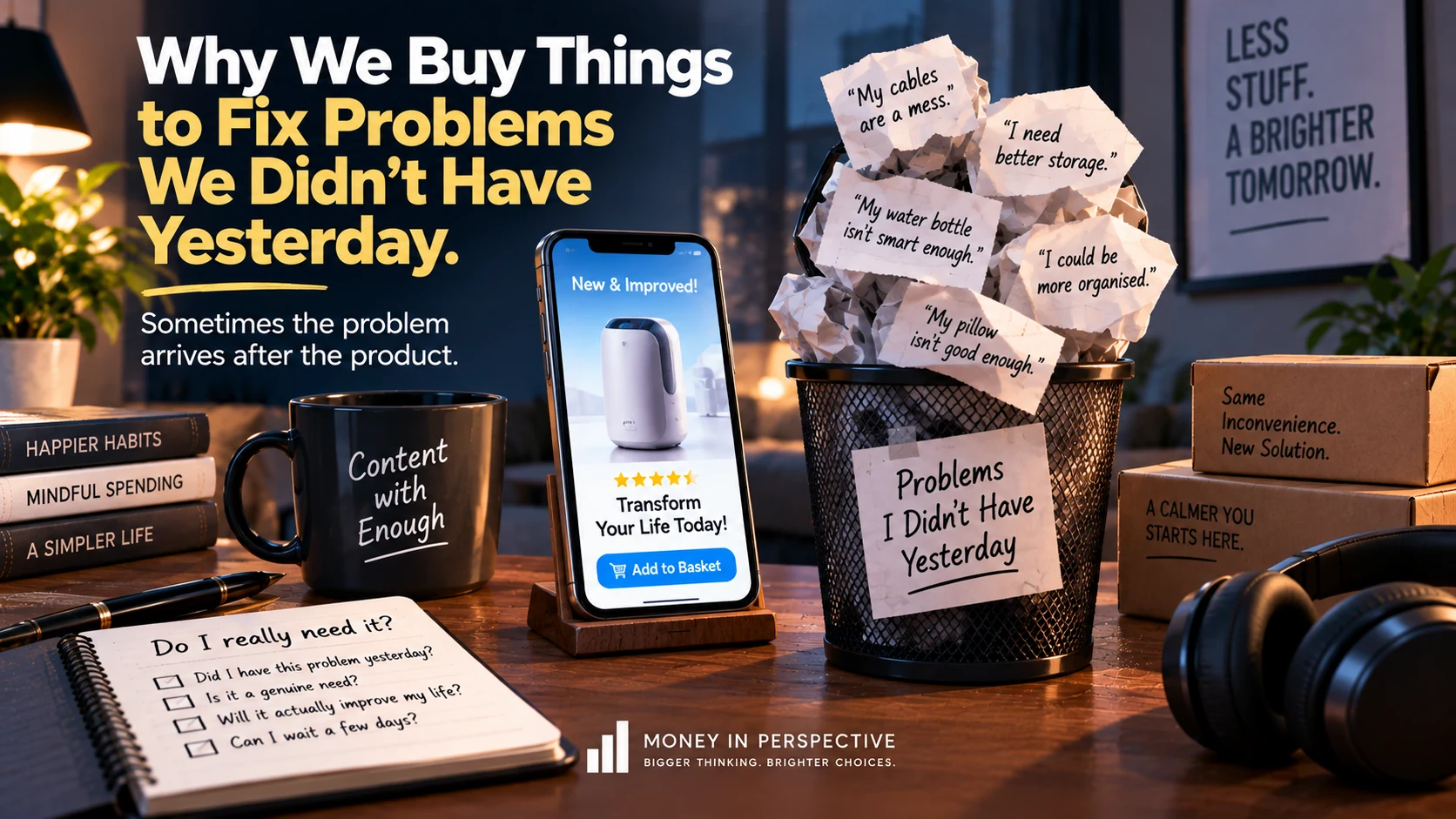
Would I still want this if nobody else ever knew I owned it?
This question is not perfect.
Some purchases are naturally social.
Clothes are seen.
Homes host people.
Cars are visible.
But the question can reveal how much of the desire comes from use and how much comes from signalling.
Neither motive makes you a bad person.
Understanding the mix simply helps you decide whether the price is worthwhile.
Social media can be edited financially too
We know photographs are curated.
Finances are curated as well.
A feed contains the new kitchen.
Not the monthly repayment.
The holiday.
Not the months of saving.
The restaurant.
Not Tuesday's leftovers.
This is normal. Nobody wants to upload a photograph captioned:
“Here is my direct debit leaving the account again.”
The problem is forgetting that the financial parts exist simply because they are not visible.
Keeping up has no finish line
There will always be someone with more.
Larger home.
Better car.
More impressive holiday.
Newer phone.
If comparison becomes the standard, there is no point at which spending produces permanent satisfaction.
You can catch one person.
Another remains ahead.
This makes social comparison a particularly expensive financial strategy.
The target moves whenever you approach it.
Your lifestyle does not need to explain itself to everyone
One of the most liberating financial decisions is allowing parts of your life to look ordinary.
Older car.
Normal phone.
Smaller home.
Simple wedding.
Affordable clothes.
This does not mean rejecting ambition.
It means not requiring every improvement in your financial position to become visually obvious.
Quiet financial progress often looks boring
Savings are invisible.
Debt reduction is invisible.
Pension contributions are invisible.
Financial resilience rarely photographs well.
This means some of the most valuable financial progress receives the least social recognition.
You may look exactly the same while becoming substantially more secure.
That is worth remembering when other people’s visible consumption makes your own progress feel slow.
You may be comparing yourself with someone who does not exist
Keeping up becomes especially expensive when the comparison is not with one person but with a collection of people. One friend has the better car. Another takes the impressive holiday. Someone else has the renovated kitchen. A colleague wears expensive clothes. Social media then combines all of those separate lifestyles into one imaginary standard.
No single person may actually live the life you are comparing yourself with. You have accidentally built a composite person who earns enough to do everything at once. That is an impossible benchmark.
One of the healthiest things you can do with money is accept that priorities require trade-offs. The household that spends heavily on travel may drive older cars. The person with the beautiful home may rarely eat out. Someone who buys premium clothes may live in a smaller property. From the outside, you usually see the thing they chose, not the things they declined in order to afford it.
This matters because comparison makes the trade-offs invisible. We see ten people's best categories and feel behind in all ten.
A personal spending hierarchy can protect against this. Choose perhaps three areas where you are happy to spend generously when affordable, and let other areas remain ordinary. You might care about travel, good food and your home. Someone else might choose cars, sport and technology. There is no need for every category to look premium at the same time.
That approach also makes saying no easier. If expensive cars are not one of your priorities, seeing a friend's new car does not need to trigger a financial identity crisis. You can admire it without converting admiration into a finance agreement.
Comparison also becomes dangerous at major life stages because expectations arrive in clusters. Moving house can lead to new furniture, decorating, appliances and the feeling that the car should somehow improve too. A wedding can expand because each element is compared with other weddings. Having children can create pressure around equipment, activities and schooling. Promotions can produce a sense that lifestyle should immediately rise to match the new title.
These moments deserve slower decisions because they are when social expectations are strongest.
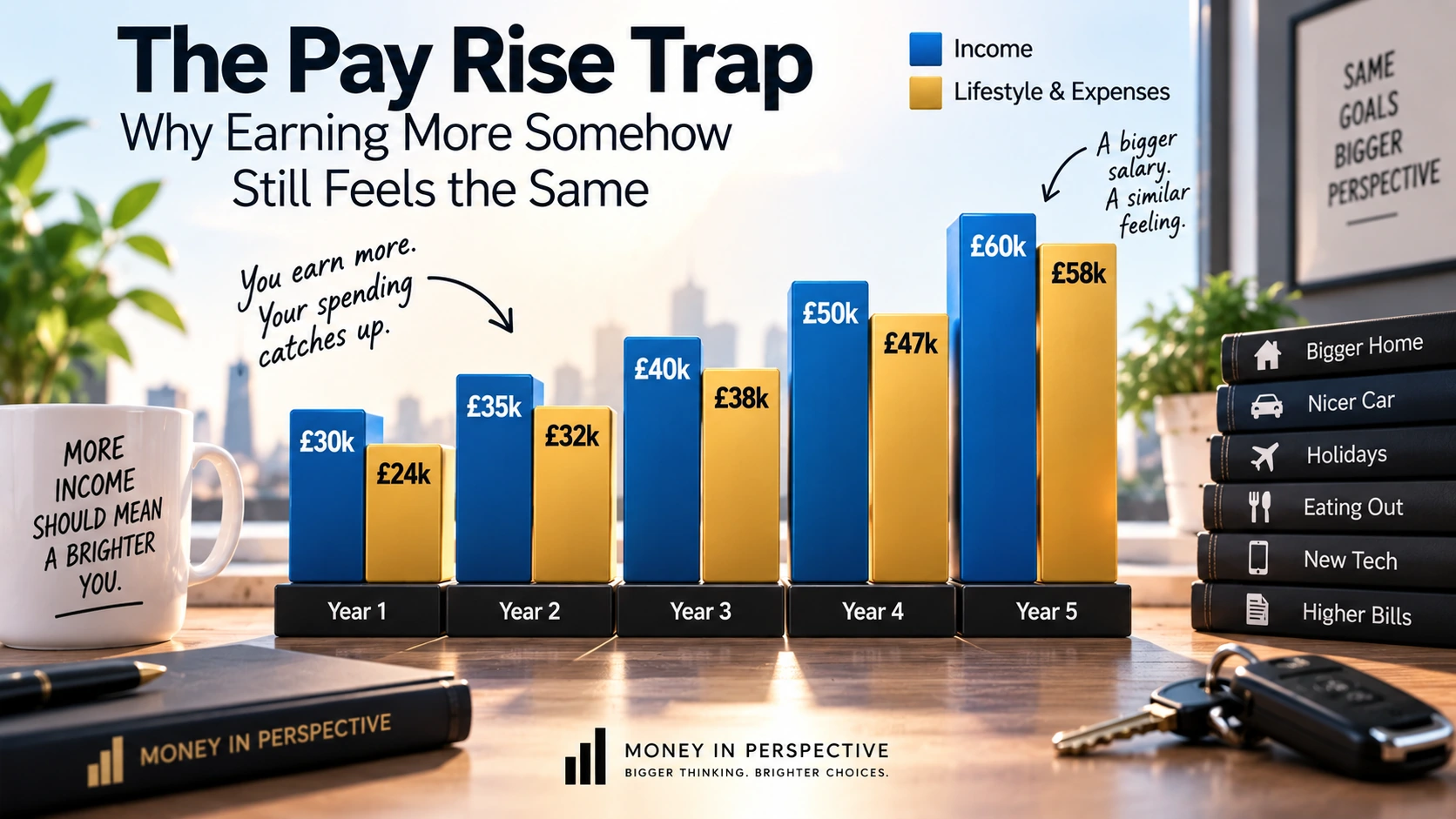
It can help to create a delay between increased income and increased lifestyle. When earnings rise, allow the extra money to exist for several months before giving it permanent jobs. That period makes it easier to decide which upgrades genuinely improve life and which simply feel appropriate for someone at your new salary.
The same applies to windfalls, bonuses and business success. Money does not have to become visible immediately.
There is also a relationship benefit to being open about limits. Friends often assume everyone else is comfortable with the same spending because nobody wants to be the first person to say a restaurant, trip or event feels expensive. One honest conversation can reveal that several people were quietly thinking the same thing.
Suggesting a cheaper plan is not a declaration of financial failure. It is simply a preference about how much you want to spend.
The more secure you become in your own priorities, the less threatening other people's choices feel. Their expensive holiday does not cancel your savings goal. Their renovated kitchen does not make yours worse. Their newer phone does not reduce what your current phone can do.
That sounds obvious, yet comparison works precisely by making somebody else's improvement feel like evidence of your deficiency.
It is not.
Money becomes much easier to manage when you stop asking whether your life looks as expensive as the lives around you and start asking whether it is becoming more like the life you actually want. Those can be completely different goals.
One creates an endless race. The other eventually gives you somewhere to arrive.
There is another useful exercise: imagine nobody in your social circle could see the next major thing you bought. The car would be invisible to colleagues. The holiday would never appear online. Nobody would visit the renovated room. Would you still choose the same version at the same price?
If the answer is yes, that is strong evidence the purchase is mainly for you. If your enthusiasm drops sharply, that does not automatically make the purchase wrong, but it reveals that social recognition is part of what you are paying for.
Knowing that can be surprisingly freeing. You can still choose the expensive option. You are simply making the decision with the full price and the full motivation visible.
Keeping up is optional
You are allowed to admire other people’s lifestyles.
You are allowed to want some of the same things.
You are also allowed to decide:
That is nice, but it is not important enough to me to pay for.
That sentence can save enormous amounts of money over a lifetime.
Because other people’s spending is information about their lives.
It is not a set of instructions for yours.