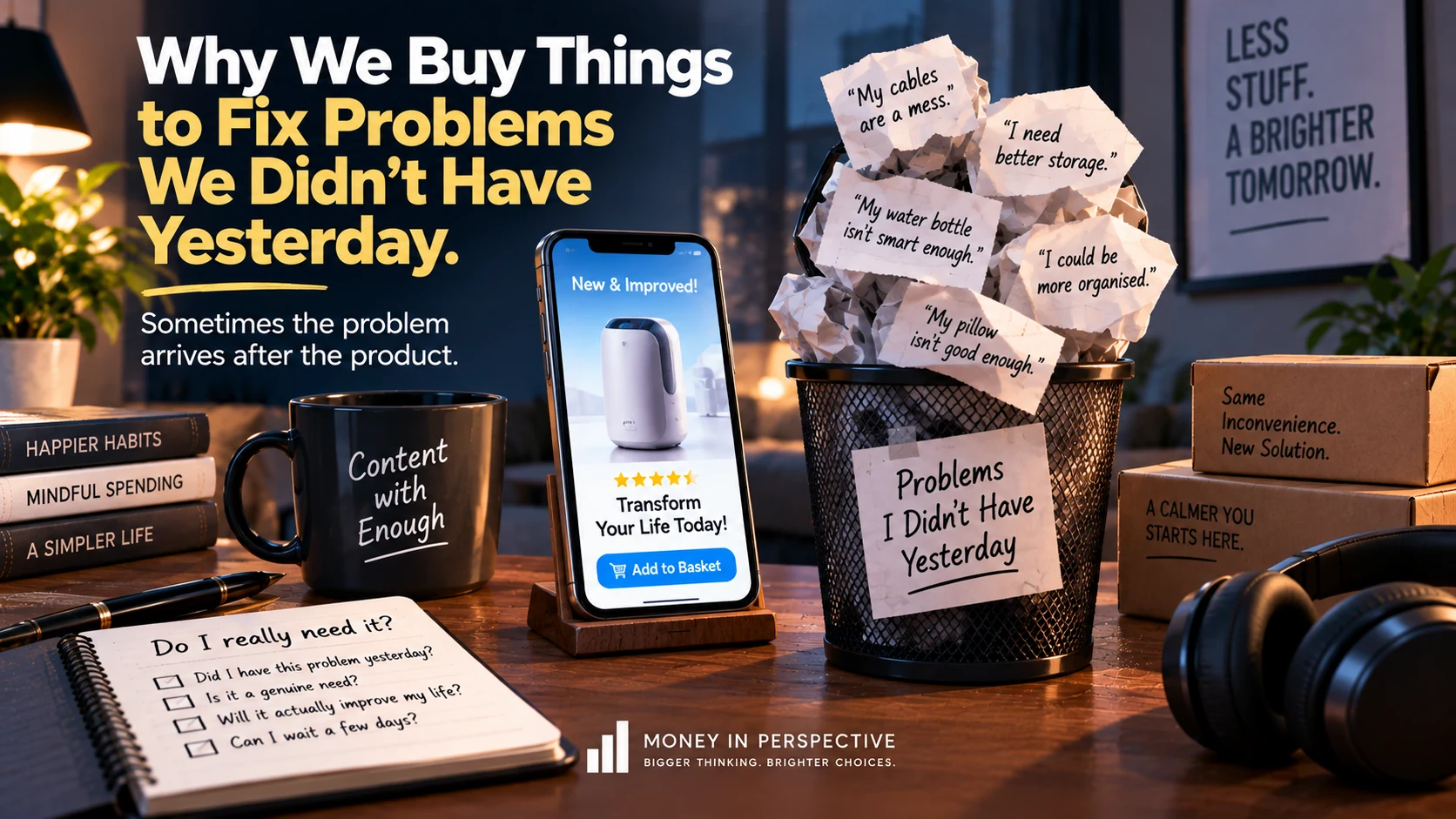
One of the great skills of modern marketing is showing you a problem you had somehow managed to survive without noticing.
Your cables are disorganised.
Your water bottle lacks technology.
Your kitchen storage is inefficient.
Your pillow is apparently destroying your spine.
Your ordinary toothbrush now looks suspiciously primitive.
Ten seconds ago, none of this mattered.
Then the product appears.
Conveniently, the problem and solution arrive together.
This is not necessarily manipulation. Many excellent products exist because somebody noticed an inconvenience and designed something better.
The interesting part is how easily discovering a product can create dissatisfaction with something that previously felt completely adequate.
The product often introduces the problem
Traditional purchasing begins like this:
I have a problem.
I need a solution.
Modern marketing often reverses the sequence:
Here is a solution.
Notice this problem.
That reversal matters.
If you had not experienced the issue independently, the product is not merely solving demand.
It is helping create demand.
The easiest example is organisation products.
You see a perfectly arranged refrigerator filled with matching containers.
Suddenly your completely functional refrigerator looks chaotic.
Nothing spoiled.
Nothing became harder to find.
The comparison changed.
Improvement has no natural stopping point
Almost everything you own has a better version.
Faster.
Smarter.
More ergonomic.
More premium.
Better designed.
If every available improvement becomes a reason to replace the current version, consumption has no natural finish line.
Your possessions are constantly being compared with products designed years later.
Of course the newer one often looks better.
The financially useful question is whether the improvement solves something that actually matters to you.
Advertising is good at making small inconveniences feel unacceptable
Many products focus on minor friction.
A device saves thirty seconds.
A kitchen gadget reduces one step.
An accessory prevents you from performing a small repetitive task.
This can provide genuine value when the task occurs constantly.
But modern consumer culture can create the expectation that every inconvenience deserves elimination.
Some inconveniences are cheaper to tolerate.
Walking across the room.
Using a knife instead of a specialised appliance.
Plugging in a cable manually.
Waiting two days for delivery.
There is no requirement that life become completely frictionless.
Social media turns products into lifestyles
Products are rarely shown alone.
A storage system appears in a beautiful home.
A suitcase appears in effortless travel.
A skincare product appears inside a calm morning routine.
A laptop appears in a perfect minimalist office.
The object becomes attached to the feeling.
You are not only buying the product.
You are briefly buying access to the lifestyle shown around it.
This is powerful because you may genuinely want the lifestyle.
The product is simply the easiest purchasable piece.
Buying the object does not always buy the behaviour
This appears frequently with self-improvement products.
Fitness equipment.
Journals.
Productivity apps.
Kitchen equipment.
Course subscriptions.
The purchase represents an intention.
You want to exercise.
Become organised.
Cook more.
Learn something.
The item feels like progress.
Sometimes it helps.
Other times, the purchase substitutes for the actual behaviour.
Owning exercise equipment is much easier than exercising.
The “problem first” rule
A useful purchasing test is simple:
Did I have this problem before I saw the product?
If yes, the product may solve something real.
If no, wait.
This does not mean the answer must be no forever.
Perhaps the advertisement genuinely revealed an inefficiency you had never considered.
Waiting simply gives the problem time to prove itself.
If the inconvenience keeps appearing over the next few weeks, perhaps the solution is worthwhile.
If both product and problem disappear from your mind, the urgency was probably manufactured.
Give new problems a probation period
For non-essential purchases, create a waiting list.
Write down the item and the problem it claims to solve.
Then wait perhaps a week or a month depending on cost.
During that period, notice whether the problem occurs naturally.
This can be surprisingly revealing.
Some products remain obviously useful.
Others become completely irrelevant once the advertisement is no longer in front of you.
Cost per problem solved is useful
Suppose a £50 gadget saves two minutes from a task performed every day.
Across a year, that may be worthwhile.
A £50 gadget saving two minutes from a task performed four times per year probably has weaker economics.
This does not need precise calculation.
Frequency matters.
A solution to a frequent annoyance has more value than a solution to a theoretical one.
Decluttering shows how often the promise fails
Look around many homes and you can see the history of solved problems.
Exercise device.
Storage product.
Kitchen gadget.
Cleaning tool.
Technology accessory.
Each item once promised improvement.
Some delivered.
Some became clutter.
This is why looking at unused possessions can improve future purchasing decisions.
Which types of products consistently become valuable?
Which consistently disappear into cupboards?
Your own history is useful data.
Clever products are particularly tempting
There is pleasure in elegant solutions.
A device that solves a small problem beautifully can be satisfying even when the problem was never serious.
That enjoyment has value.
You are allowed to buy clever objects because you like them.
The important distinction is not pretending the purchase was necessary.
A hobby purchase can be financially sensible if it fits the budget.
Convenience should earn its premium
Products that save effort deserve comparison with doing nothing.
What happens if you simply continue performing the task the old way?
Is the inconvenience genuinely costing time or creating frustration?
If not, the new solution may provide very little practical return.
The cheapest solution may already be in your house
Before buying, ask whether something you own already solves the problem.
Storage containers.
Tool.
Software.
Cable.
Kitchen equipment.
Marketing naturally emphasises specialised solutions.
Households often already contain general ones.
Using an existing object is financially unbeatable because its purchase cost has already happened.
Beware of upgrading solutions repeatedly
A second pattern appears after the first solution.
You bought the product.
Now accessories improve it.
Premium version.
Storage.
Replacement parts.
Subscription.
The original £30 solution creates a £150 ecosystem.
Again, this can be worthwhile.
Just evaluate the whole system rather than the attractive entry price.
Products can solve genuine problems brilliantly
None of this should create cynicism about innovation.
Many products materially improve life.
Dishwashers.
Navigation systems.
Noise-cancelling headphones.
Robot vacuums for some households.
Accessibility tools.
The useful question is whether the improvement is significant enough in your life.
A product does not need to be essential.
It needs to deliver enough value relative to its cost.
Buy solutions after the problem has earned attention
The strongest buying sequence is:
Notice repeated problem.
Understand why it matters.
Consider possible solutions.
Compare options.
Buy if worthwhile.
This places your life at the beginning of the decision rather than the advertisement.
When buying the solution becomes the easier part
The same pattern appears strongly with products that promise to organise our lives. A cluttered drawer is annoying, so we buy dividers. The dividers need containers. The containers fit better if the shelf is changed. Before long, a small inconvenience has turned into a miniature home-improvement project. Sometimes the result is genuinely better. Other times, we have spent money reorganising objects that did not need to exist in the first place.
This is why buying a solution can sometimes delay the more useful question: should the underlying thing be removed, changed or done differently? A larger shoe rack may solve overflowing shoes. Owning fewer shoes also solves it. A better cable-management system may help a desk. So might removing devices that are barely used. Products are good at solving the visible symptom because that is the part they can sell to us.
There is also a novelty effect. New solutions are satisfying because they make us feel as though we have improved something immediately. Ordering the product creates a small sense of progress before it has done any work. That is especially powerful when the underlying goal is difficult. Buying a planner feels easier than becoming organised. Buying cooking equipment feels easier than building the habit of cooking. Buying storage feels easier than deciding what to throw away.
None of this means the purchase is pointless. Sometimes a well-chosen tool is exactly what helps a new habit stick. The useful distinction is between a product that supports behaviour and a product that replaces behaviour. If the new running shoes make walking or exercising more comfortable, excellent. If buying them was the most active part of the fitness plan, the product solved a different problem: the desire to feel as though something had begun.
A practical test is to ask what would happen if you could not buy the product for thirty days. Would the problem keep irritating you? Would you improvise another solution? Would you change your behaviour? Or would you simply forget the issue existed? Real problems tend to survive the waiting period.
It can also help to keep a “things I nearly bought” list. This sounds unnecessary until you look back after a few months. You may find products that once felt urgent are now difficult to remember. That creates useful evidence about your own buying behaviour. It shows which categories are most likely to create temporary desire.
Another question is whether the solution creates ongoing costs. A smart device may need a subscription. A specialised appliance may need consumables. A cheap printer can lead to expensive ink. A storage system may require matching additions later. The first purchase is sometimes only the entrance fee. When evaluating a solution, consider the small ecosystem that may follow it.
The strongest purchases usually survive all of these questions. The problem existed before the advert. It happens frequently. The product solves it clearly. You can explain why it is better than using what you already own. The price fits comfortably. Weeks later, you still want it.
Those are good signs because the purchase has moved from impulse to considered solution.
There is nothing wrong with enjoying products for their own sake either. You can buy a clever gadget because it is fun. You can choose a beautifully designed organiser because you like how it looks. Personal spending does not need to pass a productivity exam. The important thing is to describe the purchase accurately. “I want this” is often a healthier sentence than inventing a problem to make the purchase feel necessary.
That distinction makes consumer decisions simpler. Needs, useful improvements and enjoyable wants can all have a place in a budget. The trouble begins when every want is promoted into a need because a product has taught us a new inconvenience.
Modern life will continue producing solutions faster than any household can buy them. There will always be a smarter bottle, faster charger, better organiser and more elegant way to perform a task that was already possible. You do not need to reject those improvements. You only need to make them earn their place.
Let the problem arrive first. Let it become annoying enough to matter. Then buy the solution if it genuinely improves your life. That order will not stop you buying good things. It simply makes it less likely that your home becomes a museum of problems you only discovered because somebody was selling the answer.
There is another useful test: imagine the product disappeared from the market tomorrow. Would you immediately search for an alternative, or would life continue almost unchanged? If you would urgently replace it, the underlying problem is probably real. If you would shrug and move on, the purchase may have mattered less than the marketing suggested.
This is especially useful for inexpensive products, because low prices encourage us to skip reflection. A £15 solution can feel too small to analyse. But homes are often filled with £15 solutions. The individual amount may be trivial; the accumulated clutter and spending are not.
A little friction before buying is therefore not a punishment. It is a filter. Good purchases usually survive it.
You are allowed to leave small problems unsolved
This may be the most financially useful idea.
Not every inconvenience needs optimisation.
Your drawer can be slightly disorganised.
Your cables can remain visible.
Your suitcase can have fewer compartments.
Your water bottle can remain astonishingly unintelligent.
Sometimes the cheapest solution is continuing exactly as you were.
Because if a problem did not exist until somebody showed you the product, there is a reasonable chance the best solution is:
close the advert.