Every product category eventually develops a premium version.
The ordinary headphones become the Pro headphones. The standard coffee machine gets a stainless-steel sibling. The hotel room gains a better view. The car receives a larger engine, larger wheels and a badge that quietly informs the car park you made the serious choice.
Sometimes the expensive version is genuinely better.
Sometimes it is dramatically better.
And sometimes it is the same basic experience wrapped in nicer materials, extra features and a price that suggests you should be impressed.
The difficult part is that price itself influences our expectations. When one product costs £300 and another costs £900, we instinctively assume the £900 version must offer a substantially better experience.
It probably offers something better.
The important question is whether the improvement is worth £600 to you.
This distinction becomes clearer when products are compared by function rather than status.
Imagine two laptops.
One costs £800 and handles web browsing, office work, video calls and light editing comfortably.
The second costs £1,600 and has a faster processor, brighter screen, more storage and premium construction.
For someone editing professional video every day, the second machine may save time and frustration for years. It could be excellent value.
For someone mainly using email and spreadsheets, much of the additional capability may remain unused.
The expensive version is objectively better in several ways.
It may still be worse value for that particular person.
That is the central idea: better and better value are not the same thing.
Premium products usually charge for some combination of improved performance, improved materials, convenience, design, durability, brand, exclusivity and additional features.
Each category deserves different treatment.
Performance is often easiest to judge.
Does the faster device save meaningful time?
Does the higher-spec tool perform a task the cheaper version cannot?
Does the upgraded appliance produce a result you genuinely notice?
If yes, the premium has a practical purpose.
The problem is that performance improvements often become smaller as prices rise.
Moving from a very cheap product to a good mid-range product can produce a dramatic improvement. Moving from good mid-range to flagship may cost far more for a smaller gain.
This is sometimes described as diminishing returns.
A £30 pair of headphones may sound substantially better than a £10 pair.
A £150 pair may be a major step again.
A £600 pair may be better than the £150 pair, but four times the price does not mean four times the enjoyment.
That does not make the premium product unreasonable. Enthusiasts may value small improvements highly. If music is a major hobby, paying more for better sound can make perfect sense.
Value is personal because the importance of the improvement is personal.
Materials create a similar question.
Metal instead of plastic.
Leather instead of synthetic material.
Solid wood instead of veneer.
These changes can improve durability, feel and appearance. They can also mainly improve the sense of luxury.
There is nothing wrong with paying for luxury if you enjoy it.
The useful thing is to identify that this is what you are buying.
A premium finish does not need to pretend it is a financial investment to be worth having.
Design matters too.
People sometimes dismiss aesthetics as superficial, but objects we use every day affect our environment. A chair, watch, phone or piece of furniture can provide value partly because it is pleasant to look at and use.
Again, the question is not whether design is “necessary”. Very little discretionary spending is necessary.
The question is how much extra you personally value the design.
Brands complicate things further.
A respected brand can represent reliability, service, resale value or consistent quality. It can also represent status.
Sometimes both are true.
A more expensive branded product may hold its value better or have easier access to repairs. That is a real financial benefit.
But paying more mainly for a visible logo is different. It can still be worthwhile if you enjoy the brand, but the reason should be clear.
One of the most effective ways to evaluate premium products is to identify the exact difference before looking at marketing language.
What does the expensive version add?
Write it down.
Better battery.
More storage.
Stronger material.
Additional feature.
Longer warranty.
Different design.
Then ask what each improvement is worth to you.
This prevents the premium version from winning simply because it is labelled Pro, Ultra, Max, Plus or any other word meaning “please look at the expensive one”.
Storage upgrades provide a good example.
Suppose a base device has 256GB and the premium configuration has 1TB at a significant additional cost.
If you store large media files and constantly run out of space, the upgrade solves a real problem.
If your current device uses 90GB, most of the extra storage may spend its life completely empty.
Buying capacity you never use is not future-proofing. It is paying today for a hypothetical future.
Future-proofing itself deserves caution.
The phrase is often used to justify premium spending. Buy the more powerful device now so it lasts longer.
Sometimes this works. A better specification can remain useful for more years.
But future needs are uncertain, technology changes and premium hardware can become outdated too.
The best future-proofing is often buying enough capability for realistic needs with a sensible margin, then keeping the product until it no longer serves you well.
Durability is another legitimate reason to pay more.
A £150 item lasting ten years can be cheaper than a £60 version replaced every two years.
This is where cost per year becomes useful.
Do not compare only purchase price. Compare expected useful life.
But be careful with assumptions. Expensive does not automatically mean durable. Some premium products are delicate, costly to repair or designed around fashion cycles.
Reviews and warranty terms can reveal more than price.
Repairability matters too.
A product that can be repaired economically may provide better long-term value than one that must be replaced after a minor failure.
Replacement parts, battery service, warranty coverage and manufacturer support are all part of the real price.
Premium products can also create premium maintenance.
Larger car wheels mean more expensive tyres.
High-end appliances may need specialist repairs.
Luxury materials may require more care.
A more expensive purchase sometimes brings a more expensive ownership ecosystem.
This does not make it bad value. It simply means the purchase price is not the complete cost.
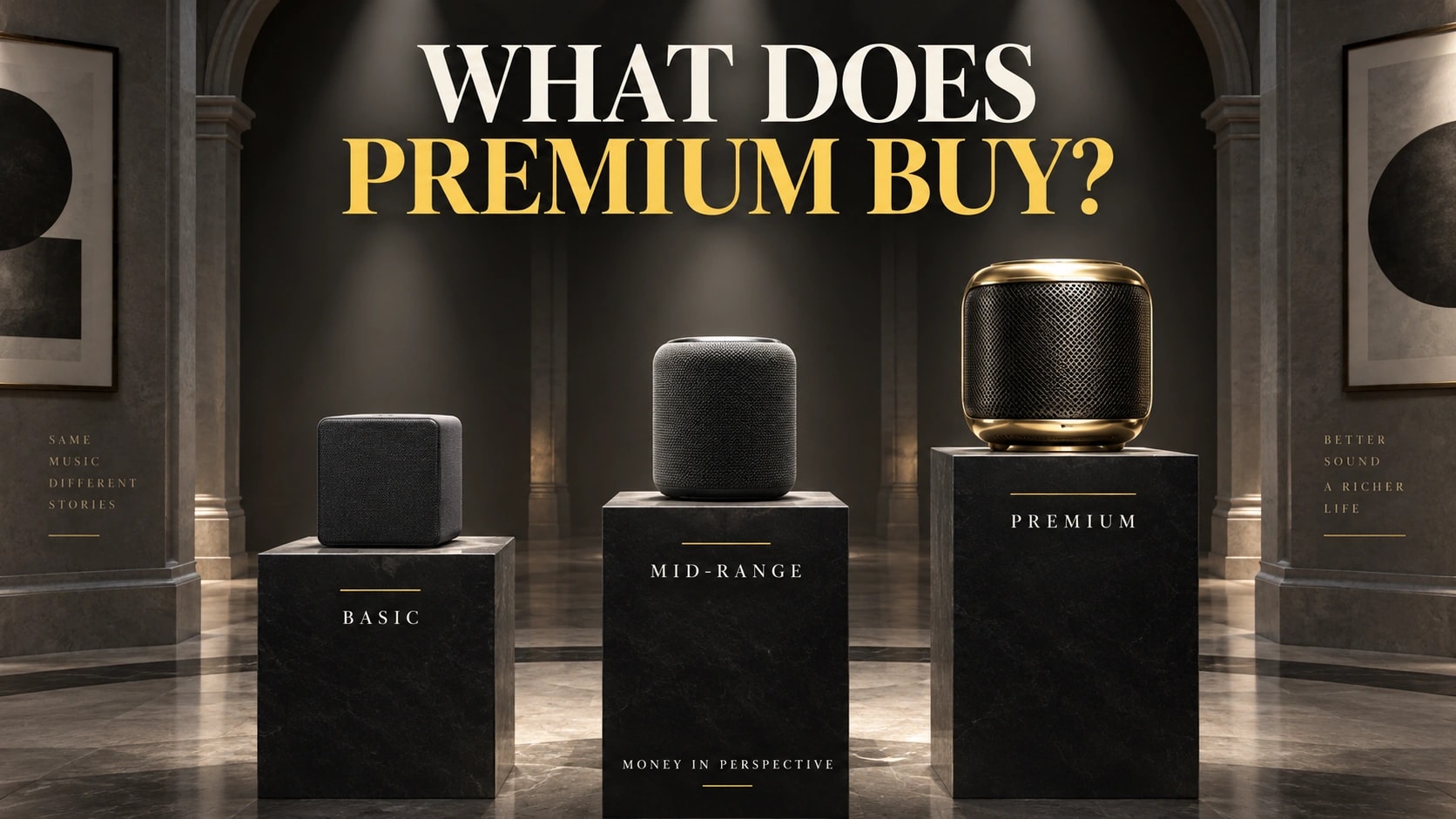
The best comparison is often between three levels rather than two:
cheap,
good,
premium.
The cheapest option may cut too many corners.
The premium option may add features you barely value.
The middle option often provides most of the practical benefit for significantly less money.
This is not a universal rule, but it explains why mid-range products are frequently strong value.
Companies understand this. Product ranges are often structured deliberately so one option looks like the sensible compromise. Sometimes that middle option genuinely is excellent. Sometimes the range is designed to push you upward through small price steps.
“This one is only £100 more.”
“And for another £80, you get…”
Eventually you are several hundred pounds above the budget because every individual upgrade looked reasonable.
The solution is to decide your priorities before entering the ladder.
What do you actually need?
What would be nice?
What is irrelevant?
Set a rough budget.
Then compare products.
This is easier than trying to resist upgrades after you have already become emotionally attached to the top model.
Cost per use is another useful tool.
A £400 coat worn 200 times costs £2 per wear.
A £120 coat worn five times costs £24 per wear.
The expensive product can be better value when it is used heavily.
This is why spending more on frequently used items can make sense.
Mattress.
Shoes.
Office chair.
Phone.
Kitchen equipment you use daily.
The same premium may be harder to justify on an item used twice a year.
There is also a happiness curve to purchases.
The upgrade often feels most exciting before and immediately after buying it. A few weeks later, the premium feature becomes normal.
This adaptation means some expensive upgrades provide less lasting satisfaction than expected.
You stop noticing the faster screen refresh, premium packaging or special finish because it becomes your new baseline.
Features that remove repeated frustration tend to hold their value better because you experience the benefit continually.
A battery that lasts all day.
Shoes that do not hurt.
A chair that supports you properly.
A tool that saves twenty minutes every time it is used.
These are often stronger reasons to pay more than features that mainly impress during the first week.
Second-hand value can also change the equation.
Some premium products depreciate less quickly, making the effective cost of ownership smaller than the purchase price suggests.
If you buy for £1,000 and sell for £600 after several years, the net ownership cost before other expenses is £400.
A cheaper item bought for £600 and sold for £100 costs £500 over the same period.
This does not mean expensive products are automatically investments. Most consumer goods lose value.
It simply means resale should be considered where it is significant.
The most important question may be this:
If the brand names and prices were hidden, which product would you choose after using both?
That thought experiment removes some of the signals that tell us which product is supposed to be better.
You may still choose the premium option.
If so, the improvement is probably meaningful to you.
If the difference feels tiny until the logos and prices return, part of the premium may be psychological.
There is nothing wrong with psychological value either. People buy beautiful things, prestigious things and luxurious things because they enjoy them.
Personal finance does not require pretending all spending is purely functional.
The mistake is confusing “I like the premium one” with “the premium one is financially sensible because it is objectively superior”.
Sometimes you simply want the nicer thing.
If you can afford it and it does not interfere with more important goals, that can be enough.
The useful discipline is to pay premium prices deliberately.
Know what you are getting.
Know which features matter.
Know the likely ownership cost.
Know whether the improvement will still matter after the excitement fades.
Then decide.
The expensive version may genuinely be much better.
It may last longer, perform better and give you more enjoyment every time you use it.
Or it may be the same basic experience with twenty features you will never touch and a finish you stop noticing by next Tuesday.
Price tells you what the seller wants.
Value tells you what the product is worth to you.
Those are not always the same number.
There is one more practical way to judge a premium: ask which version you would regret more.
Would you buy the cheaper product and spend the next three years wishing you had paid for the feature you use every day? If so, the premium may be sensible.
Or would you buy the expensive version, enjoy the difference for two weeks and then wonder why you spent another £500? That is a different kind of regret.
This is particularly useful when the product will be kept for a long time. A small daily annoyance can become significant over five years, just as a small premium can become insignificant when spread across hundreds of uses.
The goal is not to become the person who always buys mid-range or always buys premium. It is to become the person who knows why they are paying more.
That is the difference between an expensive purchase and an expensive mistake.