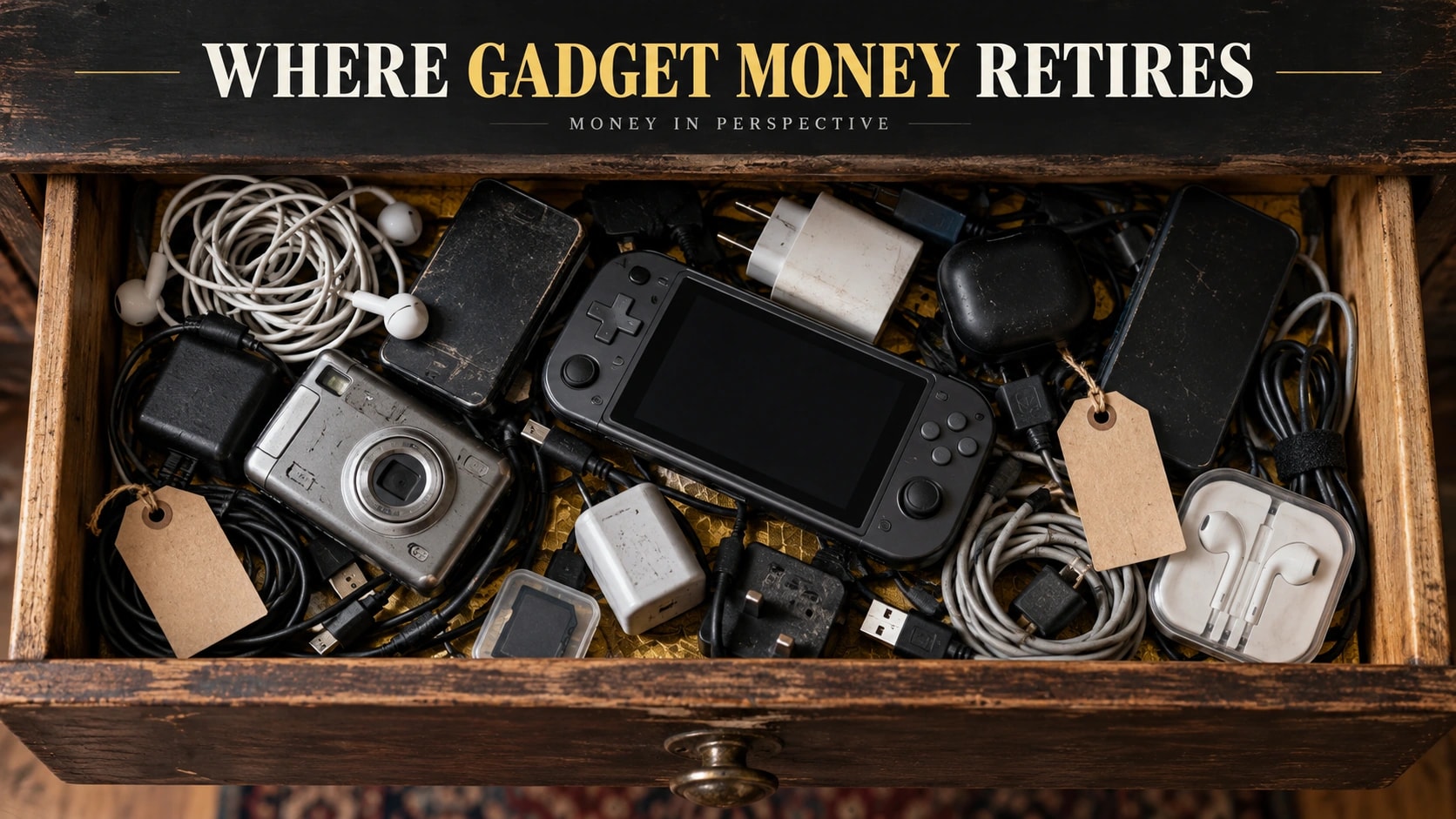
Most homes have one.
A drawer, box, cupboard or shelf containing technology that was once exciting enough to buy and is now too useful to throw away, too outdated to use and somehow important enough to keep.
Old phones.
Chargers for devices nobody remembers.
Wireless earbuds with one side missing.
Power banks.
Adapters.
Smartwatch straps.
A tablet that still works but is painfully slow.
A small speaker replaced by a better speaker.
A camera accessory bought for a trip.
Cables that might be useful one day if anyone can work out what they connect to.
This is the gadget drawer: the place where good money goes to retire.
The individual purchases rarely looked unreasonable. That is what makes the drawer interesting. It is not usually filled with one enormous financial mistake. It is filled with dozens of sensible-looking decisions that each stopped being useful sooner than expected.
Technology is particularly good at creating this pattern because products improve quickly, prices fall, new standards appear and manufacturers constantly give us reasons to believe the thing we already own is one generation away from embarrassment.
A £25 accessory feels harmless.
So does a £60 gadget.
A £15 cable.
A £40 power bank.
A £90 pair of earbuds.
The problem is not any single item. It is the frequency with which technology enters the house and the speed at which it leaves active use.
One useful way to think about the gadget drawer is as a record of buying behaviour.
Every unused item answers a question.
Why did I buy this?
What problem did I think it would solve?
How long did I actually use it?
What replaced it?
Would I buy it again knowing what I know now?
The answers can teach you far more than a generic rule about spending less on technology.
Some gadgets genuinely fail to deliver. They solve a problem badly, become unreliable or depend on software that stops being supported.
Others work perfectly but become victims of duplication. You buy a new pair of headphones, so the old pair becomes the backup pair. Then another pair arrives with a phone or as a gift. Soon the drawer contains three functioning products and none is being used.
Duplication is one of the quietest forms of technology spending.
Most people do not intentionally buy four chargers because they dream of owning four chargers. The extras accumulate through upgrades, bundles, travel purchases and moments when the existing charger was somewhere inconvenient.
Because each purchase solves an immediate problem, the household slowly builds an inventory far beyond what it needs.
The same thing happens with power banks, cables, cases, stands and adapters.
A simple technology inventory can stop this. Before buying another accessory, check what is already in the house. This sounds embarrassingly basic, but the entire gadget drawer exists partly because people do not know what it contains.
Organisation has financial value when it prevents duplicate buying.
There is also the problem of cheap gadgets.
Technology marketplaces are full of inexpensive products that promise to solve tiny inconveniences. A £12 light. A £20 mini keyboard. A £9 phone stand. A £17 smart plug. The low price makes experimentation feel safe.
Sometimes these products are brilliant.
Sometimes they are used twice and then moved gently into storage, where they wait to become electronic archaeology.
The relevant question is not whether £15 is affordable. It is whether the product is likely to become part of your routine.
A useful test is frequency.
How often does the problem occur?
If a £30 device solves something you deal with every day, it may provide excellent value.
If it solves an inconvenience that happens three times a year, the cheaper solution may be tolerating the inconvenience.
Another reason gadgets accumulate is the excitement of setup.
Technology provides a small burst of satisfaction when it is new. Unbox it. Charge it. Connect the app. Customise the settings. Test the features.
The purchase feels productive because you are doing things.
A few weeks later, the novelty fades and the device has to compete with habits that already existed.
This is why products related to fitness, productivity and smart-home automation can be especially vulnerable. Buying the device is easy. Changing behaviour is harder.
A smart notebook does not automatically make someone organised.
A fitness tracker does not exercise.
A fancy microphone does not create content by itself.
The device can support the habit, but it cannot substitute for it.
This suggests another useful rule: when buying technology to support a new habit, prove the habit cheaply first.
If you want to start running, use the phone or watch you already own before buying specialist equipment.
If you want to start creating video, use existing gear long enough to understand what limitation actually needs solving.
If you want a smart home, automate one thing you genuinely care about before buying six devices because they look impressive together.
This allows the problem to define the purchase.
Upgrade cycles create an even larger version of the gadget drawer problem.
Phones, tablets, laptops and watches often remain functional long after a newer model is released. Yet the old device can suddenly feel less desirable because comparison has changed.
The new screen is brighter.
The camera is better.
The processor is faster.
The bezels are smaller.
Your existing device did not become slower overnight, but your perception of it can change instantly.
When you upgrade, the old device often becomes a backup.
Backups sound sensible. Sometimes they are. But if the previous three phones are all still in the drawer, the household may be storing hundreds of pounds of depreciating value for emergencies that never happen.
Selling or trading devices while they still have reasonable value can reduce the real cost of upgrading.
Suppose an old phone is worth £300 today but only £150 a year later. Keeping it as a backup has effectively cost £150 in lost resale value if you never use it.
That does not mean every device must be sold immediately. Some households genuinely need spares. The point is to put a price on the choice.
The same applies to cameras, consoles, laptops and other higher-value technology.
Unused technology is unusual because it can lose value while sitting still.
A dining table can remain useful for decades. A five-year-old phone may become unsupported, have a degraded battery and be worth very little.
This makes “I might use it one day” a more expensive argument in technology than in many other categories.
Repairs deserve a place in the decision too.
A device does not always need replacing because one component has deteriorated. Batteries, screens, storage or accessories may be repairable or replaceable.
The economics depend on the product, repair price, age and expected remaining life.
A £90 repair that gives a £700 device another two years may be excellent value.
A £250 repair on a very old product with other problems may not be.
The useful habit is to compare repair with replacement rather than assuming either one automatically wins.
Software can make hardware feel old as well. A slow laptop may benefit from cleaning storage, removing unnecessary startup programs or reinstalling software. A phone may feel better after replacing the battery.
Again, not every problem needs a new device.
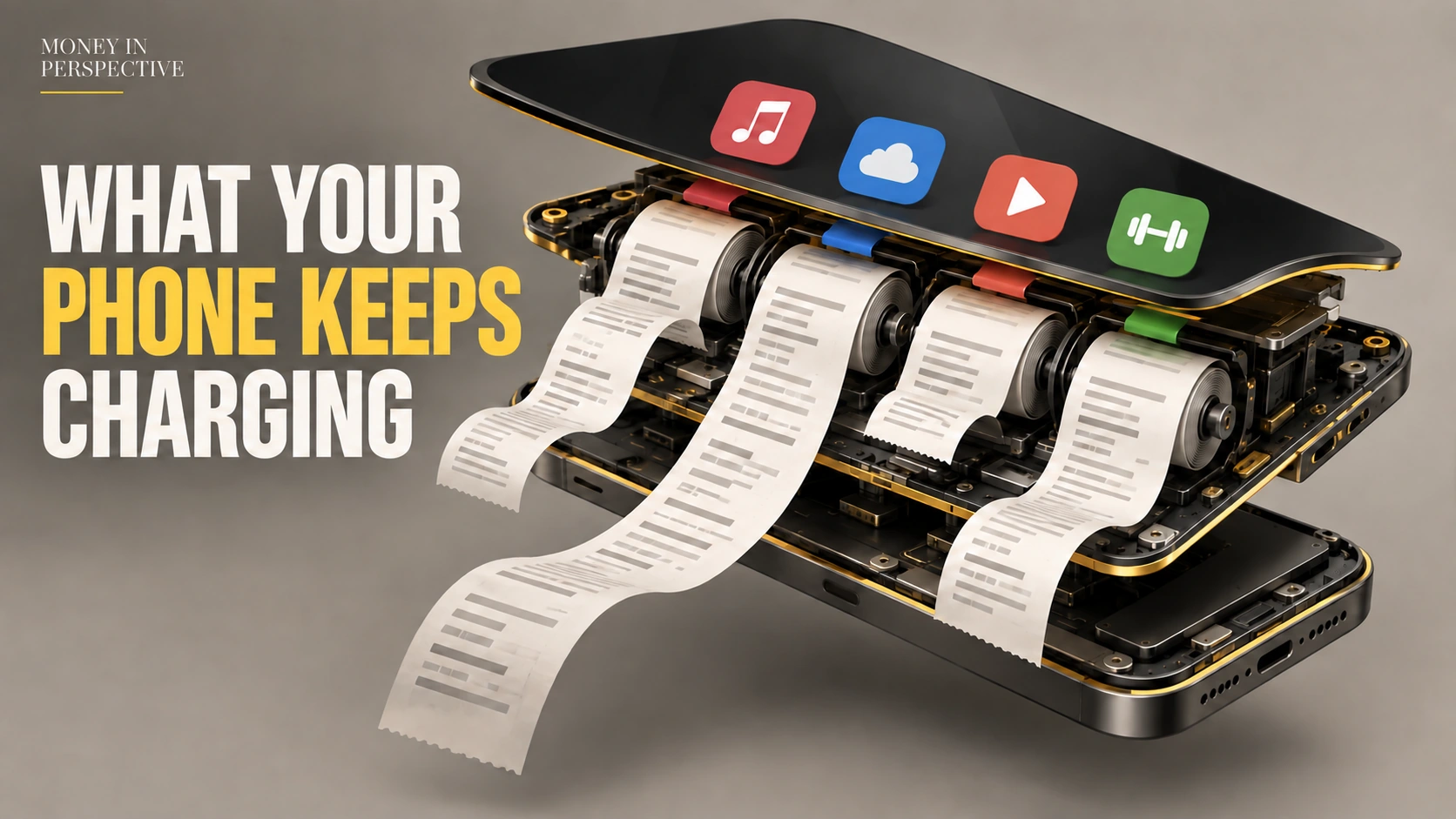
Subscriptions create another type of digital drawer.
You cannot see them physically, but they accumulate in exactly the same way.
Cloud storage.
Premium apps.
Security software.
Creative tools.
Fitness platforms.
Services attached to devices you no longer use.
A forgotten £4.99 monthly subscription is the virtual equivalent of an unused charger in the cupboard.
Reviewing technology therefore means looking at both objects and recurring payments.
Once or twice a year, take everything out of the gadget drawer.
Not metaphorically. Literally.
Sort it into four groups:
Use regularly.
Keep for a clear reason.
Sell or give away.
Recycle responsibly.
This does several things at once.
It reminds you what you own.
It releases value from items that can be sold.
It prevents duplicate purchases.
And it shows which categories repeatedly become waste.
Perhaps you discover that cheap earbuds never last for you. Buy better next time.
Perhaps smart-home gadgets consistently lose your interest. Stop buying them.
Perhaps old phones retain value because your family actually passes them down. Keep that system.
Personal evidence is more useful than universal rules.
Responsible disposal matters too. Technology contains materials that should not simply be thrown into ordinary household waste. Batteries in particular can create safety and environmental problems. Use manufacturer take-back schemes, retailer recycling or appropriate local recycling services where available.
Data security matters before selling or recycling devices as well. Back up what you need, sign out of accounts, remove activation locks where required and perform the proper factory reset.
This is not just financial housekeeping. Old devices can contain years of personal information.
There is a broader environmental point too.
Every gadget contains materials, energy, manufacturing and transport. Extending the useful life of technology can reduce waste as well as save money.
You do not need to keep obsolete technology forever to be environmentally responsible. Using products for longer, repairing where sensible and passing devices to someone who will actually use them can all be better than allowing them to depreciate unused.
The strongest purchasing question may be: where will this item be in one year?
Will it still be on your desk, in your bag or part of your routine?
Or can you already imagine it joining the drawer?
You will not always know. Some purchases disappoint despite careful thinking.
The goal is not perfect prediction.
It is to recognise familiar patterns.
If you repeatedly buy small gadgets because they are interesting rather than useful, create a hobby budget for that. Then the spending is intentional entertainment rather than pretending every device is a productivity investment.
If you love technology, there is nothing wrong with spending money on it.
People spend on clothes, sport, cars, travel and dozens of other interests.
The problem is not enjoying gadgets.
It is buying them faster than you can use them.
A waiting period helps. For non-essential technology, save the product and wait a week or two. If the desire survives and the use case remains clear, buy it.
Many gadgets will fail this test because their appeal depended on being directly in front of you.
Larger purchases deserve an even stronger question: what specific limitation of my current setup am I paying to remove?
A vague answer like “the new one is better” is weak.
A clear answer like “this cuts my video export time in half every working day” is much stronger.
Before buying something new, it can also help to create a replacement rule. A new pair of earbuds replaces an old pair rather than simply joining them. A new tablet means deciding immediately whether the old one will be sold, passed on or kept for a specific purpose. If there is no clear destination for the existing device, that is a sign the upgrade may be creating duplication rather than solving a need.
This rule is useful because it forces the hidden cost of storage into the decision. Space is not free, and clutter has a mental cost even when the object itself is small. A drawer filled with unused technology also makes it harder to find the things you genuinely need, which can trigger more duplicate buying.
The aim is not minimalism for its own sake. It is circulation. Technology should ideally be used, sold, passed on or recycled rather than sitting indefinitely between those states.
Good technology spending solves real friction, provides repeated enjoyment or supports something you genuinely do.
Bad technology spending often solves imagined future behaviour.
The gadget drawer is useful because it makes the difference visible.
It is not a box of shame.
It is a financial archive.
Open it occasionally.
Your old devices may have some very good advice about what not to buy next.
The best gadget drawer is not necessarily an empty one.
It is one where everything inside still has a job.