Your phone may have cost hundreds or even more than a thousand pounds.
That is the obvious price.
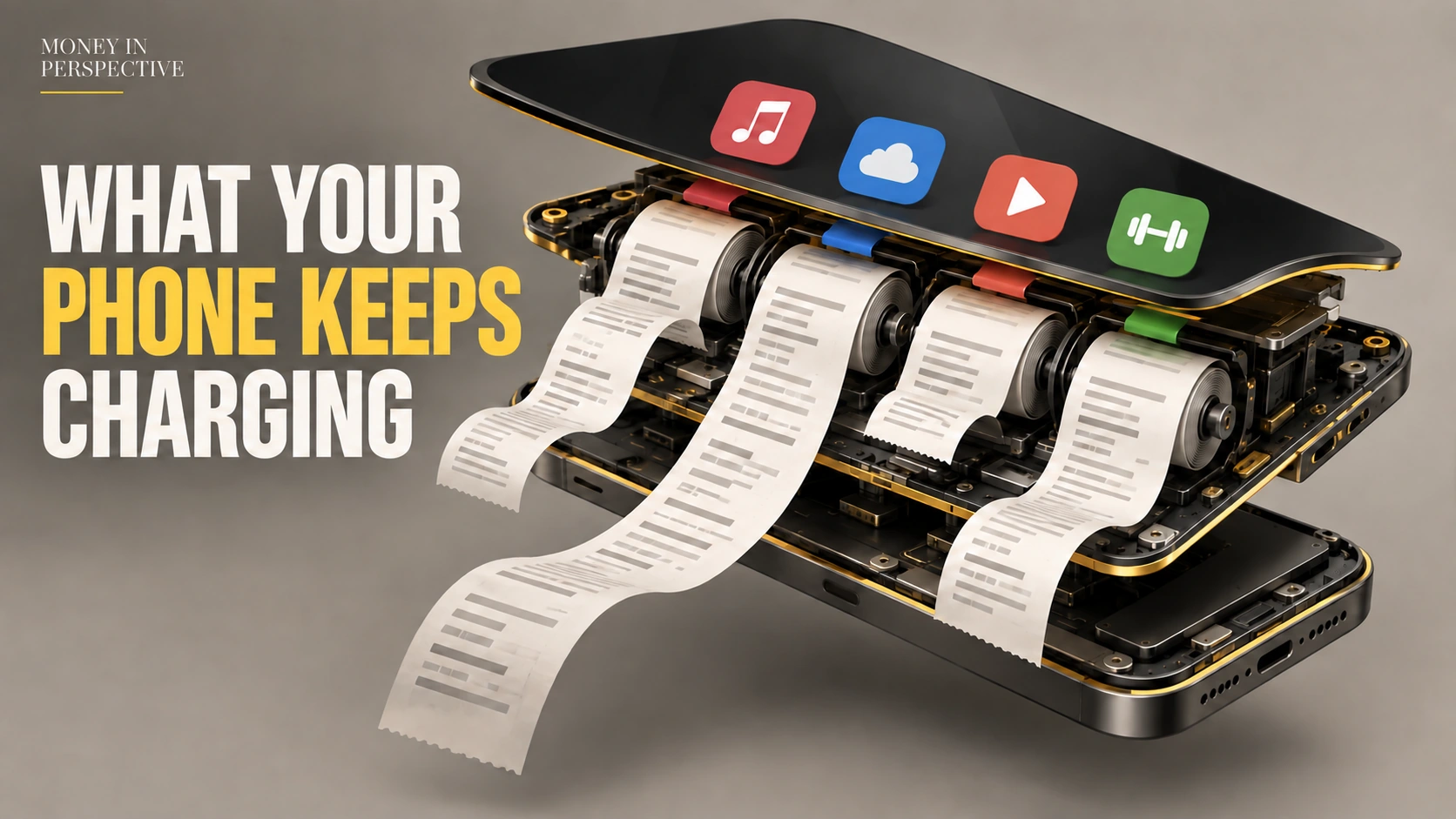
The less obvious price arrives every month afterward.
Cloud storage.
Music.
Video.
News.
Games.
Photo editing.
Fitness.
Dating.
Productivity.
AI tools.
Security.
Premium app features.
Subscriptions have turned the smartphone from a product you buy into a platform that continues asking for money long after you leave the shop.
Individually, most of these charges look harmless.
£1.99.
£4.99.
£7.99.
£12.99.
The problem is not any particular subscription.
It is how easily ten small ones can hide inside one device.
A phone makes subscription spending unusually frictionless.
You discover an app.
The premium version offers a free trial.
Payment information already exists on the device.
Face ID confirms the purchase.
Thirty seconds later, another recurring payment has entered your financial life.
There is almost no friction.
That is convenient when you genuinely value the service.
It also means the distance between curiosity and long-term spending has become extremely short.
Free trials make this even easier.
A trial asks you to decide whether something is worth paying for later while giving you the benefit now.
The cancellation decision belongs to future you.
Future you is busy.
The result is predictable.
Subscriptions can continue months after the original interest disappeared.
The amounts are often small enough to avoid triggering concern.
A £150 annual bill attracts attention.
£12.49 each month can become invisible.
This is why annualising subscriptions is so useful.
£2.99 per month is about £36 a year.
£7.99 is roughly £96.
£14.99 is about £180.
A collection of subscriptions worth £75 each month costs £900 across a year.
That does not mean £900 is excessive if those services provide significant value.
It means the category deserves the same attention as any other £900 annual purchase.
The phone itself makes this harder because subscriptions are fragmented.
Some are billed through Apple or Google.
Others charge a card directly.
Some are bundled with mobile contracts.
Some come through PayPal.
Some belong to family accounts.
One household may therefore have recurring app spending spread across several statements.
The first step is simply finding it.
Look at the device's subscription management page.
Then look at bank and card statements for recurring digital payments.
You may discover services that do not appear in the app-store list because they were purchased elsewhere.
Do not cancel everything immediately.
The objective is value, not subscription minimalism.
Music streaming may be used every day.
Cloud storage may protect thousands of photographs.
A productivity app may save hours of work.
Those can be excellent purchases.
Instead, ask a simple question for each one:
Would I deliberately subscribe to this again today at the current price?
If yes, keep it.
If the answer is “I suppose so” or “I forgot I had that”, the subscription deserves a closer look.
Usage is another useful test.
Many digital services make it easy to feel as though you use them more than you actually do.
A fitness app may have been opened three times in two months.
A premium photo editor may exist because you edited one holiday picture.
A game subscription may have been exciting at launch and untouched since.
Past usage is imperfect because future plans can change.
But it gives evidence.
The strongest subscriptions usually solve a repeated need.
The weakest often support an imagined version of ourselves.
Language app because we are definitely learning Spanish.
Meditation service because this is the month we become calm.
Productivity tool because a beautiful interface might finally fix procrastination.
Sometimes the subscription genuinely helps.
Sometimes paying for the aspiration becomes easier than doing the behaviour.
This is similar to unused gym memberships.
Digital subscriptions are simply less visible.
Cloud storage deserves special attention because it tends to ratchet upward.
You begin with a small plan.
Photographs and backups expand.
The next tier appears.
Then another device joins the account.
Eventually the household pays monthly for storage without knowing what occupies it.
Cloud storage can be extremely valuable.
Data loss is expensive emotionally and practically.
The point is to know what you are paying for.
Occasional cleanup, removing duplicate files and reviewing device backups can sometimes prevent unnecessary upgrades.
The same principle applies to mobile data.
Many people remain on large data plans because the number sounds reassuring.
Wi-Fi availability and working habits may mean actual usage is far lower.
Check consumption over several normal months.
If you consistently use 15GB, paying for 100GB may not create meaningful value.
Conversely, if you regularly reach your limit, a larger plan can save stress and additional charges.
Actual behaviour should set the plan.
Bundling complicates the subscription picture.
A mobile network may include streaming.
A bank account may include insurance or media perks.
An internet package may include television.
A family membership may duplicate a service somebody else already pays for.
Households can therefore pay twice for essentially the same access.
An annual subscription audit should look across the household, not only one person's phone.
Family plans can also be excellent value where several people genuinely use the service.
Five individual music subscriptions may cost significantly more than one family plan.
But a family plan is not automatically a saving if half the household never uses it.
Again, usage matters.
Software subscriptions have become particularly normal.
In the past, you might buy an application once.
Today, many services charge monthly or annually.
The model has advantages.
Developers receive ongoing revenue.
Users receive updates, cloud features and support.
The downside is that software can become a permanent household operating cost.
A £10 app is easy to buy once.
A £10 monthly app costs £600 over five years.
That may still be excellent value for professional software used constantly.
For casual use, ownership alternatives may deserve consideration.
It is also worth comparing monthly and annual plans.
Annual payment often offers a discount.
That is worthwhile when you are confident the service will be used all year.
It can be wasteful when the annual discount persuades you to prepay for a product you abandon after two months.
The cheapest subscription is not the one with the biggest percentage discount.
It is the one you continue valuing.
Cancellation friction matters too.
Good businesses make cancellation reasonably straightforward.
Others rely on customers forgetting.
This is why recurring payments deserve a system rather than memory.
One option is to create a calendar reminder a few days before annual renewals.
For monthly services, review the category every three months.
You do not need to inspect every payment every week.
A short periodic review is enough.
Another technique is to maintain a subscription list with four columns:
service,
monthly or annual cost,
renewal date,
reason for keeping it.
This sounds excessive until you realise households routinely manage thousands of pounds of recurring spending with almost no central list.
The exercise can take fifteen minutes.
The result can last a year.
The subscription problem also interacts with phone upgrades.
A new phone may include free trials.
Three months of streaming.
Six months of fitness.
Cloud storage promotions.
These offers can be genuine value.
Just note the end date.
“Free for six months” means “paid from month seven unless you cancel”.
The business model is perfectly clear.
Your diary should be equally clear.
There is also a broader behavioural issue.
Subscriptions reduce the pain of buying because they separate payment from usage.
You do not decide whether a movie is worth £10 tonight.
You already pay £10 every month, so watching it feels free.
This can be valuable.
It encourages use.
But it also means you stop evaluating the service each time.
A weak subscription can survive for years because no individual month feels expensive enough to challenge.
One useful test is to imagine the annual cost appeared as one invoice tomorrow.
Would you pay it immediately?
A £15 monthly service becomes £180.
If you would happily pay £180 for another year, keep it confidently.
If you would hesitate, investigate why.
You might discover the service still deserves the money but monthly pricing was hiding how substantial the commitment had become.
Some subscriptions also survive simply because cancelling takes effort.
You need to remember a password, visit a website rather than the app, or decide whether you might need the service again next month.
That small amount of friction can keep a weak subscription alive for years.
A useful countermeasure is a “one in, one review” rule.
Whenever you add a new recurring digital service, review one existing service at the same time.
You do not have to cancel anything.
The new payment simply triggers a quick check of the old ones.
This prevents the subscription stack from expanding indefinitely.
Another useful distinction is between personal and professional subscriptions.
A £20 monthly app used to earn income may deserve a completely different standard from a £20 entertainment app.
For professional tools, ask whether the product saves time, improves output or helps generate revenue.
For personal services, ask whether the enjoyment is still worth the annual cost.
Neither category is morally superior.
The point is to judge each by the benefit it is supposed to provide.
Price rises deserve special attention too.
Subscription businesses often increase fees gradually, and because the service is already part of your routine, the higher price can pass without a fresh decision.
A £2 increase looks small.
Repeated across several services, it can materially change the annual total.
When a renewal notice arrives, treat it as an invitation to make the decision again.
Would you subscribe at the new price if you were not already a customer?
If yes, keep it confidently.
If not, inertia is doing more work than value.
Finally, remember that deleting an app does not necessarily cancel the subscription.
People can remove the visible reminder from their phone while the payment continues quietly in the background.
Cancellation should always be confirmed through the relevant account or billing service.
There is no reason to be anti-subscription.
Subscriptions can provide extraordinary value.
A music service may replace buying dozens of albums.
Cloud storage can protect valuable data.
Professional software can generate income.
A video service may provide hundreds of hours of entertainment for less than a few cinema trips.
Good subscriptions are often among the most efficient purchases people make.
The problem is accumulation.
Every company wants to become one of the small monthly charges you stop noticing.
Your phone is the perfect place to collect them.
That is why the best subscription budget is intentional.
Choose the services that genuinely improve your life.
Use family plans where appropriate.
Cancel experiments that did not stick.
Review annual renewals.
Avoid paying for multiple products solving the same problem.
Most importantly, keep the total visible.
Your phone does not cost only what you paid for the hardware.
It can become the gateway to hundreds or thousands of pounds of recurring spending across its lifetime.
That is not automatically bad.
It simply means the cheapest device in your pocket may contain the most expensive drawer of subscriptions in your entire house.
Open it occasionally.