A £1,200 phone sounds expensive.
£49.99 a month sounds manageable.
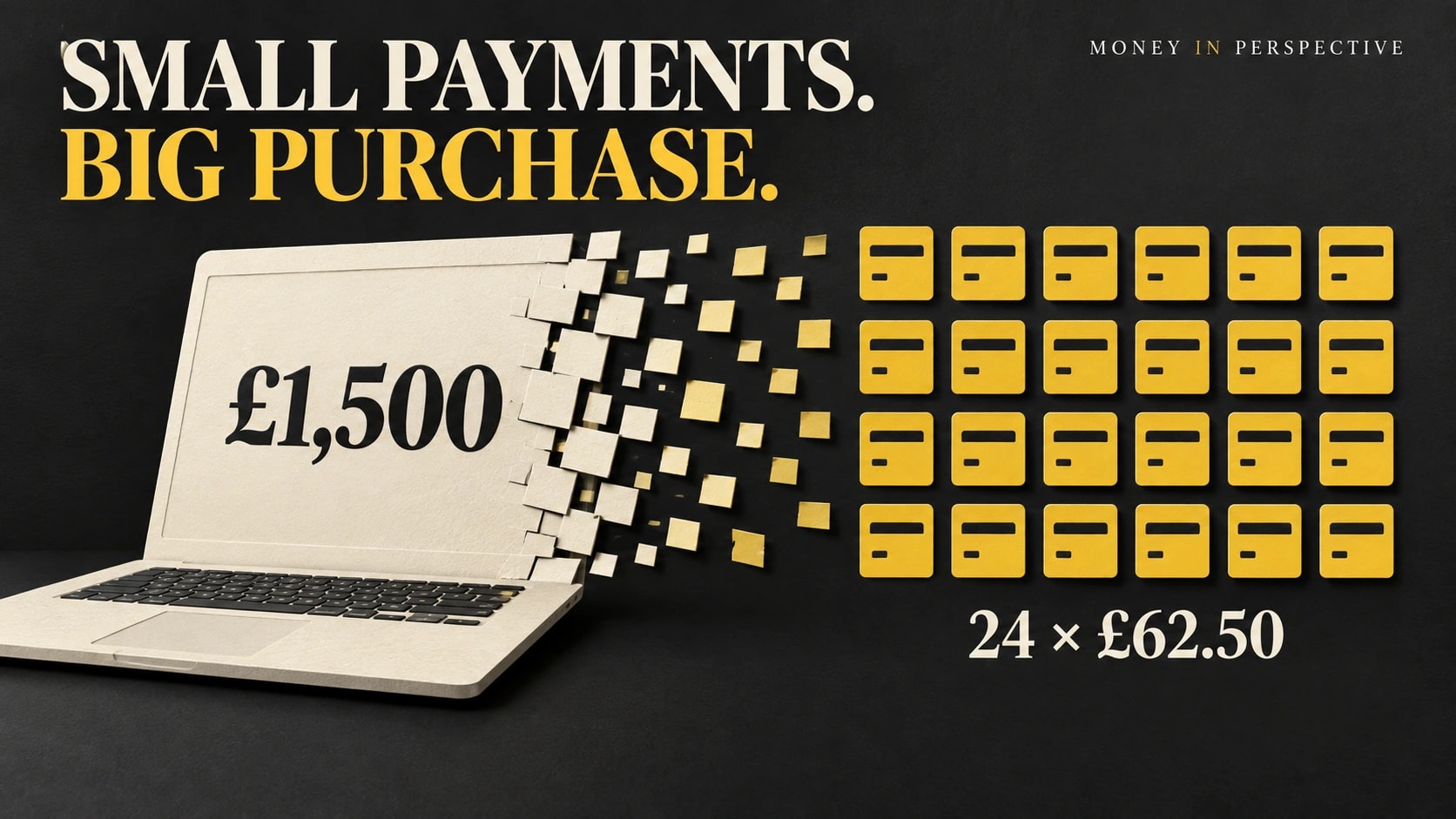
That difference is not accidental. It is one of the most powerful changes in modern consumer spending: expensive products are increasingly presented as monthly amounts rather than total prices.
Phones, laptops, tablets, watches, televisions, software and even accessories can now be purchased through instalments, contracts or subscription-style plans. The result is that products which would once have required a large, obvious financial decision can now enter the household as another monthly direct debit.
The technology has not necessarily become cheaper.
The price has simply been translated into a number that feels easier to accept.
Monthly pricing works because people naturally judge affordability using current cash flow. If you have £60 spare each month, a £49.99 payment may feel possible. A £1,200 purchase feels much more serious because it requires thinking about the full amount at once.
Both ways of looking at the price are valid. Cash flow matters. Many people cannot or do not want to spend £1,200 in one transaction. Spreading the cost can be useful, particularly when financing is genuinely interest-free and the purchase is necessary.
The problem begins when the monthly number replaces the total number entirely.
Imagine two phones.
Phone A costs £700 outright.
Phone B costs £1,200, presented as £50 a month for twenty-four months.
The monthly payment may make Phone B feel surprisingly reasonable. Yet you are still choosing to spend £500 more. The contract has not removed the difference. It has divided it into twenty-four smaller decisions that you only make once.
This is why monthly pricing changes the psychology of upgrades.
An extra £240 on the total price can sound significant.
An extra £10 a month sounds minor.
That makes premium models easier to justify. More storage is another £5. Better specifications are another £8. Insurance is another £9. A smartwatch bundle is another £12.
Each addition is judged against one month rather than the whole contract.
By the end, the original £35 plan can become £70 or £80 without any single step feeling dramatic.
This is not unique to technology. Car finance works similarly. So do subscription services, buy-now-pay-later plans and annual products converted into monthly memberships. Technology simply provides a particularly clear example because devices are upgraded frequently and the products are designed to feel desirable long before the old ones stop working.
One useful habit is to translate every monthly technology purchase back into its total commitment.
If a phone costs £52 per month for twenty-four months, calculate £52 multiplied by 24.
If insurance adds £11 per month, calculate that too.
If the contract includes a service plan, data package or upgrade fee, separate those amounts where possible.
The point is not to make the purchase look frightening. It is to see what you are actually agreeing to.
A monthly payment can also obscure ownership.
Some plans are straightforward finance agreements where the device becomes yours. Others include trade-in requirements, balloon payments, upgrade conditions or lease-like structures. The monthly number may look similar across different offers while the final position is very different.
Before comparing plans, understand what happens at the end.
Do you own the device?
Do you return it?
Is there a final payment?
Can you keep it and move to a cheaper SIM-only plan?
Does upgrading restart another long commitment?
The most expensive technology habit is not always buying an expensive device. It can be remaining permanently inside an upgrade cycle.
Consider someone who pays £50 a month for a phone contract and upgrades every two years. The payment becomes part of normal life. It never disappears. The person stops thinking of the phone as a £1,200 purchase and starts thinking of “my phone bill” as £50.
That makes keeping the old device for an additional year feel unusual, even though doing so could release hundreds of pounds.
Once a device is paid for and still works well, the cheapest phone you can own is often the one already in your hand.
This is where monthly pricing interacts with lifestyle inflation. When income rises, it becomes easy to absorb slightly larger payments. A £10 increase here and a £15 increase there barely changes the month on its own. Across several devices and subscriptions, the household can build a significant permanent cost base.
Suppose you have a £55 phone plan, £20 smartwatch plan, £25 tablet finance, £12 cloud storage, £18 software subscription and £15 device insurance. That is £145 a month.
Across a year, it is £1,740.
Across two years, £3,480.
Again, those products may all be useful. The issue is that monthly presentation can make the total technology lifestyle much harder to see.
This is why an annual technology audit can be valuable.
List every technology-related monthly payment.
For each one, note:
What is the total annual cost?
When does the commitment end?
What do I own at the end?
Do I still use the product?
Would I deliberately sign up for this again today?
This final question is particularly useful. Some monthly payments survive because cancelling requires effort, not because the service still provides enough value.
The same thinking should be applied when choosing between buying outright and financing.
Paying cash is not automatically better. If the finance is genuinely interest-free, the total price is identical and keeping cash available is important, monthly payments may be sensible.
Financing becomes more problematic when it encourages you to buy a more expensive product than you would choose if you had to look at the full price.
That is the behavioural test.
Ask yourself: if both devices had to be paid for today, which one would I buy?
If the answer changes dramatically when monthly finance is introduced, the payment structure is influencing the product choice.
That does not make the more expensive choice wrong. It simply means the financing is doing part of the selling.
Technology companies and retailers understand this extremely well. A product page can make the monthly amount visually prominent while the total price receives less attention. Trade-in credits reduce the apparent payment further. Limited-time deals create urgency. Bundles add accessories for “only” a few pounds more.
Every component is designed to keep the monthly figure psychologically comfortable.
Consumers can use the same structure in reverse.
Set your own total technology budget first.
If you are willing to spend £800 on a phone, compare options within £800 regardless of whether the retailer presents them as £33, £41 or £47 per month.
Now financing becomes a payment method rather than a pricing strategy.
Another useful approach is to consider cost per year of ownership rather than cost per month of finance.
A £1,000 phone kept for four years costs roughly £250 per year before resale value, repairs or financing costs.
A £700 phone replaced every two years costs £350 per year.
The more expensive phone can therefore be better value if it genuinely lasts longer and you actually keep it.
This matters because the best financial decision is not always buying the cheapest device. Reliability, software support, battery life and resale value all matter. The problem is not premium technology. It is paying premium prices while keeping upgrade habits designed around short contracts.
Monthly pricing also affects accessories and services.
A protection plan at £9.99 per month feels small. Over three years, it approaches £360. That may be worth it if the cover is strong and you value the protection. But compare it with other insurance you already have, manufacturer warranties and the realistic replacement risk.
Cloud storage at £2.99 per month is easy to ignore. Over five years, it is nearly £180. Again, perhaps excellent value. The point is visibility.
Small recurring technology charges become expensive mainly because they are allowed to become permanent without review.
There is also a useful distinction between affordability and value.
You may easily afford £60 per month.
That does not tell you whether the device is worth £1,440 over two years.
Affordability asks whether the payment fits.
Value asks whether the product deserves the total amount.
Good financial decisions consider both.
This becomes even more important when several monthly commitments overlap. A household can be perfectly capable of paying each one individually while becoming financially inflexible overall. The problem appears when income drops, another major cost rises or a new priority emerges. Fixed monthly commitments are difficult to redirect because the money has already been promised.
That is why there is value in allowing some contracts to end without immediately replacing them.
When a device is paid off, pause.
See what the cheaper month feels like.
If the phone still works, keep the difference.
You can always upgrade later.
The technology industry is very good at making the end of a contract feel like the beginning of a shopping opportunity. It can also be the beginning of a saving opportunity.
Paying monthly is not bad. It is simply a way of dividing a price.
The danger is forgetting that the original price still exists.
A £1,200 phone paid at £50 a month is still a £1,200 phone.
A £240 upgrade presented as £10 extra is still a £240 upgrade.
And a collection of harmless monthly charges can still become thousands of pounds across a few years.
Use monthly payments when they help your cash flow.
Just keep translating them back into the language retailers would rather you forget:
the total.
There is another reason monthly technology pricing is powerful: it makes comparison harder. A device costing £899 outright can be compared instantly with one costing £1,099. But when one is £37.46 a month, another is £43.99 with a trade-in, and a third includes data for £58, the products are no longer presented in the same language.
That complexity encourages people to compare payments rather than economics.
Before choosing, put every option onto the same basis. Work out the total device cost, the service cost, any interest or fees, and what you expect the device to be worth at the end. You do not need a financial model. A few lines in a notes app are enough.
Trade-ins deserve the same treatment. A £300 trade-in credit sounds like a discount, but the old device has value. The real question is whether the trade-in amount is good compared with selling it elsewhere, and whether the credit is encouraging an upgrade you would not otherwise make.
Upgrade programmes can also create a subtle sense that keeping a device is wasting an entitlement. If the plan says you can upgrade after twelve or twenty-four months, the option begins to feel like something you should use. But an upgrade right is not free money. It is usually part of a commercial structure designed to keep you inside the cycle.
Sometimes the smartest upgrade is declining the upgrade.
Battery replacement illustrates this well. A phone that feels old may simply have a tired battery. If a relatively modest repair restores a full day of use, that can extend the life of the device by another year or two. The comparison should therefore include repair, not only replacement.
The same applies to laptops with replaceable storage, accessories that can be repaired, and software that can be cleaned up rather than abandoned with the hardware.
Monthly pricing is excellent at making acquisition easy. Good money management also considers how cheaply you can continue using what you already own.