Cheap is attractive for a very sensible reason: it leaves more money in your account today.
If two things appear to do the same job, paying less feels efficient. Sometimes it is. Supermarket own-brand food, basic clothing, refurbished technology and simple household products can offer excellent value because the expensive alternative does not add enough benefit to justify the price.
The trouble is that purchase price is only one part of cost.
A cheap item that breaks quickly, needs replacing often, wastes time or creates higher running costs can end up costing more than the expensive version you avoided.
This is the idea of total cost of ownership.
It sounds like something used to evaluate industrial machinery, but it applies perfectly well to shoes, appliances, cars, furniture, technology and even services.
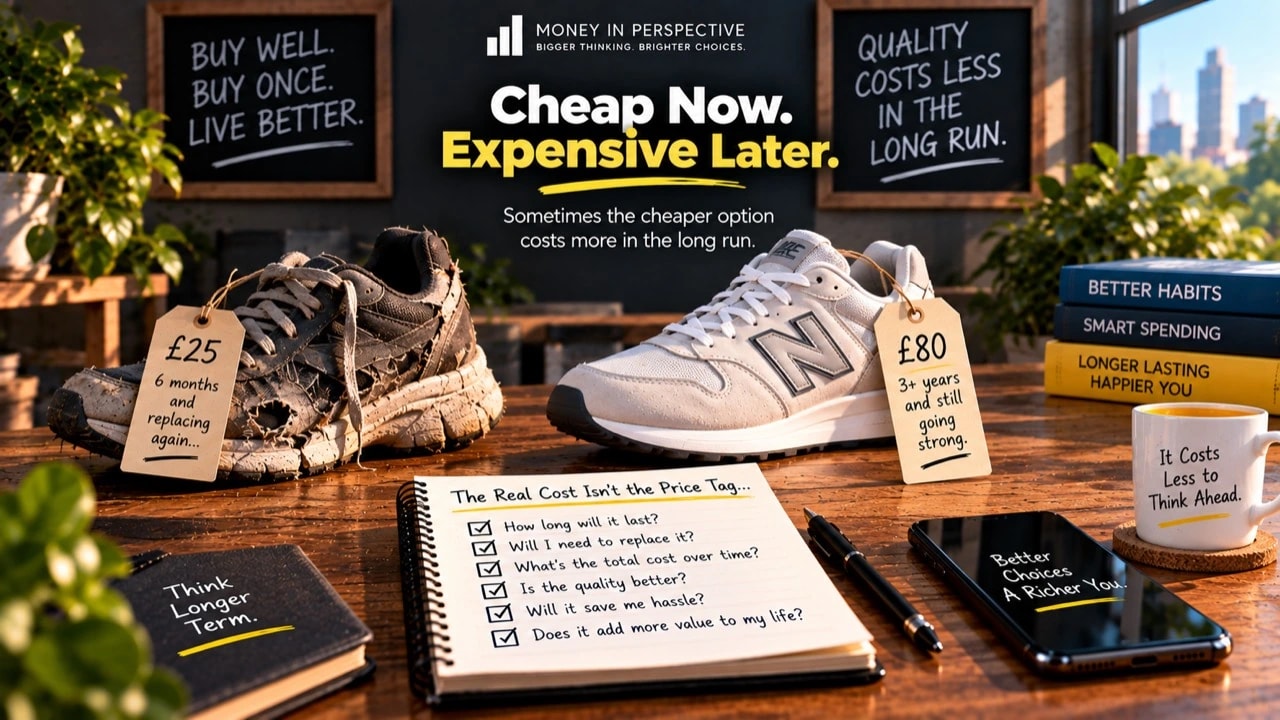
Suppose one pair of shoes costs £35 and lasts six months. Another costs £90 and lasts three years.
The £35 pair looks cheaper at the checkout. If you repeatedly replace it, three years may require six pairs, costing £210.
The £90 pair was more expensive to buy and cheaper to own.
Of course, life is rarely that neat. The £90 pair might fail early. The £35 pair might last years. Price is not a guarantee of quality.
That is why the useful lesson is not “buy expensive”.
It is “look beyond the first price”.
Durability is one of the clearest examples.
Furniture can be inexpensive because it uses lighter materials, simpler construction and lower-cost fittings. That may be completely appropriate for a temporary flat, student room or piece you do not expect to keep for long.
The same furniture can be poor value if it needs replacing several times in a home where you wanted something to last for decades.
Context matters.
A £50 table you need for two years can be a better purchase than a £500 table.
A £50 table replaced five times because you actually needed a long-term piece can be a false economy.
Appliances add running cost to the calculation.
A cheap heater, fridge, washing machine or other device may consume more energy than a more efficient alternative. The difference in purchase price can therefore be partly offset over time by utility costs.
Again, the answer is not automatically to buy the appliance with the highest efficiency rating regardless of price. Estimate how often it will be used, how long you expect to keep it and how large the running-cost difference actually is.
A premium that takes thirty years to recover may not be financially compelling.
A premium recovered in two years might be.
Repairs matter too.
Some inexpensive products are effectively disposable. When a small component fails, repair is difficult or costs almost as much as replacement.
Other products are designed around replaceable parts and have support available for years.
A higher upfront cost can buy access to an ecosystem that extends useful life.
This is especially relevant with tools, appliances, bicycles and technology.
Before spending significantly more, check whether the product really is repairable rather than assuming price equals longevity.
Warranty can provide useful information, although a long warranty does not automatically prove superior quality.
Still, warranty length, parts availability and customer support can change the cost of ownership if something goes wrong.
The cheapest purchase becomes expensive very quickly when replacing it involves weeks of arguments, shipping fees or buying another item while the first sits unusable.
Shoes and clothing show another form of cost: comfort.
A cheap item that technically lasts may still be poor value if it is uncomfortable enough that you stop wearing it.
Wardrobes are full of bargains that were “too cheap to leave” and then spent years untouched.
Cost per wear is a useful way to think.
A £100 jacket worn 100 times costs £1 per wear.
A £25 jacket worn twice costs £12.50 per wear.
The expensive product can provide far better value when it becomes part of your real life.
This is why buying around your actual habits matters more than hunting for the lowest price.
Cheap travel can work the same way.
A hotel far outside the centre may save £30 a night but create daily transport costs, long journeys and lost holiday time.
A cheaper flight may land at an inconvenient airport and require an expensive transfer.
The correct comparison is the total trip, not the first number on the search page.
Services are another important category.
The cheapest contractor, accountant, designer, mechanic or builder may be excellent. High price does not guarantee competence.
But choosing purely on price can be risky when poor work creates rework, delays or larger problems later.
The right comparison includes quality, experience, reliability, scope and what happens if something goes wrong.
Paying twice is one of the most expensive forms of saving money.
There is a phrase people use after a disappointing purchase: “I should have just bought the good one.”
Sometimes this is wisdom.
Sometimes it is hindsight bias.
The goal is not to become so afraid of cheap products that every purchase turns premium.
That creates a different problem: assuming higher price automatically equals better value.
Premium brands understand that consumers associate price with quality. Sometimes the association is deserved. Sometimes you are paying for marketing, design or status rather than meaningful durability.
This is where research matters most for expensive items.
Look for long-term reviews, not only first impressions.
How does the product behave after a year?
Are there common failures?
Can batteries be replaced?
Are spare parts available?
Does the manufacturer continue supporting it?
How strong is resale value?
These questions are often more useful than a specification sheet.
Resale value can reduce ownership cost dramatically.
A £1,000 product sold for £600 after several years has a net depreciation cost of roughly £400 before maintenance and other costs.
A £600 product with almost no resale value may cost more to own over the same period.
Cars, cameras, phones, watches and some furniture can all show this effect.
Again, resale should not be overestimated. Markets change, condition matters and future prices are uncertain.
It is simply another piece of the total.
Finance costs belong in the calculation too.
An expensive product bought with high-interest credit can become much more expensive than its ticket price.
A cheap product paid for outright may therefore be better value even if the premium version lasts longer.
The comparison has to include how you will pay.
This is one reason “buy once, cry once” is not universally good advice. Buying quality is useful only when the higher cost fits your finances.
Going into expensive debt to avoid replacing a moderately priced item can defeat the purpose.
There is also opportunity cost.
Money spent on a premium product cannot be used elsewhere.
Suppose the £400 version is clearly better than the £150 version but only slightly better for your needs. The extra £250 might deliver more value in savings, travel, debt repayment or another purchase.
Value is not decided inside the product category alone.
You are choosing between uses of money.
This is why the middle of the market is often attractive.
The cheapest version may remove too much quality.
The premium version may add features you barely value.
A solid mid-range product can provide most of the benefit without either extreme.
The challenge is that marketing tends to make the middle feel boring.
Entry-level is presented as compromise.
Premium is presented as aspiration.
The sensible middle does not always create much excitement.
That does not make it poor value.
Tools provide a good example of matching quality to use.
A professional tradesperson using a drill every day has a strong reason to pay for durability, performance and service support.
Someone hanging two shelves a year may never recover the value of the professional tool.
Same product category.
Completely different economics.
Frequency is one of the strongest indicators of whether paying more makes sense.
If something touches your life every day, small improvements accumulate.
Mattress.
Office chair.
Shoes.
Phone.
Kitchen equipment you use constantly.
If something spends most of its life in a cupboard, premium quality may have fewer opportunities to repay you.
Safety changes the decision as well.
There are categories where buying purely on price is a poor strategy because failure carries serious consequences.
Electrical products, protective equipment, vehicle components and other safety-critical items deserve attention to standards, reputable suppliers and suitability.
Cheap is not a problem by itself.
Unknown quality in a high-consequence category can be.
There is also a sustainability argument for durability.
Replacing products less often can reduce waste, shipping and manufacturing demand. Repairable products can stay in use longer.
That benefit is not always perfectly aligned with saving money, but often the two point in the same direction.
The most useful question before buying is not “What is the cheapest option?”
Ask:
What will this probably cost me over the period I expect to use it?
That means considering purchase price, expected life, running costs, repairs, maintenance and resale where relevant.
Then add something spreadsheets struggle with: how much better is the experience?
A cheaper mattress that affects sleep may be terrible value.
A cheaper phone that performs every task you need perfectly may be excellent value.
The answer is personal because utility is personal.
It can also help to classify purchases by expected lifespan.
Disposable or short-term items can justify a strong focus on price.
Medium-term items deserve some durability research.
Long-term items deserve more attention to build quality, repairability and whether your needs are likely to change.
This prevents you from applying the same buying rule to paper towels and sofas.
There is another hidden cost of cheap: time spent shopping again.
Replacing an item means researching, ordering, collecting, returning or installing another one.
For busy people, that friction matters.
If paying a little more genuinely reduces repeated replacement, the value includes time as well as money.
One final habit can improve these decisions: calculate the break-even point. If the premium version costs £120 more but is likely to save £30 a year in running costs, it takes four years to recover the difference. If you expect to keep it for eight years, the premium may make financial sense. If you expect to replace it in two, perhaps not.
The same idea works with repairs. If repairing a £500 item costs £180 and is likely to add only six months of life, replacement may be more sensible. If the repair is £60 and could add three years, the calculation changes completely.
Break-even thinking stops vague claims like “this one will save money in the long run” from doing too much work. Long run should mean something.
It also helps with subscriptions attached to cheap products. A low-cost device that requires a £10 monthly service becomes a very different purchase after three years. Hardware price is only the entrance fee. Always include the ecosystem.
But avoid inventing durability where there is no evidence.
An expensive logo is not a lifetime guarantee.
Read reviews.
Check warranties.
Look at materials and repair support.
Buy the level of quality your actual use deserves.
There is no virtue in paying more merely to prove you understand quality, just as there is no virtue in always choosing the cheapest option. Good value can be cheap, expensive or somewhere between.
The useful skill is matching the level of quality to the importance, frequency and expected life of the thing you are buying.
Cheap can cost more.
Expensive can cost more too.
The best purchase is the one that solves the problem for the lowest sensible total cost over its useful life.
Sometimes that will be the bargain.
Sometimes it will be the premium option.
And very often, it will be the unexciting product in the middle that simply works for years.