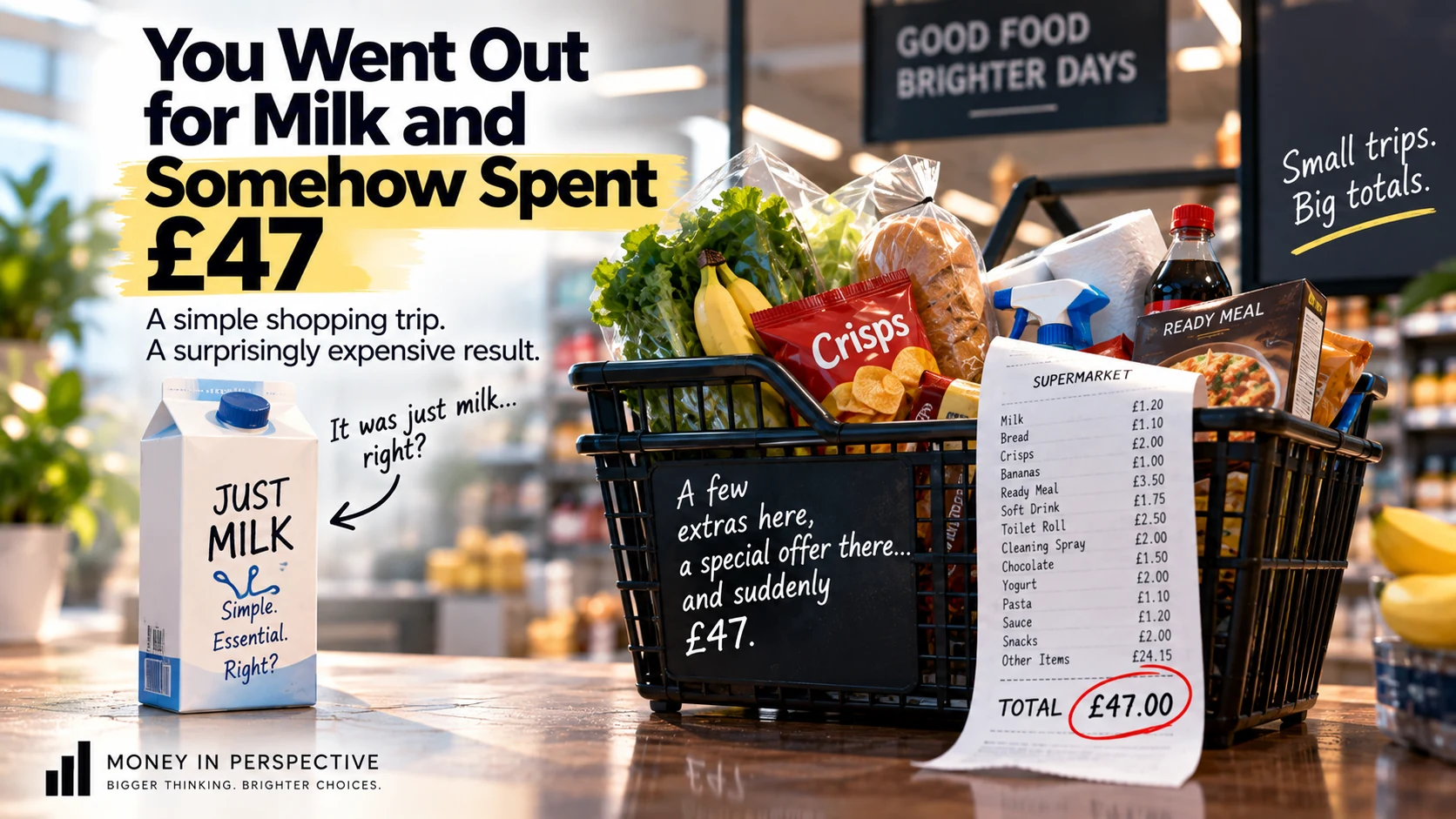
You needed milk.
That was the assignment.
There was no complicated shopping list, no weekly grocery mission and certainly no intention to spend nearly fifty pounds.
You walk into the supermarket, collect the milk and then remember that bread is running low. That seems sensible. You pass the fruit, decide bananas would be useful and notice something on offer nearby.
While you are there, you remember washing-up liquid.
Then snacks.
Something for tomorrow’s lunch.
A drink.
A household item you will “need eventually”.
The middle aisle introduces you to a product you had never considered owning until thirty seconds ago.
At the checkout, the original carton of milk sits among a collection of completely defensible purchases.
Total: £47.
The milk has had an extraordinary afternoon.
“While I’m here” is an expensive sentence
Supermarkets benefit from a basic truth: once you are already inside, the effort required to add another item is tiny.
The phrase “while I’m here” removes much of the normal friction from buying.
You might not travel specifically to the supermarket to purchase biscuits, a candle and some storage containers.
But once you are standing beside them, the decision feels different.
The travel has already happened.
The trolley exists.
The payment will happen anyway.
Adding one more product feels almost free in effort, even though it is not free financially.
Small trips often lack boundaries
A planned weekly shop usually has some structure.
You may have a list.
A rough budget.
An idea of meals.
A top-up trip for one item often has none of those things because it seems too small to require planning.
Ironically, this can make the smaller trip more vulnerable to impulse purchases.
You know what the large shop is for.
The small trip can become whatever the supermarket suggests along the way.
Promotions change the question
Offers are particularly effective because they change the decision from:
Do I need this?
to:
Is this good value?
Those are different questions.
A product can be excellent value and still be completely unnecessary.
Half-price biscuits are still more expensive than biscuits you were not going to buy.
Buy-one-get-one-free can be useful for something you already consume.
It is less useful when the offer is the reason the product entered your trolley in the first place.
Supermarkets are designed for discovery
Retail layout is not random.
Products are positioned carefully.
High-demand essentials may require customers to walk through other sections.
Promotional displays occupy prominent space.
Checkout areas historically became homes for small impulse items because waiting creates an ideal moment for one final purchase.
Modern self-checkout has changed some of this, but the principle remains.
Retailers want shoppers to notice more than the item they arrived for.
That is simply good retailing.
Your job as a shopper is not to defeat the supermarket.
It is to know which discoveries actually improve your purchase.
Hunger makes almost everything look useful
There is a reason people warn against grocery shopping while hungry.
Hunger changes the attractiveness of food.
Suddenly the basket contains ingredients for three different versions of dinner and enough snacks to survive a minor national emergency.
The advice sounds obvious because it is obvious.
That does not make it ineffective.
If you are doing a larger food shop, eating beforehand can reduce the likelihood of buying based on immediate appetite rather than actual household needs.
“It will get used” is not always enough
Another common justification is that the item will eventually be useful.
Washing products.
Kitchen items.
Bulk food.
Household supplies.
Sometimes buying ahead is sensible.
The problem is that “eventually” can turn a quick trip into a large stock-building exercise.
Buying something three weeks early is not automatically a saving just because it will eventually be consumed.
Cash flow matters too.
If repeatedly buying future needs is making current shopping expensive, the timing deserves consideration.
Lists do more than prevent forgetting
A shopping list is often described as a memory tool.
It is also a boundary.
It defines the purpose of the trip before the supermarket gets involved.
This does not mean you must treat the list like a legal contract.
If you remember something genuinely needed, add it.
The value of the list is that every unplanned item becomes a conscious deviation rather than an invisible expansion of the trip.
Try separating “need” from “good idea”
When something unplanned catches your attention, place it mentally into one of two categories.
Need: something you genuinely forgot to list.
Good idea: something that looks useful or appealing.
Both can be purchased.
The distinction simply creates a second of thought.
That pause is often enough to prevent a £3 item from joining ten other £3 items.
The middle aisle deserves particular respect
Certain supermarkets have perfected the art of selling products entirely unrelated to why you entered.
Milk and bread somehow lead to power tools, yoga equipment, lamps, garden accessories or an object whose purpose only becomes clear after reading the box.
These aisles are entertaining precisely because of unpredictability.
If you enjoy browsing them, treat that as leisure spending.
Perhaps give yourself a limit.
Now the purchase is not pretending to be groceries.
Top-up trips multiply exposure
Another reason the £47 milk run happens is frequency.
If you visit a supermarket five times per week, you expose yourself to five sets of offers, displays and impulse opportunities.
Planning slightly better and reducing unnecessary top-up trips can lower spending without changing what you eat.
This is not always practical. Fresh food, family schedules and small storage spaces may require frequent visits.
But when several trips occur simply because planning failed, there is usually financial leakage.
Convenience stores make urgency more expensive
Running out of one item can also send you to a smaller convenience shop where prices may be higher.
That is not a criticism. Convenience locations have a different business model.
The useful lesson is that forgetting basics can repeatedly create a premium.
A small household list of commonly replenished items can reduce these emergency purchases.
Look at the receipt after surprising shops
If you intended to spend £5 and spent £47, the receipt is valuable information.
Do not simply conclude that groceries are expensive.
Ask what actually happened.
How much was necessary?
How much was useful but unplanned?
How much was promotion-driven?
How much was impulse?
This reveals whether the problem is food prices, planning or browsing behaviour.
Often it is a mixture.
Do not become absurdly strict
There is no need to put back a £2 chocolate bar because it was not written on the sacred shopping list.
Shopping can contain spontaneity.
The goal is not perfect compliance.
It is avoiding the situation where twenty spontaneous decisions are all individually justified and collectively surprising.
Give unplanned spending a small allowance
One practical approach is to allow a certain amount of flexibility.
Perhaps your grocery budget includes £10 each week for unplanned extras.
Now you can try something new, respond to an offer or buy a small treat without feeling as though the budget has failed.
Once the allowance is used, later extras require more thought.
The cheapest shop is not always the one with the lowest prices
This is another interesting point.
A supermarket can have excellent prices but still be expensive for you if its environment consistently encourages additional buying.
Another shop with slightly higher unit prices may produce a smaller total because you buy only what you intended.
Behaviour affects value.
Shopping habits are more important than one bad trip
Everyone has a shopping trip that becomes inexplicably large.
That is not a financial crisis.
The useful question is whether it happens repeatedly.
If most top-up shops become £30, £40 or £50 trips, the pattern deserves attention.
Perhaps larger planned shops would work better.
Perhaps click-and-collect reduces browsing.
Perhaps lists need improving.
The correct solution depends on why the spending expands.
When the little shops become another weekly shop
There is also a budgeting problem hidden inside the “quick top-up” shop. Because the trip was never supposed to be a proper grocery run, the amount often escapes the weekly food budget in your head. The large supermarket shop feels like groceries. The £18 spent on Tuesday evening and the £27 spent on Friday afternoon can feel like separate little emergencies. By the end of the month, those smaller visits may have added the equivalent of another full shop without ever feeling like one.
That is why it can help to track top-up spending separately for a few weeks. You do not need a complicated spreadsheet. Simply note how many extra food-shop visits happened after the main shop and what they cost. If the number is consistently high, the issue may not be that you lack discipline in the supermarket. It may be that the original plan is not covering the household properly. Perhaps lunches were forgotten, snacks were underestimated, or fresh items are being bought in quantities that do not last.
There is an important difference between impulse spending and poor planning. They can look identical on a bank statement. If you keep returning because the household genuinely runs out of essentials, buying less impulsively will not solve everything. The main shop itself may need to change.
Online grocery shopping can be useful here because it removes much of the physical browsing. You can search directly for what you need, see the running total before paying and remove items without the awkward feeling of putting them back on a shelf. It is not automatically cheaper: delivery fees, minimum orders and online promotions can create their own temptations. But for people who reliably overspend when walking through a store, reducing exposure can be valuable.
Another useful habit is to pause before the checkout and look at the basket as though it belonged to somebody else. Which items clearly belong to the original purpose of the trip? Which are sensible additions? Which appeared simply because they were nearby? This takes less than a minute and avoids the miserable version of budgeting where every item is judged while you are trying to shop.
It also helps to remember that supermarkets are not the enemy. Their job is to sell products, and a pleasant store that helps you discover useful things is doing its job well. The responsibility is simply shared: the shop presents opportunities, and you decide which ones deserve your money.
If the occasional milk run becomes £47, nothing terrible has happened. If nearly every small shop does, that is useful information. The solution is not to become the person who enters the supermarket wearing blinkers and refuses to acknowledge the existence of biscuits. It is to give small trips the same basic purpose that larger trips already have.
A simple rule can work well: decide before entering what kind of shop this is. Is it a one-item emergency, a small top-up, or a proper shop? Give the trip a rough spending ceiling that fits that purpose. A top-up might reasonably become £12 instead of £5. It probably should not quietly become £50 every time.
That tiny bit of intention changes the experience. You can still buy the forgotten bread, take advantage of a genuinely useful offer and pick up something enjoyable. You are simply less likely to discover at the checkout that the milk has somehow acquired forty-five pounds' worth of friends.
A useful final check is to compare how much food is being thrown away at home. Repeated top-up trips sometimes happen while cupboards already contain plenty of food, just not the food anyone feels like eating. In that case, the answer may be less shopping rather than better shopping. Planning one or two meals around what is already there can reduce both waste and the number of emergency visits.
That makes the supermarket problem easier to see. You are not trying to buy the fewest possible things. You are trying to make each trip reflect what the household will realistically use before another trip becomes necessary.
Milk was never the problem
The original carton may have cost £1.50.
It did its job perfectly.
The rest of the transaction arrived because the trip had no strong boundary and the supermarket provided twenty opportunities to expand it.
There is nothing sinister about that.
Shops sell things.
We walk through them.
Sometimes things come home.
The useful habit is simply knowing whether the £47 shop was genuinely useful or whether a £1.50 errand accidentally became entertainment.
Because the next time you say:
“I’m just popping out for milk,”
your bank account may want more information.