Ten pounds does not feel like much money.
That is exactly why it can become expensive.
A £10 purchase usually avoids the part of your brain reserved for serious financial decisions. You do not open a spreadsheet. You do not compare three providers. You do not delay the purchase for a week. You simply tap the card and move on.
The problem is not the ten pounds.
The problem is repetition.
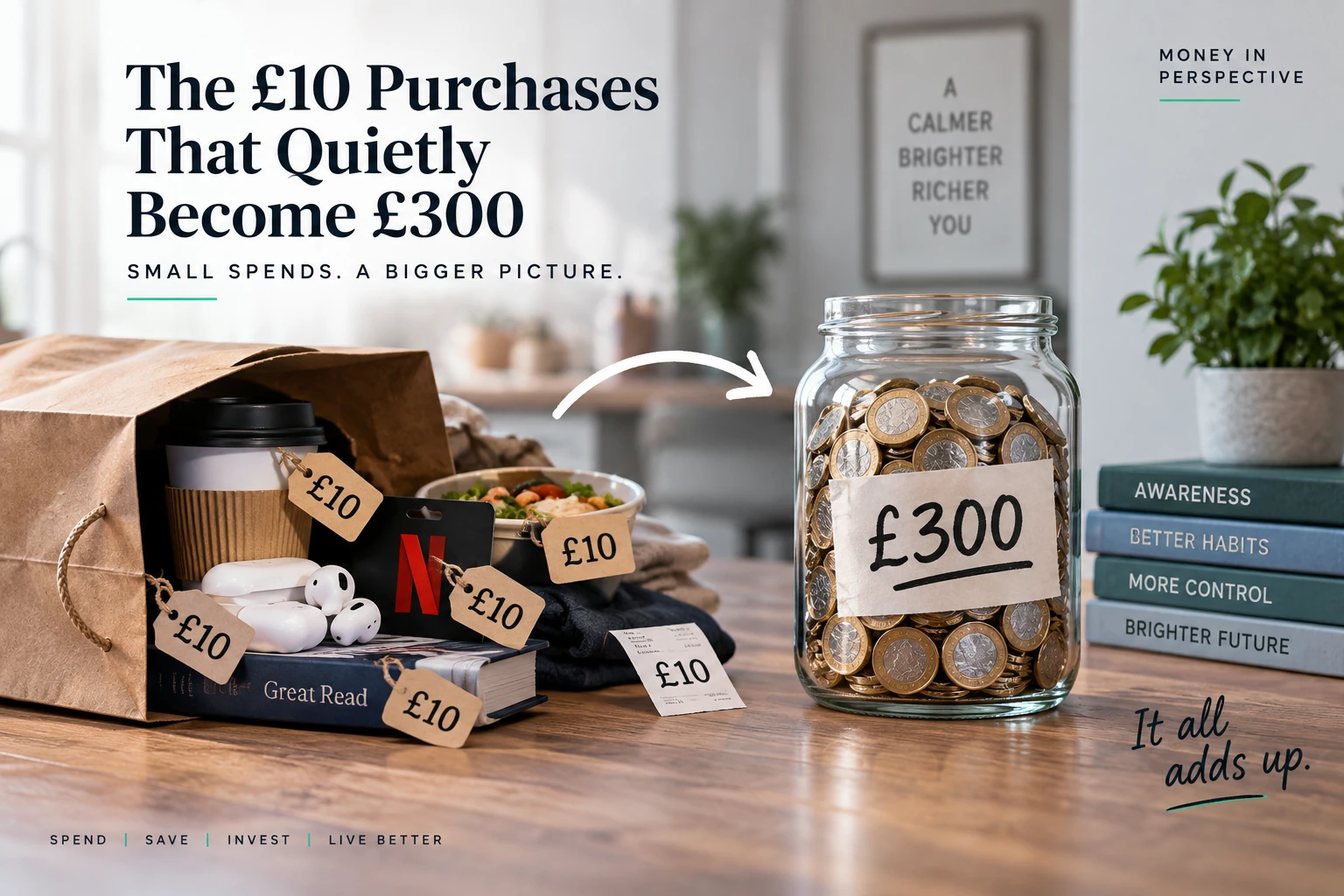
One £10 purchase is £10.
Ten are £100.
Thirty are £300.
A habit that costs £10 three times a week becomes more than £1,500 over a year.
Nothing dramatic has to happen.
There is no luxury purchase and no financial crisis.
The money simply leaves in small, forgettable pieces.
That is why low-value spending can be difficult to understand.
We judge each transaction individually.
The bank account experiences them collectively.
Consider a normal week.
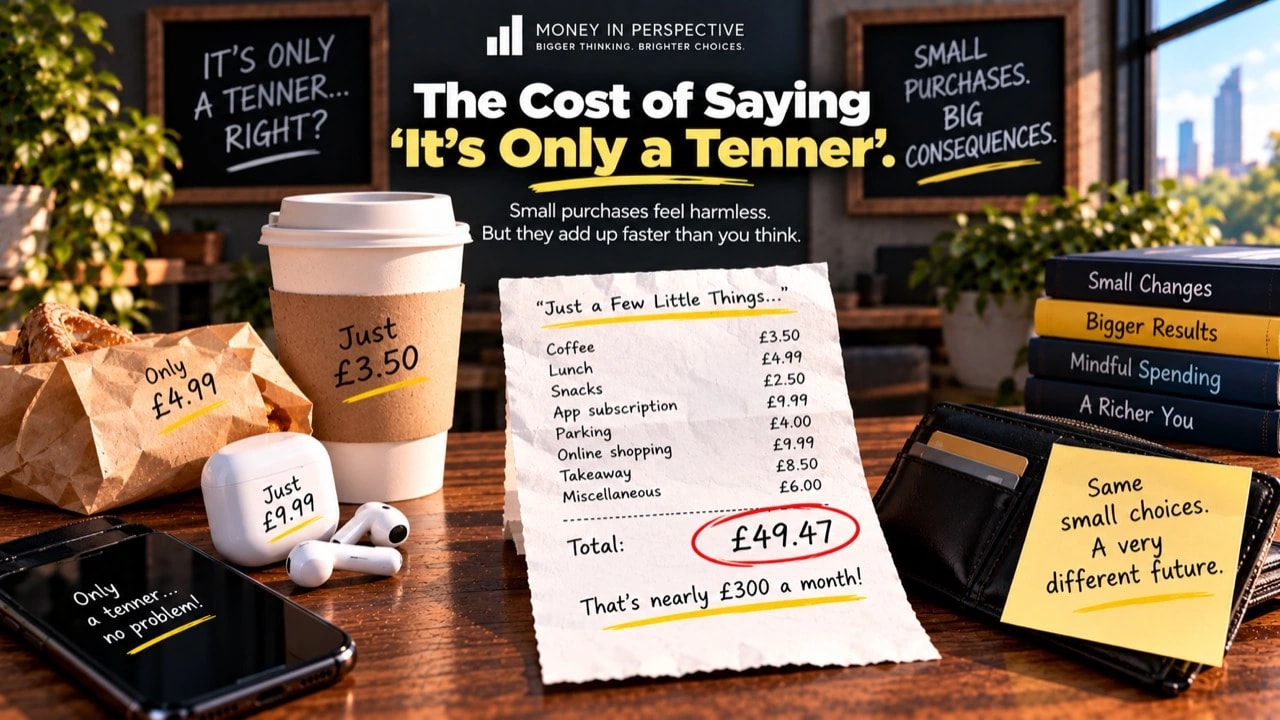
£10 lunch because you forgot to bring food.
£10 on something small online.
£10 on snacks and drinks.
£10 on a taxi because the weather is terrible.
None of those decisions looks unreasonable.
Do the same thing most weeks and the pattern becomes a four-figure annual category.
This does not mean every small purchase should be eliminated.
That is one of the least helpful interpretations of personal finance.
The question is whether the spending provides enough repeated value to justify the repeated cost.
A £10 weekly football game may be excellent value if you enjoy it, exercise and see friends.
A £10 weekly app purchase you barely remember may be poor value.
Same price.
Different return.
Small purchases become dangerous mainly when they are both frequent and forgettable.
This is why “it’s only a tenner” is such a powerful phrase.
The word “only” closes the discussion.
You have already decided the amount is too small to matter.
Sometimes that is true.
It is impossible and exhausting to optimise every pound.
But if you hear yourself saying “only” several times a week, the category may deserve one look.
A useful approach is to stop judging the transaction and start judging the habit.
Instead of asking whether this £10 takeaway add-on is affordable, ask how often similar add-ons happen.
Instead of asking whether this £12 taxi is expensive, ask what taxis cost across a typical month.
Frequency changes the meaning of price.
Digital payments make this harder to notice.
Cash used to provide immediate feedback.
Spend a £10 note and the note disappeared.
Contactless payment makes £10 feel almost weightless.
Tap.
Notification.
Done.
The purchase is convenient and the balance remains abstract until you check it.
This is not an argument against cards.
Digital payments are useful and often safer.
It simply means visibility needs to come from somewhere else.
A banking notification can help.
So can a weekly review.
Look at every discretionary transaction below perhaps £15 or £20.
Add them up.
The result may surprise you.
The next question is more important: which ones do you remember?
If £120 left the account in small purchases and most of it created useful or enjoyable experiences, the category may be fine.
If £120 disappeared and almost none of it feels memorable, there is probably low-value spending to remove.
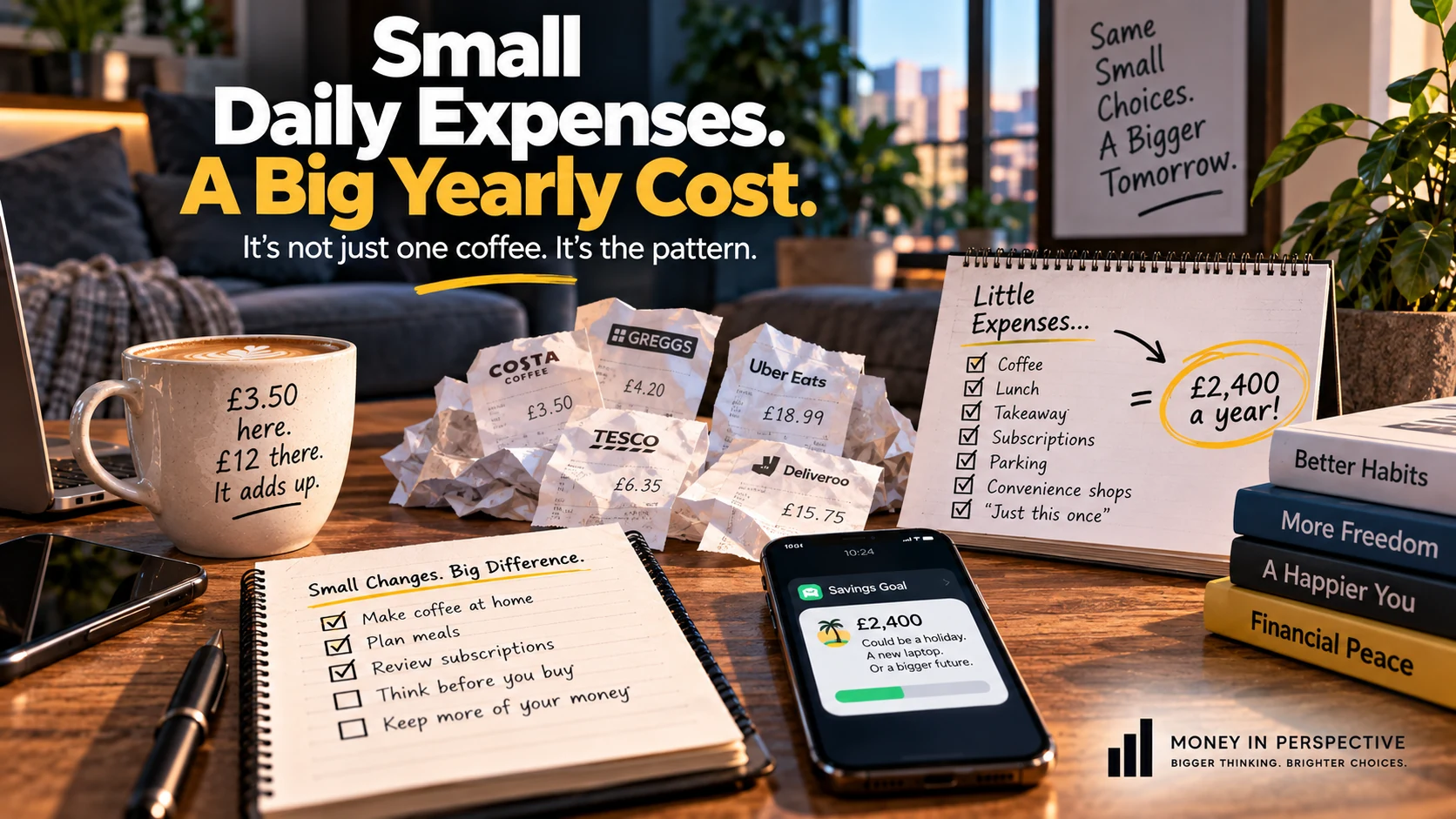
Food is one of the most common areas.
Coffee.
Snacks.
Lunch.
Delivery fees.
Quick top-up shops.
Individually modest.
Collectively meaningful.
The answer is not necessarily bringing food from home every day.
Perhaps bought lunch is one of the best parts of your working week.
Keep it.
You might discover the real problem is £40 of delivery fees and impulse snacks that provide little satisfaction.
Selective cuts are usually easier to sustain than declaring war on every small pleasure.
Convenience spending works the same way.
£10 can buy time.
Taxi.
Delivery.
Premium shipping.
Prepared food.
These can be excellent decisions.
If £10 saves an hour on a day when time matters, the value may be obvious.
The problem is when convenience becomes automatic.
Paying £10 to remove every small inconvenience can produce a very expensive lifestyle without one purchase ever feeling luxurious.
This is why small spending is not really about price.
It is about whether the premium solves something that matters.
Retailers understand small-price psychology well.
Add-ons are often deliberately priced in a range that feels harmless.
Another £7.
Only £9.99.
Upgrade for £12.
The main purchase has already been mentally accepted, so the extra feels small by comparison.
Suppose you buy something for £80.
A £10 add-on is only 12.5% more.
That framing can make the extra seem trivial.
Repeat the same behaviour across ten purchases and you have spent another £100.
Checkout pages are full of these opportunities because they work.
Protection plan.
Faster delivery.
Accessory.
Premium version.
Donation.
Tip.
None is necessarily poor value.
Just ask whether you would buy the extra if it were presented separately.
That removes some of the anchoring effect of the main purchase.
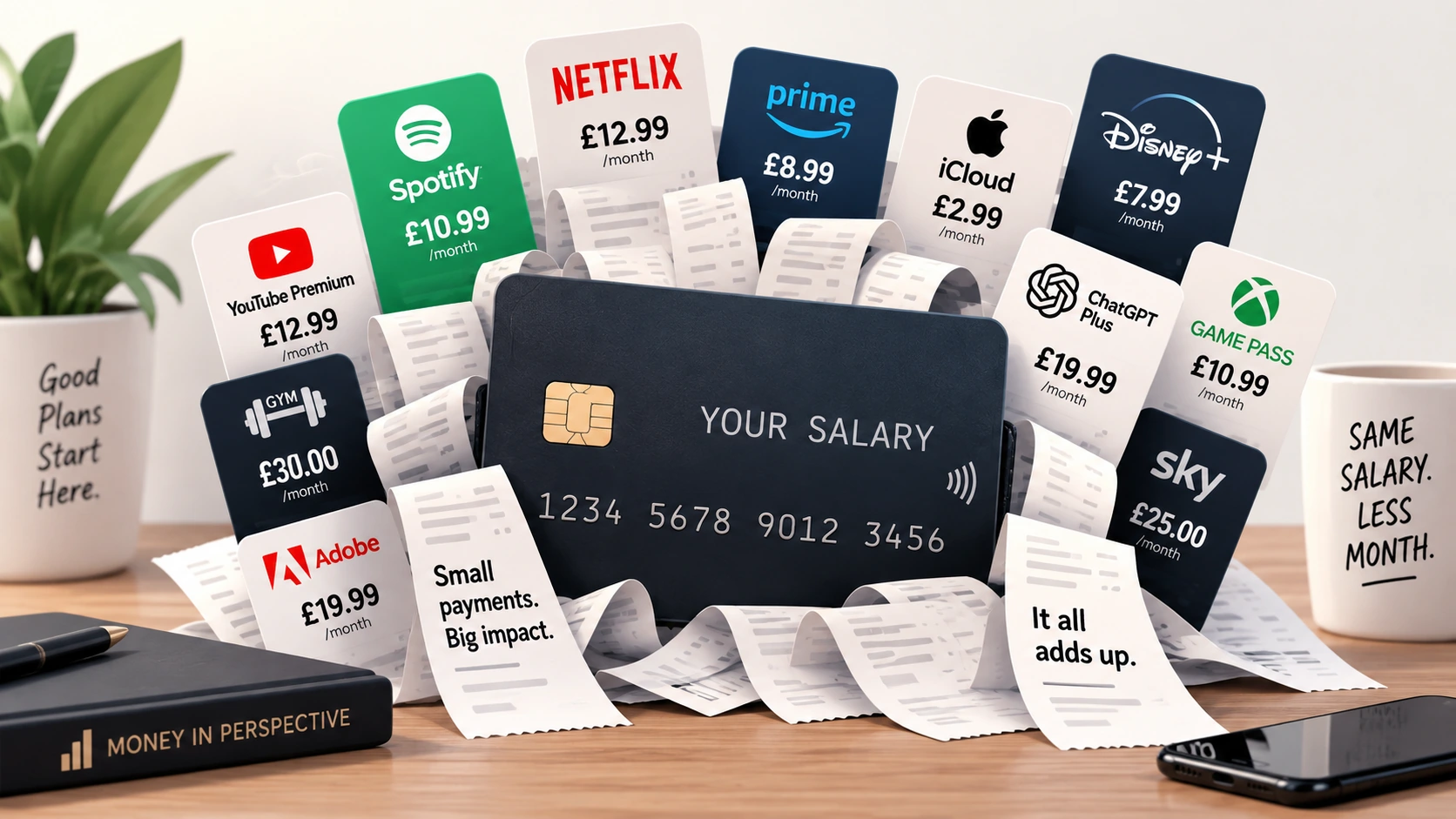
Subscriptions are another version of the £10 problem.
£9.99 a month sounds insignificant.
Across a year it is about £120.
Three subscriptions at that price approach £360.
The small amount repeats automatically, which means it deserves more attention than a one-off £10 purchase.
This is why recurring small costs should be annualised.
Would you pay £120 today for another year?
If yes, great.
If not, the monthly price may be hiding weak value.
Small purchases also cluster around emotions.
Bad day.
Bored.
Tired.
Celebrating.
You buy lunch, then coffee, then a taxi, then a takeaway.
Each expense has a reason.
Together, one difficult day becomes £40 or £50 of extra spending.
The useful response is not guilt.
It is identifying the trigger.
If stressful workdays reliably create expensive convenience, perhaps the budget should include some of it.
Or perhaps preparation can reduce the pattern.
Meal in the freezer.
Emergency snacks at work.
Money deliberately set aside for taxis.
A realistic plan works better than expecting your most organised behaviour every day.
There is also a social element.
A £10 contribution here.
A drink there.
Small gifts.
Group collections.
These costs can accumulate, but relationships matter.
Not all repeated spending needs to be optimised.
The aim is to separate meaningful social spending from automatic participation you do not value.
One powerful technique is a small-spending allowance.
Decide that perhaps £100 or £150 a month is available for random discretionary purchases.
You do not need to categorise every coffee and snack.
Use the money.
Enjoy it.
When the allowance is running low, you have information.
This protects both enjoyment and the rest of the budget.
Another method is the weekly total.
If daily tracking feels tedious, look once a week.
How much went on transactions under £20?
Do not aim for zero.
Aim for awareness.
Over time, you may notice patterns.
Friday is expensive.
Office days cost more.
Late-night online shopping creates purchases you regret.
The pattern gives you a target that is more useful than “spend less”.
You can also use a waiting list for small online purchases.
Anything non-essential goes onto a note for forty-eight hours.
If you still want it, buy it.
This works because low prices often create immediate action.
The waiting period restores the question that price removed: do I actually want this?
You will still buy some items.
Others will become irrelevant surprisingly quickly.
Cost per use is useful too.
A £10 purchase used fifty times is extremely cheap.
A £10 gadget used once is expensive relative to its value.
Homes are often full of inexpensive items that were easy to justify and difficult to use consistently.
Kitchen tools.
Phone accessories.
Storage products.
Exercise gadgets.
Cheap can produce clutter because the threshold for buying is low.
This is why low price and good value should not be confused.
The best £10 purchase can be better than a £100 purchase.
The worst £10 purchase is still money exchanged for nothing useful.
Annualising behaviour can create perspective, but it should not become a scare tactic.
Personal finance advice sometimes says, “That £5 coffee is £1,825 a year,” as if every recurring pleasure becomes irrational when multiplied by 365.
That misses the point.
If you love the coffee and can afford £1,825 a year for that routine, it may be entirely worth it.
Annualising should reveal the size of a choice, not decide whether the choice is allowed.
The same applies to the £10 habit.
If £1,500 a year funds a hobby you care about deeply, excellent.
If £1,500 a year disappears into purchases you barely remember, you have found an easy opportunity.
The easiest savings are often not the largest purchases.
They are the repeated low-value ones.
Cutting one poor £10 habit three times a week can free more than £1,500 a year without touching the things you genuinely enjoy.
That can fund a holiday.
Build an emergency fund.
Reduce debt.
Increase investments.
Or simply create breathing room.
This is why small spending deserves attention even though it is not always the main financial problem.
Large fixed costs usually shape the budget more.
Housing, transport and childcare can dwarf coffee and snacks.
But small purchases have one advantage: they are often easy to change.
You do not need to move house to stop buying something you do not care about.
A strong financial plan therefore looks at both.
Big costs for big structural improvements.
Small habits for easy efficiency.
There is no need to count every penny forever.
You can study your spending for one month, learn the pattern and then simplify.
Perhaps you discover that small purchases average £300 a month.
You decide £200 provides nearly the same enjoyment.
Now you have created £100 of monthly margin without monitoring every transaction indefinitely.
That is the real objective.
Not becoming someone who is frightened of spending £10.
Becoming someone who knows when £10 is genuinely small and when it is part of something much larger.
The phrase “it’s only a tenner” can be completely true.
Sometimes ten pounds is exactly the right amount to spend.
Just remember that your bank account does not hear the word “only”.
It hears every transaction.
And it adds them perfectly.
A useful final exercise is to group those small purchases by purpose rather than by retailer.
Ten pounds at a supermarket might be groceries, a snack or a completely unplanned household item.
Ten pounds through an app might be transport, entertainment or convenience.
What matters is what the purchase was doing for you.
Once grouped, the pattern often becomes clearer.
You may discover that the real issue is not small spending at all.
It is one repeated behaviour such as buying lunch because mornings are rushed, paying for delivery because evenings are unplanned, or ordering inexpensive gadgets because browsing has become a hobby.
That is good news because specific problems are easier to solve than vague ones.
Fix the rushed mornings and the lunch spending may fall without any budgeting effort.
Plan two easy dinners and delivery costs may drop.
Create a hobby allowance and online shopping becomes intentional rather than accidental.
Small purchases are useful clues.
They show where money is leaking, but also where life is asking for convenience, enjoyment or better planning.
The aim is not to squeeze every £10 out of existence.
It is to make sure repeated £10 decisions are supporting the life you actually want rather than quietly building a £300 total you never chose.