There is a phrase capable of making surprisingly expensive purchases sound financially sensible:
“It’s fine. It’s tax deductible.”
Business owners use it for equipment, software, travel, vehicles, professional services and a long list of other costs.
The logic seems attractive.
If the business can claim tax relief on an expense, part of the cost is effectively reduced through a lower tax liability.
That part can be true.
The dangerous leap is turning “the expense may reduce taxable profit” into “the expense barely costs anything.”
Those are very different statements.
A business expense does not become free because it receives tax relief.
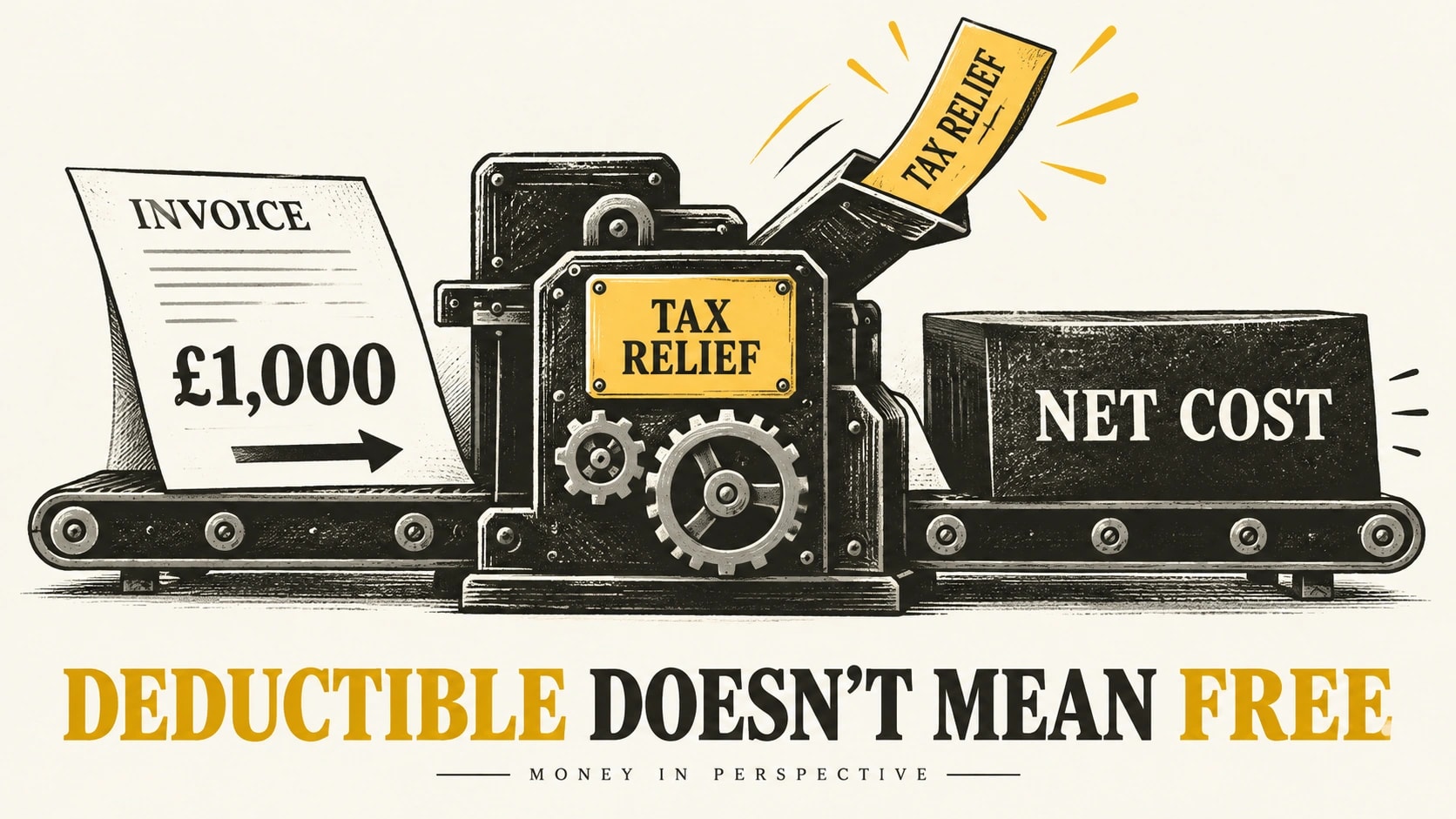
If the business spends £1,000 unnecessarily and receives some tax benefit from that expenditure, the business still spent £1,000.
The tax saving may reduce the effective net cost.
It does not put the entire £1,000 back.
This sounds obvious, yet the psychology of tax can make business owners behave differently from ordinary consumers.
Imagine spending £1,000 personally on something you do not need.
Most people would focus on the £1,000 leaving the account.
Now place the same purchase inside a business and label it tax deductible.
Suddenly the cost can feel strategic.
The commercial question should come first:
Does the business actually benefit from spending this money?
Only after that should tax treatment be considered.
Suppose a business needs a new laptop because the current machine is unreliable and slowing down work.
The purchase may make excellent commercial sense.
Tax relief, if available under the relevant rules, improves the economics further.
Now imagine buying a second expensive laptop primarily because the business wants to reduce its tax bill before year-end.
If the device provides little additional value, the business has spent a much larger amount to save only part of that amount in tax.
It may have been financially better to keep the profit and pay the tax due.
This is the central principle:
Never spend £1 solely to save a fraction of £1 in tax.
The exact fraction depends on the business, the expense, the tax system, timing and individual circumstances.
That is why specific tax treatment should be checked properly rather than assumed.
But the commercial principle remains consistent.
The first test for expenditure should be whether the business needs it and whether the expected value justifies the cost.
Tax comes afterward.
One reason the misunderstanding persists is that people often talk about taxable profit as though tax is applied to revenue.
A legitimate deductible expense can reduce taxable profit.
That matters.
But reducing profit also means the business has less profit.
There is no prize for achieving the smallest possible tax bill if the method was making the business unnecessarily poorer.
A business earning healthy profit and paying the correct tax can be in a stronger position than one that aggressively spends everything before year-end to avoid a liability.
This becomes particularly important with cash flow.
A tax benefit may affect a future liability.
The cash for the purchase usually leaves now.
A business can therefore create immediate cash pressure while expecting tax relief later.
If the bank balance is already tight, buying unnecessary equipment for tax reasons can make the company less resilient.
Cash is especially important around payroll, VAT, suppliers and other fixed obligations.
A deduction on a tax computation does not pay next week's wages.
This is why tax planning should sit inside cash-flow planning rather than override it.
VAT creates another version of the misunderstanding.
A VAT-registered business may, where the rules allow, recover input VAT on certain business purchases.
People sometimes describe this as “getting the VAT back,” which can make the purchase feel significantly cheaper.
Recovering eligible VAT can absolutely reduce the net VAT cost.
The underlying net purchase still exists.
If a £1,200 VAT-inclusive purchase contains £200 of recoverable VAT in a simplified example, the business has not acquired the item for nothing.
It has effectively paid the net amount, subject to the actual rules and its circumstances.
Again, tax treatment alters cost.
It does not erase it.
Business and personal use can complicate matters further.
An expense paid through the company is not automatically deductible simply because the company card was used.
Tax systems generally contain rules about business purpose, private use and specific categories of expenditure.
Some costs may be deductible in full.
Some partly.
Some treated differently.
Some not deductible at all.
Vehicles, entertainment, travel, home working, clothing and mixed-use assets can have more complicated treatment than owners expect.
This is why “put it through the business” is not a reliable tax strategy.
The accounting records should reflect what actually happened, and the correct tax treatment should be determined according to the relevant rules.
Documentation matters too.
Invoices, receipts and evidence of business purpose can be important.
Good records are useful even beyond tax.
They help management understand where money is going.
A company with hundreds of small recurring expenses can easily lose sight of how much software, subscriptions and services are costing.
Every individual payment can be legitimate and deductible while the collection is commercially inefficient.
This is one of the most important distinctions between allowable and worthwhile.
An expense can be perfectly legitimate for tax purposes and still be a bad business purchase.
Imagine a company paying for five different software tools whose functions overlap.
All five may be genuine business expenses.
That does not mean the company should keep all five.
If two can be removed without affecting operations, profitability improves.
The tax bill may rise slightly because expenses fell.
The business is still better off because it kept more profit.
This can feel counterintuitive.
Owners sometimes react negatively when their accountant says tax is higher because profit increased.
But higher tax caused by genuinely higher profit is normally a much better problem than lower tax caused by unnecessary spending.
The objective is not to maximise tax.
The objective is to maximise sustainable after-tax value while complying with the rules.
Tax planning can absolutely help.
Using legitimate allowances, choosing appropriate timing and structuring transactions correctly can reduce unnecessary tax.
That is different from buying things purely because they may attract relief.
The distinction is intent and commercial value.
Timing purchases can make sense where the business already needs them.
Suppose equipment is due to be replaced within the next two months and bringing the purchase forward has a legitimate tax or operational advantage.
That can be sensible planning.
Suppose no replacement is needed, but the business buys equipment to “use up profit”.
That requires much stronger justification.
Businesses should also consider opportunity cost.
£10,000 spent on equipment cannot simultaneously fund marketing, staff, debt repayment or cash reserves.
Even if the purchase receives favourable tax treatment, another use of the money may generate more value.
The correct question is therefore not merely:
“Can we deduct this?”
Ask:
“What return will this spending create compared with the alternatives?”
This is basic capital allocation.
Small businesses often do it informally, but the principle matters.
Cash should go where it produces the strongest combination of return, efficiency, resilience and strategic value.
Tax is one factor inside that decision.
It should not be the only one.
Vehicles are a good example of where tax language can distort thinking.
Business owners may hear about favourable treatment for certain vehicles or acquisition methods and begin the purchasing decision with tax.
But a vehicle is still a major financial commitment.
Purchase price.
Finance.
Insurance.
Maintenance.
Fuel or electricity.
Depreciation.
Potential private-use consequences.
The correct vehicle for the business should be selected first based on actual use and total economics.
Tax treatment can then influence the final structure.
Starting with “what vehicle gives the biggest deduction?” can lead to purchasing far more vehicle than the business needs.
The same applies to office equipment.
A £2,000 desk is not automatically a stronger financial decision than a £500 desk because both are business expenses.
If the expensive desk improves comfort, health, productivity or durability enough to justify the difference, good.
If the reason is mainly that the business can claim it, the logic is weak.
There is also a cultural issue inside growing companies.
Once employees believe “the business pays” and tax relief exists, spending discipline can soften.
Travel upgrades.
Software trials never cancelled.
Unused memberships.
Small equipment purchases.
Individually, none may matter.
Collectively, expense culture can reduce margin.
Strong businesses create approval processes proportionate to size.
Not bureaucracy for the sake of it.
Simply a pause before money leaves.
What is this for?
Who uses it?
Is there an existing alternative?
Is it recurring?
What is the expected benefit?
These questions are commercial, not tax questions.
A legitimate deduction should pass them too.
One useful way to think about tax relief is as a discount that applies only if you wanted the underlying business purchase anyway.
Imagine a shop offers 20% off something you do not need.
You have not saved 20%.
You spent 80%.
Tax relief works differently in technical terms, but the behavioural analogy is useful.
A reduction in effective cost does not turn unnecessary spending into saving.
Another mistake is spending near year-end simply because cash is visible.
Profits may have been strong.
The bank account looks healthy.
Owners become tempted to buy things before the year closes.
But some of that cash may need to fund future tax, VAT, payroll, debt or slower trading periods.
A tax liability can be unpleasant.
Running out of working capital is worse.
Cash reserves have value even though they do not reduce tax.
They allow the company to survive problems and take opportunities.
A healthy business should therefore balance tax efficiency with liquidity.
The cheapest tax bill is not always the strongest financial position.
It is also worth remembering that accounting expense and tax deduction are not necessarily the same thing or timed in the same way.
Capital assets, depreciation and tax allowances can be treated differently depending on the rules.
This is another reason casual assumptions can create confusion.
For material purchases, check the actual treatment with appropriate professional guidance.
The phrase “tax deductible” often compresses a complicated answer into two words.
For ordinary business decisions, a simple hierarchy works well.
First: Does the business need or genuinely benefit from this?
Second: Can the business comfortably afford it?
Third: Is this the best use of the money?
Fourth: What is the correct accounting and tax treatment?
That order keeps the commercial decision in control.
Tax planning remains important without becoming a reason to spend.
There is nothing clever about paying more than necessary in tax.
Businesses should claim legitimate reliefs and structure transactions appropriately.
But there is equally nothing clever about reducing tax by wasting money.
Profit after tax is still profit.
Cash retained after paying the correct tax can strengthen the business, fund growth or reward owners.
That is usually preferable to a cupboard full of equipment purchased because December was approaching.
The next time somebody says, “It’s fine, it’s tax deductible,” finish the sentence.
Tax deductible does not mean free.
Then ask whether you would still want the expense if tax relief did not exist.
If the answer is yes because the business genuinely benefits, the tax treatment may make a good purchase even better.
If the answer is no, the business probably does not need a deduction.
It needs to keep the money.