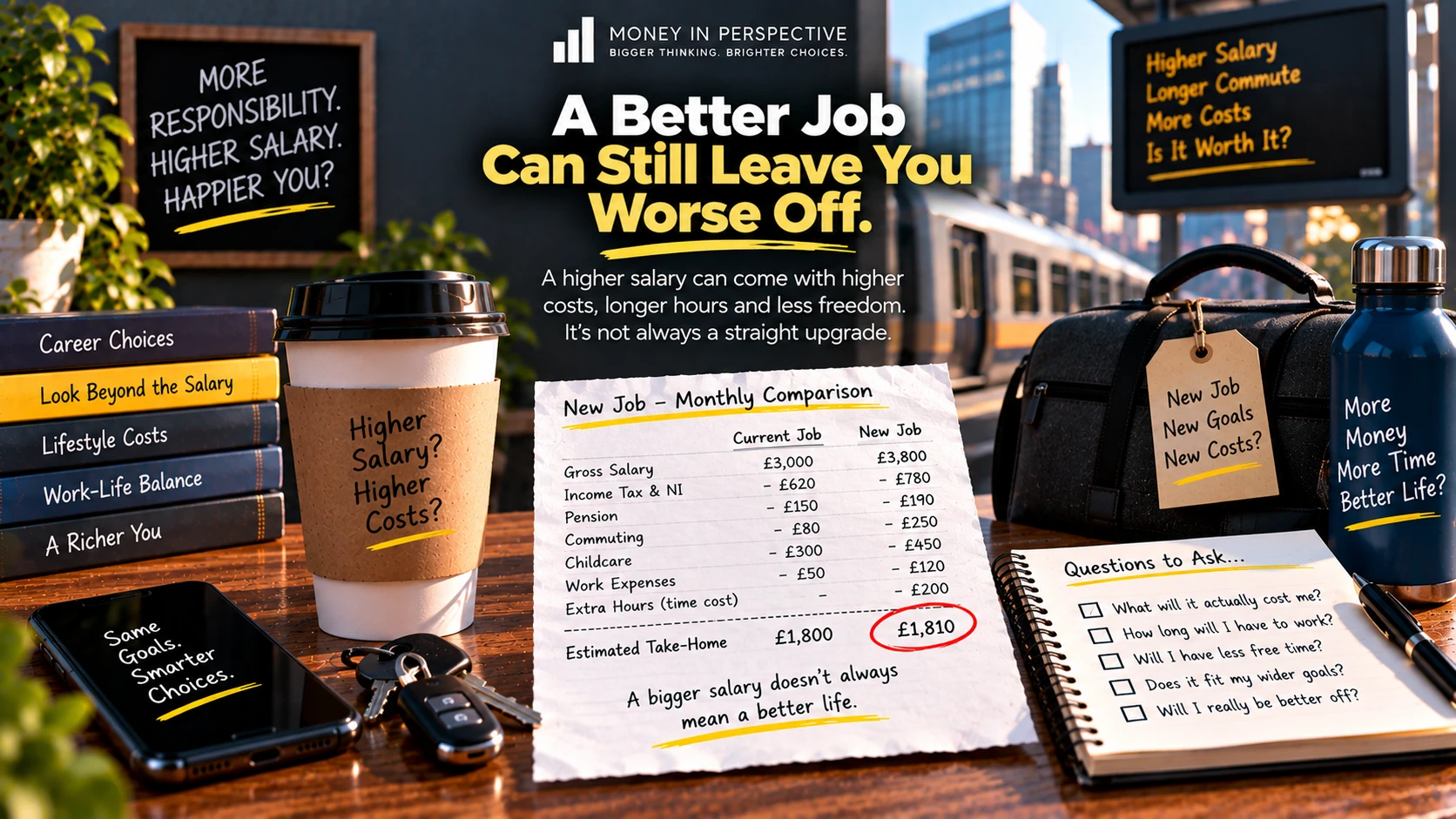
A better job should leave you better off. That sounds obvious. The new role pays more, has a more impressive title and perhaps works for a company people recognise. On paper, the move looks like progress.
Then the new job begins.
The commute is longer. You need more childcare. The pension is worse. The bonus is less certain than expected. Lunch costs more near the office. You are working longer hours, travelling more and spending money simply to keep up with the new routine.
The salary increased. Your life did not necessarily improve.
This is why job comparisons are more difficult than comparing one annual salary with another. A role is an entire financial and lifestyle package, and the headline number can hide both costs and benefits.
The first step is to compare take-home pay rather than gross salary. A £5,000 increase in salary does not mean £5,000 more arrives in your bank account. Income tax, National Insurance and, depending on your circumstances, pension contributions or student loan repayments can reduce the difference.
You do not need to perform the calculation perfectly yourself. Payroll calculators can provide a reasonable estimate, and individual tax circumstances may require more care. The important principle is that gross salary is the starting point, not the amount you gain.
Now subtract costs created by the new role.
A commute is the obvious one. Suppose your current job costs £40 a month to reach and the new one costs £220. That is £180 a month, or more than £2,000 a year. If the take-home improvement is £250 a month, most of it has already disappeared.
Driving brings additional costs beyond fuel, including mileage, tyres, servicing and depreciation. Rail fares can be simpler to see but may still require parking, buses or taxis at either end. Hybrid patterns can complicate ticket choices. The correct number is the realistic annual cost of the journey you will actually make.
Time matters too. A job paying £4,000 more but adding ninety minutes of travel every working day is not the same as a £4,000 increase for identical hours. That extra time may be acceptable because the role is more interesting or creates future opportunity. It should still be counted as part of the trade.
Childcare can turn a seemingly excellent offer into a very different financial decision. An earlier start or later finish may require breakfast clubs, after-school care, nursery extensions or extra help from family. A role with flexible home working can sometimes be worth more to a household than a higher salary with rigid attendance.
Benefits deserve equal attention. Employer pension contributions can vary significantly. If one employer contributes much more than another, the difference is part of compensation even though it does not appear in monthly spending money.
The same applies to private medical insurance, life cover, income protection, company cars, share schemes, training budgets, professional subscriptions and other benefits. Some have little value to a particular employee. Others would be expensive to replace personally.
Annual leave is another form of compensation that is easy to underestimate. Moving from thirty days to twenty-five days means losing a working week of paid time. A higher salary may still compensate for that, but the reduction should be visible in the comparison.
Flexible working can be even more valuable because it changes the rest of life. The ability to work from home, adjust start times or handle appointments without taking leave can reduce both costs and stress. Two jobs with the same salary can therefore have very different practical value.
Then consider hours.
Job descriptions normally show contracted hours. Real jobs have cultures.
Does everyone leave on time?
Are evenings expected?
Are weekend emails normal?
Does the senior title come with calls during holidays?
A role can have a higher salary and a lower effective hourly rate if the time commitment expands enough.
Suppose Job A pays £45,000 for a genuine forty-hour week. Job B pays £52,000 but regularly consumes fifty hours. Ignoring all other factors, Job B pays more annually but less for each hour of your time than the headline difference suggests.
This calculation is not intended to turn careers into hourly gig work. Senior roles often involve responsibility that does not fit neatly into a clock. The point is to understand whether the extra money is purchasing a proportionate amount of additional labour from you.
Location can make a higher salary feel smaller too. A role in a more expensive city may require higher rent, more expensive transport and higher everyday spending. £60,000 in one place can provide less disposable income than £50,000 somewhere cheaper.
Relocation has one-off costs as well: deposits, removals, legal fees, travel, new furniture or temporary accommodation. If the role lasts many years, those costs may be insignificant. If the job does not work out, they can matter.
Probation and job security deserve attention. Leaving a stable role for a higher-paying position with a long probationary period, uncertain funding or volatile commission structure introduces risk. Risk does not automatically mean decline the offer, but it has value.
A large variable bonus should also be separated from guaranteed salary. If the new job pays £45,000 plus “up to £15,000 bonus”, do not compare it as though it were a £60,000 salary unless the bonus is highly predictable. Ask how it is calculated, how often it has historically paid out and whether the targets are within your control.
Sales roles make this particularly important, but the principle applies anywhere compensation depends on performance.
Some job moves are financially worse in the short term and still excellent decisions. A lower initial salary may buy training, experience or a route into a better-paying field. A demanding role may accelerate a career. A move to a respected employer may increase future options.
This is where a simple one-year comparison can be misleading. Careers are long-term investments as well as sources of current income.
The question becomes: what is the role likely to do for my position in three to five years?
That does not justify every sacrifice in the name of “career progression”. Employers can overpromise future opportunity just as employees can overestimate it. Look for concrete evidence: training, promotion paths, responsibilities, qualifications, exposure and the careers of people who previously held similar roles.
There is also a psychological effect to changing jobs. A higher salary can encourage immediate lifestyle upgrades. Better car. More expensive clothes. More meals out. A nicer flat closer to the office. Some of these changes may be practical. Others are simply a response to feeling richer.
This can make the financial benefit of the move disappear even when the job itself is objectively better.
One way to protect the gain is to leave your lifestyle largely unchanged for the first few months. Let the higher income accumulate. Learn the real costs of the role. Then decide deliberately what should improve.
A good job comparison can be done on one page.
Start with guaranteed gross salary.
Estimate take-home pay.
Add the realistic value of benefits you care about.
Subtract additional commuting, childcare and unavoidable work costs.
Note annual leave and flexibility.
Estimate the real weekly time commitment.
Then write down the non-financial benefits and costs: interest, stress, learning, promotion potential, culture and stability.
The result will not produce a mathematically perfect winner. It will stop one number from dominating the decision.
It is also worth comparing what you are leaving behind. People often scrutinise a new offer while taking current benefits for granted. Perhaps your existing employer has an excellent pension, generous sick pay or unusually flexible management. Those things become visible only after they disappear.
Conversely, familiarity can make a weak current package seem more valuable than it is. Do not stay purely because change creates uncertainty. Compare both sides with the same level of honesty.
Negotiation can sometimes solve the problem. If commuting makes the offer marginal, ask about hybrid work. If salary is fixed, perhaps additional leave is possible. If the pension is weaker, a higher salary may compensate. If childcare is the issue, flexible start and finish times may have more value than another small pay increase.
Employers cannot accommodate every request, but compensation has more than one lever.
You should also consider the cost of being unhappy. A higher-paying job that damages health, relationships or sleep can be extremely expensive in ways that never appear in a spreadsheet. The opposite is also true: a role that is more engaging and less stressful can improve life even if the financial gain is modest.
That does not mean “follow your passion” and ignore money. Financial pressure creates stress too. The objective is balance.
The phrase “better job” should therefore be treated carefully.
Better salary?
Better hours?
Better career prospects?
Better location?
Better flexibility?
Better culture?
Better financial security?
A role can improve some and worsen others.
For someone with expensive childcare, flexibility may be worth thousands. For someone early in a career, learning may matter more. For someone supporting a family on one income, guaranteed salary and stability may dominate.
The correct choice changes with circumstances.
Before accepting a higher-paying job, imagine a normal Tuesday six months after starting. What time do you wake up? How do you travel? What does childcare look like? When do you get home? What do you spend on an ordinary day? How tired are you? What opportunities has the role created?
That ordinary Tuesday may tell you more than the annual salary.
One final factor is reversibility. Some job changes are easy to undo; others are not. If accepting a role requires relocating, signing a long lease, buying a second car or arranging expensive childcare, the household is making commitments that may remain even if the job disappoints. A modest pay rise can therefore support a surprisingly large increase in fixed costs.
It is worth asking what happens if the role ends after six months. Could you comfortably carry the new commitments while searching for another job? This does not mean planning for failure. It means recognising that a salary increase can encourage costs that are much harder to reduce than the salary was to gain.
A cautious approach is to let the job prove itself before permanently upgrading the lifestyle around it. Use the first few months to understand the commute, workload, bonus, culture and true take-home difference. If the improvement is real and sustainable, there will still be time to spend some of it.
The same approach helps with benefits. Read the details rather than assuming every package with more items is better. A company may advertise private healthcare that you barely use, while another offers an employer pension contribution worth several thousand pounds. One benefit is more visible; the other may be financially more valuable.
Finally, remember that a job can be better even when it leaves you slightly worse off financially. You might accept lower disposable income for work you enjoy, reduced stress, better training or a path into a career you want. That can be a completely rational decision.
The important thing is to know that you are making the trade.
Problems arise when someone takes the “higher-paying” job expecting an obvious financial improvement and discovers later that commuting, childcare, weak benefits and longer hours consumed most of it.
A proper comparison does not remove uncertainty. It simply gives you a much better chance of choosing the job for the right reasons.
A better job can absolutely leave you better off. Higher income is powerful, and careers often require moving to progress.
Just do not assume that a larger number on the offer letter automatically means a larger life.
The job pays you.
The job also changes what your time, routines and household cost.
Count both.