A salary can sound excellent and still feel strangely ordinary once it reaches real life.
£40,000. £50,000. £60,000.
These numbers carry psychological weight. They can represent progress, status and security. People often use annual salary as shorthand for how well a job pays and, sometimes, how well someone is doing financially.
But annual salary is only the gross headline. It is not the amount that reaches your bank account, and it certainly is not the amount left after the job itself and the rest of life have taken their share.
That is why a salary number can sound much better than it actually feels.
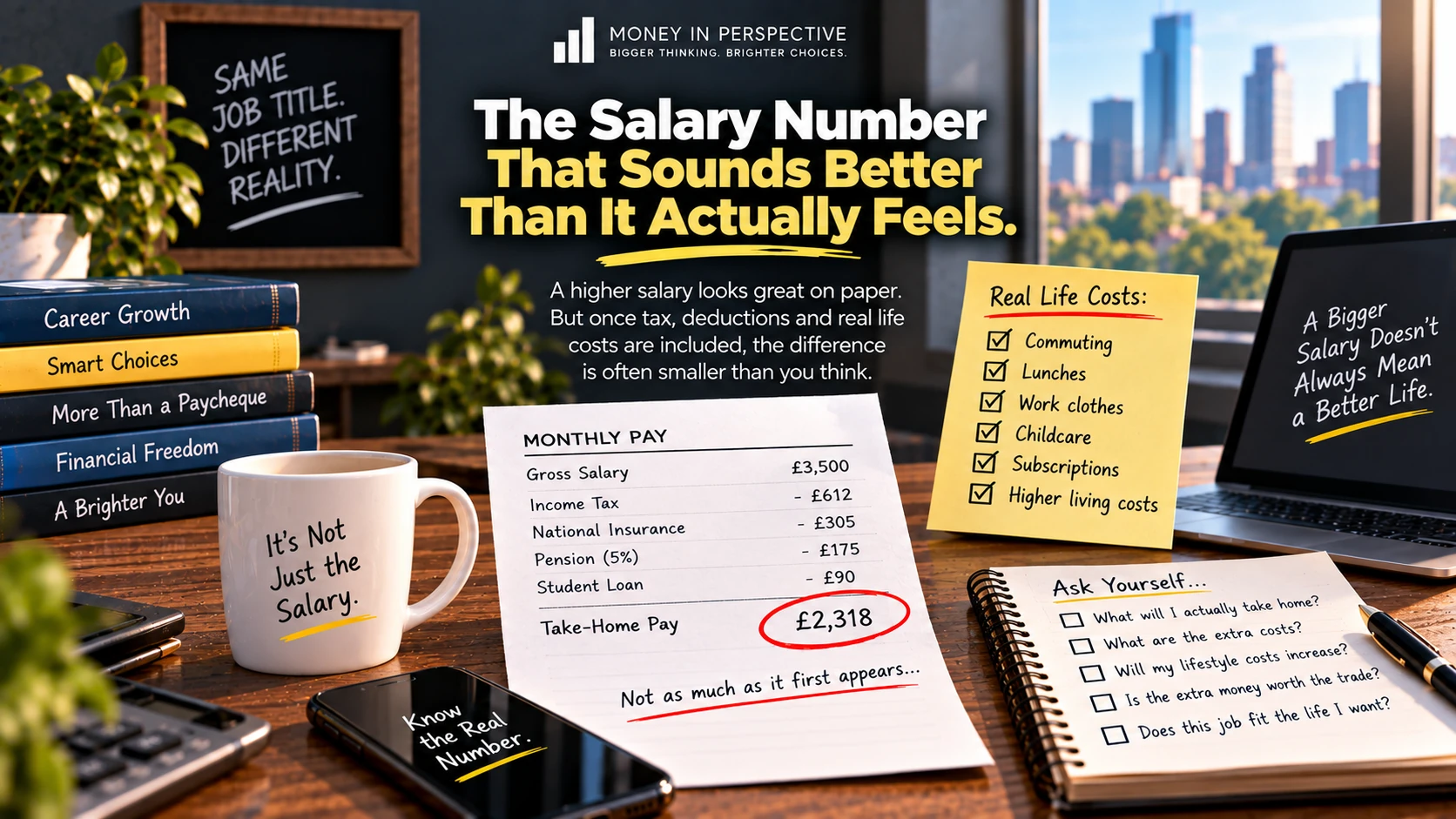
The first gap is obvious: tax and other deductions.
If a job advert says £50,000, you do not receive £50,000 to spend. Income tax and National Insurance reduce the amount, and depending on your circumstances there may also be pension contributions, student loan repayments or other deductions.
This does not make the salary misleading. Gross pay is the standard way employment is quoted. The problem appears when we emotionally respond to the gross number as though it were disposable income.
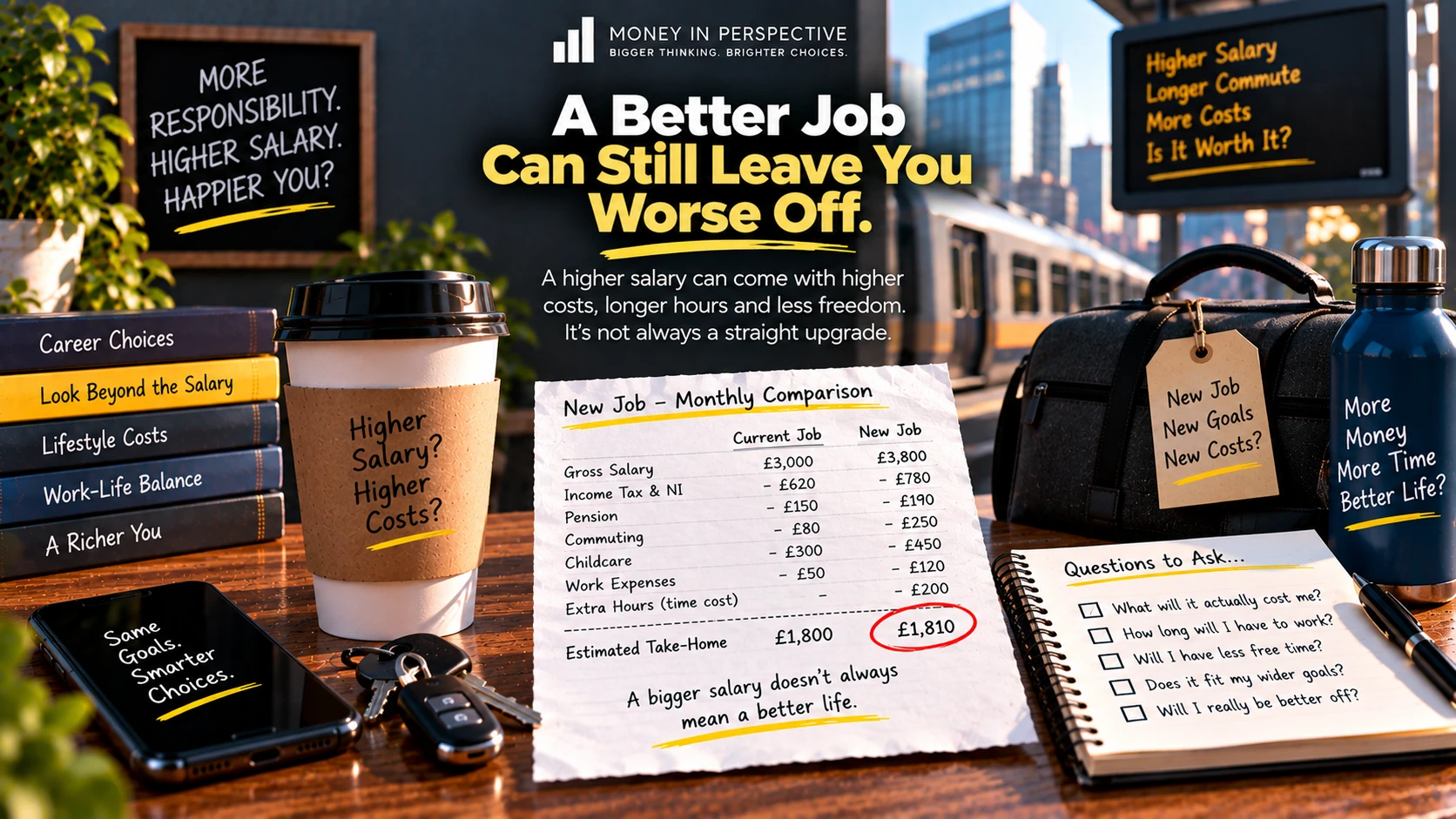
The difference becomes particularly noticeable around pay rises. Moving from £40,000 to £45,000 sounds like another £5,000. In reality, the increase in take-home pay is smaller. That can make a promotion feel underwhelming even though the payroll is correct.
The second gap is between take-home pay and fixed life costs.
Rent or mortgage.
Council tax.
Utilities.
Food.
Transport.
Childcare.
Debt.
Insurance.
Once these expenses are paid, two people with the same salary can have completely different amounts of financial freedom.
A salary does not exist in isolation from circumstances.
Someone earning £55,000 while living cheaply with low housing costs may have more disposable income than someone earning £70,000 in a high-cost area with childcare and a large commute.
This is why comparing salaries without comparing lives can be misleading.
Location is particularly important. A salary that feels generous in one part of the country may feel much tighter in another because housing and transport costs differ significantly.
A promotion requiring relocation can therefore raise income while reducing disposable cash. The annual number improved, but the environment around it became more expensive.
Work itself can consume part of salary too.
Commuting is effectively a fee paid for access to the job. Rail fares, fuel, parking and car wear can cost thousands per year. Add office lunches, work clothing and the convenience spending created by long days, and the practical value of the salary changes further.
This is why two £50,000 jobs can feel very different. One might be a fifteen-minute walk from home with flexible hours. The other may require two hours of daily travel and expensive season tickets.
The payslip is the same. The life around it is not.
Hours matter as well.
A £60,000 salary for a predictable forty-hour week is different from £60,000 for a role that routinely consumes sixty hours.
Annual salary can hide the effective price at which you are selling your time.
There is no need to treat every salaried job like an hourly contract. Senior roles often involve flexibility and responsibility that do not fit neatly into a timesheet. But if one job pays 20% more and demands 40% more time, the extra salary may be less impressive than it first appears.
Benefits can move the comparison in the other direction.
Employer pension contributions.
Annual leave.
Private healthcare.
Life assurance.
Bonuses.
Share schemes.
Professional training.
Company cars.
Flexible working.
These can add meaningful value beyond salary.
A job paying £48,000 with an excellent pension and generous leave may have stronger total compensation than a £52,000 job with minimal benefits.
The problem is that benefits are harder to boast about and harder to compare, so salary tends to dominate the conversation.
Pensions are a good example. Employer contributions do not create immediate spending money, which makes them easy to undervalue. Yet over many years, a stronger contribution can be worth a substantial amount.
Annual leave is similar. Five extra paid days off may have significant personal value even though the salary number does not change.
Then there is bonus pay.
A salary package advertised as “up to £70,000” may include a £55,000 base salary plus a bonus that is uncertain, performance-dependent or historically difficult to achieve.
When planning household finances, guaranteed income and variable income should not be treated as identical.
A bonus is useful when it arrives. It is dangerous when the mortgage relies on it arriving.
The same principle applies to overtime and commission. If a lifestyle only works when extra earnings are consistently available, the headline salary may be giving a false sense of security.
There is also a psychological milestone effect.
People attach meaning to round salary numbers.
£30,000.
£50,000.
£100,000.
Reaching the number can feel like crossing into a new financial category. But the practical improvement may be less dramatic because expenses tend to rise gradually alongside income.
This is lifestyle inflation.
A higher salary can bring a nicer car, more expensive housing, better holidays, more convenience and higher expectations. None of these choices is inherently bad. The problem is that the financial benefit of the pay rise can be consumed before it ever creates greater security.
Someone can earn significantly more than five years ago and still feel equally stretched because the lifestyle expanded at the same speed.
This is why it is useful to ask what a pay rise is actually for.
Perhaps the goal is to increase pension contributions.
Build a house deposit.
Pay down debt.
Create an emergency fund.
Reduce working hours later.
If the extra income has a purpose, the salary increase is more likely to create lasting improvement rather than simply disappear into a more expensive version of normal life.
Another useful number is disposable income rather than salary.
After tax and necessary costs, what is genuinely available for saving, investing, discretionary spending and goals?
This number is less glamorous but more useful.
A £50,000 salary that leaves £800 a month of genuine flexibility may feel richer than a £65,000 salary that leaves £300 after large fixed costs.
Net worth matters too, although it tells a different story.
Income measures what flows in.
Wealth reflects what has accumulated.
A person on a moderate salary with savings, investments and little debt may be financially stronger than someone earning much more with no reserves and large liabilities.
Again, salary is useful information. It is simply incomplete.
This is why salary comparison can create unnecessary pressure.
You hear that a friend earns £10,000 more and assume they are much further ahead. Perhaps they are.
Or perhaps they live in a more expensive city, have a larger mortgage, support family members or carry debts you know nothing about.
You can see the salary. You cannot see the entire financial system around it.
Career decisions become better when salary is treated as one component.
When considering a new role, ask:
What will the actual take-home difference be?
What new costs will the job create?
What benefits will I gain or lose?
How many hours will it require?
What does it do for my future career?
How stable is the income?
How flexible is the work?
These questions turn “£5,000 more” into a real comparison.
The same approach helps during salary negotiation.
A higher base salary is valuable, but if the employer cannot move much, other elements may still improve the package. Additional leave, remote work, pension contributions, training or flexible hours can have real value.
Not every employer will negotiate these. The point is simply that compensation has more than one dimension.
For your own finances, it can also help to translate annual salary into monthly take-home pay and then into the amount left after core expenses.
This is not because annual salary is meaningless. It is because monthly money is what life actually experiences.
Rent is monthly.
Food is weekly.
Bills arrive regularly.
Savings goals need funding.
The annual number may sound impressive while the monthly reality still feels tight.
There is also a difference between being highly paid and feeling financially secure.
Security comes partly from margin.
If your income is high but almost all of it is committed to fixed costs, losing the job becomes frightening very quickly.
If a slightly lower income leaves room for savings and fewer obligations, the household may feel much more resilient.
This is why a salary increase is most powerful when some of it remains unspent.
Keeping part of every pay rise can gradually widen the gap between income and essential costs. That gap creates options.
It can fund emergencies.
Allow career changes.
Reduce dependence on overtime.
Make parental leave easier.
Give you the ability to say no to a bad job.
That is a deeper form of wealth than simply reaching a larger salary number.
There is another reason salary can feel smaller than expected: financial commitments often rise before the pay rise arrives. People may move closer to work, replace a car, increase pension contributions or take on childcare based on the new role. By the time the first higher payslip lands, some of the improvement has already been allocated.
This is why a short delay before upgrading fixed costs can be useful. Let a few higher payslips arrive. See the actual net difference. Learn the true cost of commuting and work. Then decide how much of the increase should become permanent lifestyle.
The same principle applies to bonuses. A one-off payment is best treated cautiously when considering permanent monthly commitments. A £5,000 bonus can fund something valuable, but it does not necessarily justify adding £300 a month of ongoing costs.
It can also help to separate salary satisfaction from financial progress. A person may be proud of reaching £50,000 and still decide that the next important goal is not £60,000. Perhaps the priority becomes flexibility, additional leave or a shorter commute. There is no rule that career success must always be measured by the next salary milestone.
Conversely, someone on a modest income may reasonably decide that increasing earnings is the most important financial move available. Cutting subscriptions and coffees has limits. A stronger salary can create a much larger improvement. The point is not to dismiss salary; it is to understand what the number can and cannot tell you.
One practical habit is to review each pay rise before spending it. Compare the new net pay with the old. Decide what percentage should improve today’s lifestyle and what percentage should improve tomorrow’s security. Even keeping half of the increase can make progress visible while still allowing life to become better now.
None of this is an argument against earning more.
Higher income can transform finances. For people whose essential costs already consume most of their pay, increasing income may be far more effective than cutting small expenses.
The point is to measure the gain properly.
A salary is a headline.
Take-home pay is closer to reality.
Disposable income is closer again.
And quality of life sits beyond all of them.
If you earn £60,000 and it feels less dramatic than you expected, that does not necessarily mean you are careless with money. It may mean the gross number was never designed to describe how wealthy everyday life would feel.
Look beyond the salary.
Count what reaches you.
Count what the job costs.
Count what your life requires.
Then judge the number.
A salary sounds best when it is quoted annually.
It feels best when enough of it remains after everything else to give you choice.