A pay rise is one of the clearest symbols of career progress.
More money.
Higher salary.
A bigger number when someone asks what the role pays.
It is easy to assume that the offer with the highest salary is therefore the better job.
Often it is.
But salary is only one part of what work gives you and one part of what work takes from you.
A job can pay more while demanding substantially more time, travel, energy and flexibility. Once those costs are included, the extra salary may provide less improvement than the headline number suggests.
In some cases, more free time can be worth more than the pay rise.
This does not mean money is unimportant. Income matters enormously. A higher salary can improve housing, saving, debt repayment, retirement planning and day-to-day security.
The point is that salary should be compared with the whole job rather than in isolation.
Imagine two roles.
Job A pays £45,000 and requires a standard working week with a short commute.
Job B pays £52,000 but regularly demands longer days, more travel and occasional weekend work.
The £7,000 difference sounds significant.
But how many additional hours does Job B require?
If the new role adds ten hours of work and commuting each week, that can exceed 500 hours across a year.
The pay rise is no longer simply £7,000 for the same life.
It is £7,000 in exchange for hundreds of additional hours, before tax and before any extra costs created by the new routine.
This is where an effective hourly rate becomes useful.
You do not need a perfect calculation. Estimate the total time the job consumes, including unpaid overtime and meaningful commuting.
Then compare salary after considering taxes and work-related costs as appropriate.
A higher annual salary can produce a surprisingly small improvement per hour when the time commitment rises sharply.
Commutes deserve particular attention because they are easy to exclude from job comparisons.
A forty-five-minute journey each way adds seven and a half hours to a five-day working week.
That is almost another working day spent travelling.
Across a year, the time becomes substantial.
Then add the financial cost of the commute: fuel, train fares, parking, vehicle wear or taxis.
A job paying £4,000 more may not improve your finances much if commuting absorbs a large part of the difference.
Remote and hybrid work changed how many people think about this. A lower-paying job that allows several days at home may reduce transport, food and clothing costs while returning hours of time.
That time has value even if it never appears on a payslip.
Free time can be used for sleep, exercise, children, relationships, hobbies, side projects or simply doing nothing.
The phrase “doing nothing” can sound financially unproductive, but rest has value. A life does not become better merely because every hour produces money.
There is also the question of energy.
Two jobs can require the same official hours while having completely different effects after work.
A role with constant pressure, long travel or unpredictable demands can consume the evening even after the laptop closes.
You may technically have free time but lack the energy to use it.
That can create additional spending.
Takeaways because cooking feels impossible.
Taxis because you are late.
Convenience purchases because everything needs to be faster.
Weekend spending because leisure time feels scarce and must be maximised.
A more demanding job can therefore increase both income and the cost of maintaining the lifestyle required to do it.
Again, this does not mean the higher-paying role is a bad decision. It means the salary difference should be compared with the lifestyle difference.
Career growth can justify periods of intense work too.
A demanding role may build skills, reputation or experience that creates better options later. A temporary sacrifice in free time can have a strong long-term return.
The important word is temporary.
If the plan is to work intensely for two years to reach a specific goal, that is different from drifting into a permanently demanding lifestyle because every next promotion requires another piece of your time.
It helps to know what the extra money is for.
Suppose a pay rise gives you an additional £300 a month after deductions and extra commuting costs.
What will that £300 do?
Pay off debt faster?
Build a house deposit?
Support children?
Increase retirement savings?
Fund travel?
If the money has a valuable purpose, the trade can be very attractive.
If the extra £300 mostly compensates for the inconvenience of the job through takeaways, transport and stress spending, the benefit may be smaller.
This is why lifestyle inflation can make pay rises feel disappointing.
A new role pays more, so spending expands.
Nicer car because the commute is longer.
More convenience because time is shorter.
More expensive social spending because income is higher.
The salary rises but the sense of financial progress barely changes.
Sometimes protecting free time can improve finances indirectly because it makes lower-cost behaviours easier.
Time to cook.
Time to exercise without expensive convenience solutions.
Time to manage household tasks.
Time to compare purchases.
Time to care for children or relatives.
These are not always possible or desirable substitutes, but they show why time and money interact.
Benefits should also be included in the comparison.
Pension contributions.
Annual leave.
Bonus structure.
Private healthcare.
Parental leave.
Flexible working.
Training.
Company car.
Share schemes.
A role paying less in cash can have stronger total compensation.
Conversely, an impressive salary can look less attractive if benefits are weak.
Annual leave is particularly important because it is literally paid time.
An extra five days of holiday can be valuable even though it does not increase salary. For someone who values travel, family time or recovery, those days may matter more than a modest pay increase.
Flexibility can be even harder to price.
Being able to start later for childcare.
Working from home when needed.
Taking an appointment without using half a day of annual leave.
Choosing when to concentrate work.
These benefits do not appear neatly in a salary comparison, but they can improve daily life substantially.
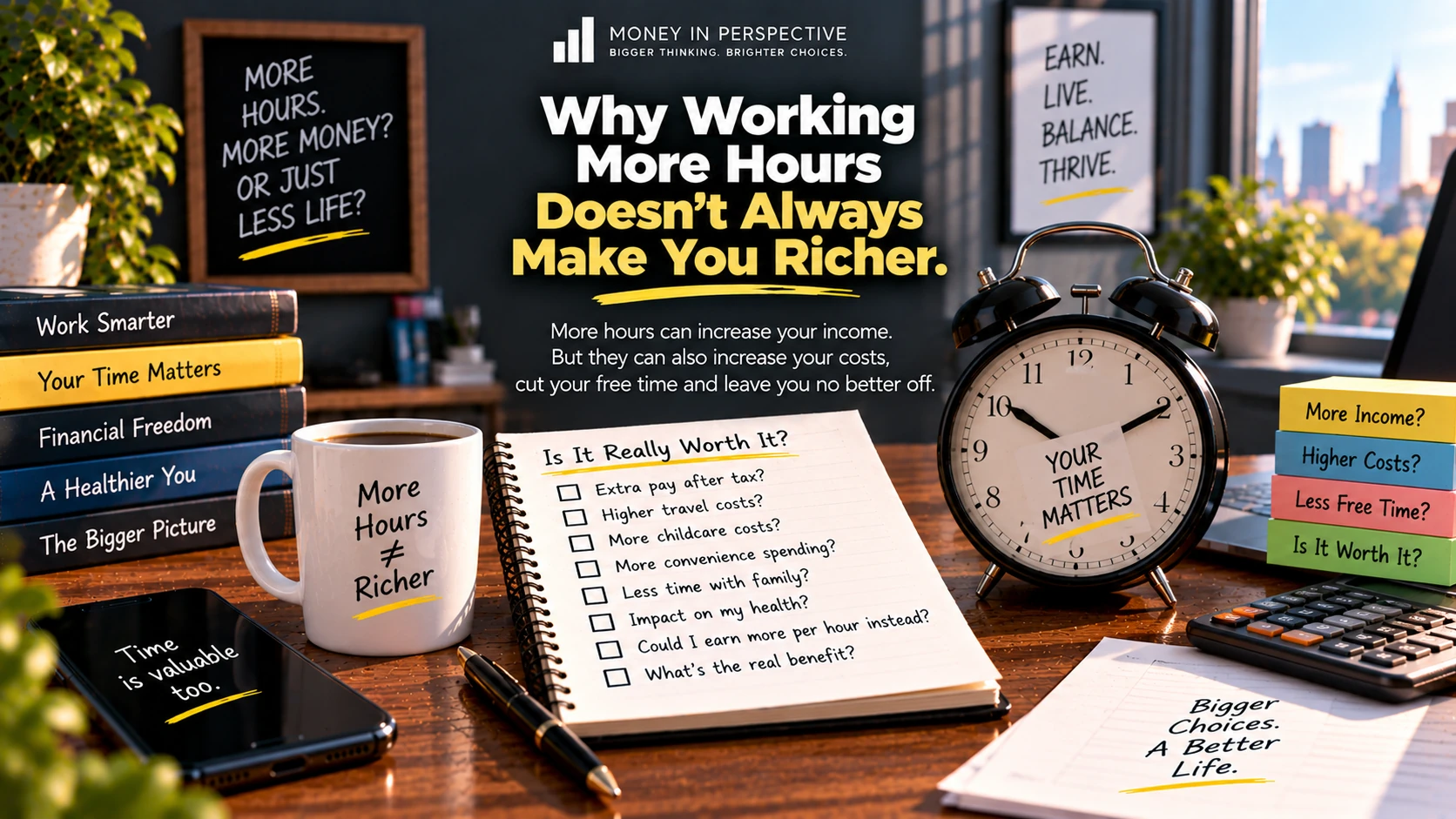
One way to assess an offer is to create two columns.
Money:
salary,
bonus,
pension,
benefits,
commuting cost,
other work-related costs.
Time and lifestyle:
contracted hours,
realistic hours,
commute,
remote days,
annual leave,
schedule control,
weekend expectations,
travel,
stress level based on what you can reasonably learn.
Then ask what is changing in both columns.
This prevents salary from dominating simply because it has the clearest number.
There is also a useful question to ask before accepting more responsibility:
What am I giving up for this pay rise?
Perhaps the answer is very little. Excellent.
Perhaps the role offers more money and better flexibility. Even better.
But perhaps the answer is evenings, weekends and the ability to mentally leave work.
That may still be worth it.
The decision simply deserves to be conscious.
People at different financial stages will value the trade differently.
Someone struggling to cover essential costs may rationally prioritise additional income because each extra pound has enormous value.
Someone already financially comfortable may value an extra day off more than another few thousand pounds.
Neither preference is more correct.
The value of money changes depending on what the next pound can improve.
The value of time changes too.
A parent with young children may value flexibility intensely.
Someone building a business on the side may value evenings.
A person early in a career may willingly trade time for accelerated learning.
A person approaching retirement may want the opposite.
This is why there is no universal salary at which free time becomes more important.
It is a personal calculation.
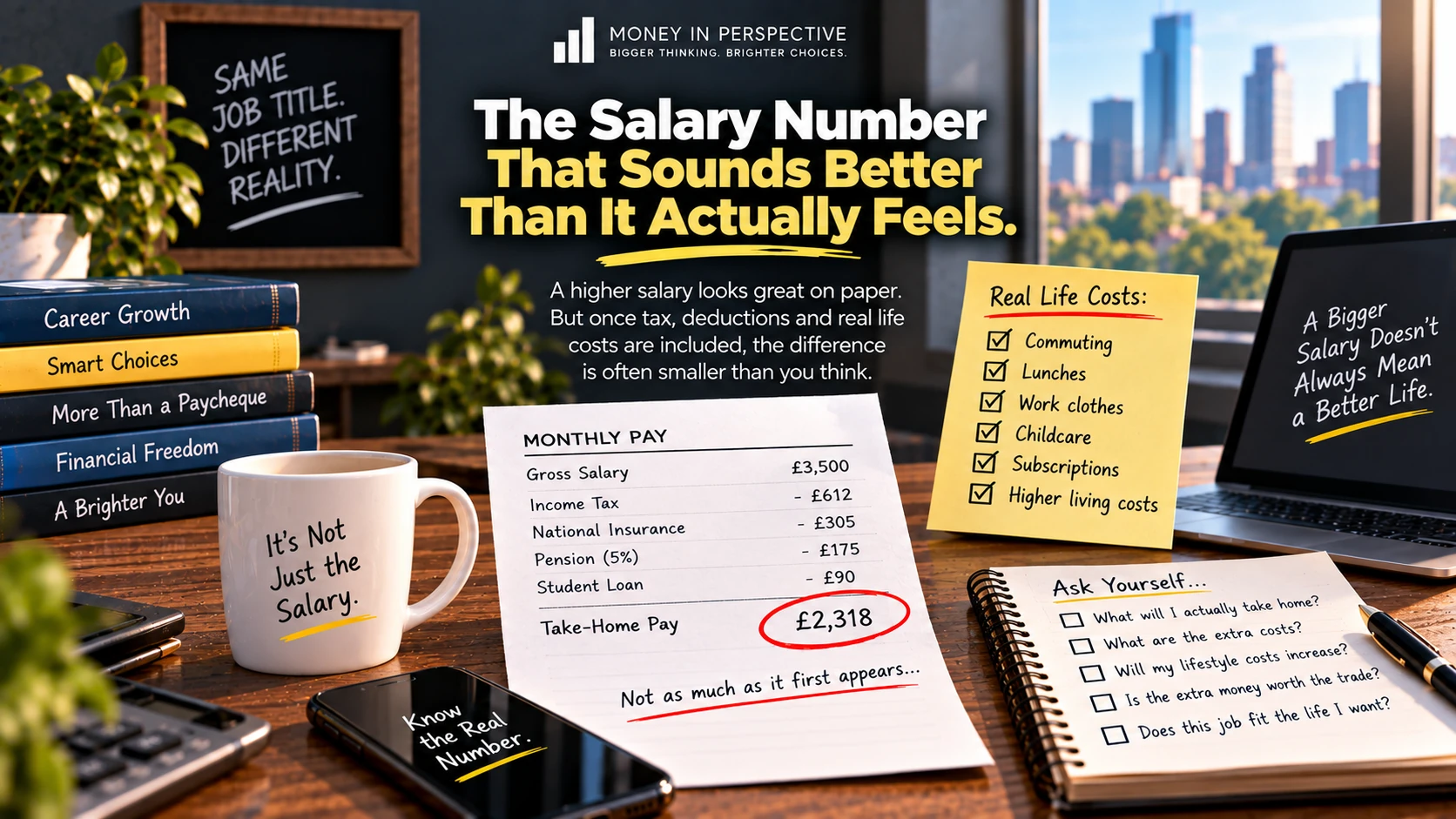
The tax system can also affect the marginal value of additional salary, depending on income and circumstances. The exact effect varies and may involve tax, National Insurance, student loan repayments or benefit interactions. The practical point is that the gross pay rise is not the same as the additional amount reaching your bank account.
For an important decision, compare expected take-home pay rather than only headline salary.
Then subtract the extra costs the role creates.
If the £8,000 pay rise becomes £4,500 of additional take-home pay and the commute costs £2,000 more, the practical improvement is very different from the number in the job advert.
There is another possibility that people sometimes overlook: asking for flexibility instead of all of the available cash.
Depending on the employer and role, a compressed week, additional leave, hybrid arrangement or reduced hours might create more value than a modest salary increase.
Not every employer will agree. Not every role permits it.
But compensation does not always have to be negotiated only in pounds.
The same principle applies after you have already reached a comfortable income.
You do not need to accept every opportunity to earn more if the cost is a life you like less.
Ambition is not measured only by salary.
You can be ambitious about your health, relationships, hobbies, family or independence.
Money supports those things. It does not automatically outrank them.
There is also a danger in assuming free time must be productive to be valuable.
If you choose a lower-paying job and then use the extra evening to watch television, the time has not been wasted.
Rest is one of the things time is for.
The financial world is very comfortable assigning a value to every working hour and strangely uncomfortable assigning value to an hour that belongs entirely to you.
Yet most people work partly because they want resources to enjoy the rest of life.
That makes free time part of the return on working, not an obstacle to it.
A pay rise is worth celebrating when it genuinely improves your position.
Just measure the improvement properly.
Look at the extra take-home pay.
Look at the extra costs.
Look at the extra hours.
Look at the commute.
Look at the flexibility.
Look at what the new role does to the rest of the week.
Then decide which package creates more value for you.
Sometimes the answer will obviously be the higher salary.
Sometimes a role paying less but giving you back ten hours a week will be the richer offer in everything except the number printed on the contract.
And sometimes the best career decision is not the one that pays the most.
It is the one that leaves enough of your life available to enjoy what the money is for.
One final way to frame the decision is to price the time itself.
If one role gives you five extra free hours each week, that is roughly 250 hours across a working year. What would you need to be paid to willingly sell those hours back?
There is no correct rate. The question simply reverses the usual comparison. Instead of asking how much salary you would give up for more time, ask how much money would make the lost time worthwhile.
For some people, the answer will be modest because the extra income is urgently useful. For others, the number will be surprisingly high.
That is valuable information. It shows that free time is not merely what remains after work. It is an asset with its own value, even if no employer writes that value on a payslip.
This perspective can also prevent salary from becoming the only scoreboard for career success. A person earning less but controlling their schedule, sleeping properly and having time for people they care about may not have made an inferior career choice. They may simply be optimising for a different return.
Work consumes a large part of adult life. Comparing jobs only by salary is like comparing holidays only by flight price: the number matters, but it does not describe the whole experience.
The strongest decision is the one that considers both currencies.
Money pays for life.
Time is the part of life you are spending to earn it.