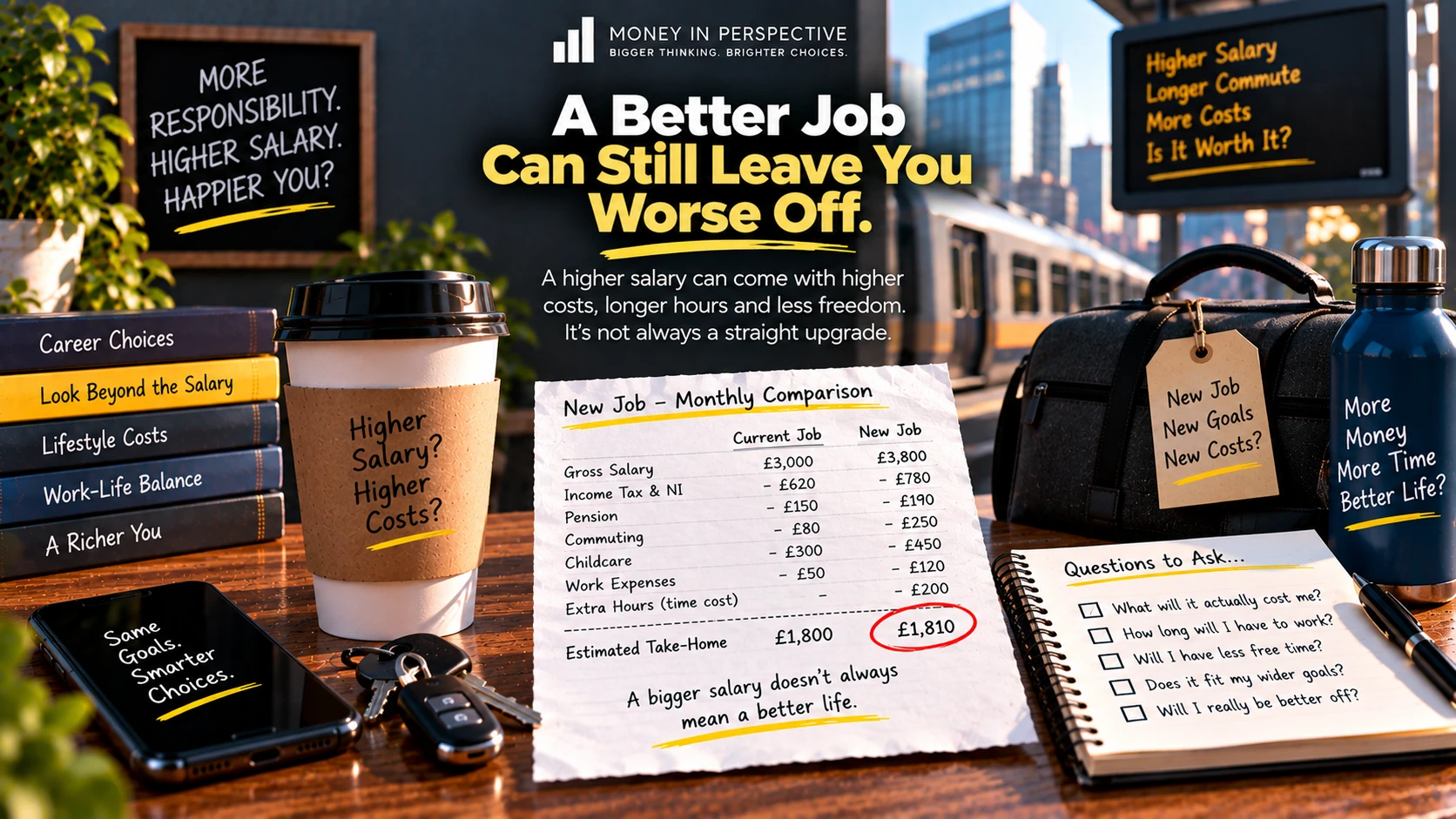
Working more hours seems like one of the most straightforward ways to earn more money.
If ten extra hours produce ten extra hours of pay, the logic appears simple. More work equals more income.
Sometimes that is exactly right. Overtime can be a powerful way to clear debt, build savings, fund a major purchase or increase income without changing jobs.
But the relationship between hours and wealth is not always as clean as it looks.
Extra hours can create extra costs. They can reduce the value of each hour of free time. They can affect health, family life and the ability to do lower-cost things for yourself. In some jobs, additional hours are not even paid separately.
This means working more can increase income without making you proportionately richer.
The first thing to examine is the actual net pay from overtime.
An extra £200 of gross pay is not always £200 of additional spending money. Tax, National Insurance, pension contributions and, depending on circumstances, student loan repayments can reduce the amount that reaches your bank account.
This does not mean “overtime is not worth it because of tax”. That common statement is usually too simplistic. Earning more normally still leaves you with more net income.
The useful question is how much more.
If five extra hours create £70 of additional take-home pay, compare the decision using £70 rather than the gross figure.
Then look at costs created by working those hours.
Childcare is one of the clearest examples. A parent accepting an extra shift may need to pay for additional care. If the overtime produces £90 after deductions and childcare costs £45, the practical financial gain is closer to £45 before considering transport or food.
Transport can matter too. An additional shift may mean another commute, parking charge or taxi if public transport is unavailable at unusual hours.
Food is another hidden cost. Long shifts make bought meals, coffee and takeaways more appealing. These purchases are not moral failures. They may be entirely sensible responses to having less time and energy.
But they reduce the net financial return from the extra work.
Suppose an overtime shift adds £100 to take-home pay. The extra commute costs £12, food costs £15 and childcare costs £25. The household is roughly £48 better off.
That may still be worthwhile. It is simply a different decision from “I earned an extra £100”.
Time has value as well, although it is harder to price.
If you work an additional eight hours on Saturday, those eight hours are no longer available for rest, family, errands, exercise or hobbies.
For someone who needs the income, the trade may be easy.
For someone already comfortable, the question becomes whether the marginal money is worth giving up scarce free time.
This is why the value of overtime changes with financial circumstances.
The first extra shift used to pay an urgent bill may be extremely valuable.
The fifth extra shift used to increase already comfortable discretionary spending may feel less worthwhile.
Economists would describe part of this as diminishing marginal utility: an additional pound can matter less when your basic needs and important goals are already covered.
You do not need the terminology to recognise the feeling.
There is also a point where working more can reduce performance.
Fatigue leads to mistakes.
Concentration falls.
Recovery takes longer.
If the extra hours damage your main job performance, they may carry a career cost that is much larger than the overtime payment.
This is particularly important where overtime becomes chronic rather than occasional.
A temporary period of extra work to reach a defined goal is different from living permanently at maximum capacity.
One has an end point.
The other can become a lifestyle.
Burnout is not merely a wellbeing issue. It can have financial consequences.
Extended sickness absence, reduced productivity, career changes made under pressure and spending designed to compensate for exhaustion can all affect money.
The goal is not to calculate a cash price for every emotion. It is to recognise that human capacity is limited.
Self-employed people face another version of the problem.
Working more hours does not necessarily mean billing more hours.
Administration, marketing, chasing payment, bookkeeping and customer support may expand alongside paid work. An owner can work sixty hours while only a portion directly generates revenue.
This is why business owners should distinguish hours worked from productive or billable hours.
The same principle appears in salaried jobs where longer hours are unpaid.
If a £50,000 role regularly requires fifty-five hours each week while a £45,000 role genuinely requires forty, the higher salary may come with a lower effective hourly rate.
That does not automatically make the lower-paying job better. The senior role may offer stronger progression or more interesting work.
But “earning more” should include the time required to earn it.
There is also an opportunity cost to overtime.
What else could you do with those hours?
Study for a qualification.
Build a side business.
Apply for higher-paying jobs.
Exercise.
Rest.
Spend time with family.
Some alternatives have financial value. Others have personal value.
If overtime pays £15 per hour but studying could help you move into a role paying £10,000 more each year, repeatedly choosing the immediate money can delay the larger gain.
This is not always the case. Future opportunities are uncertain; overtime pay is real now.
The point is simply that an hour can have more than one use.
There are situations where working more is extremely effective.
If overtime is paid at a premium rate, no new childcare or travel costs are created and the work is manageable, the financial return can be excellent.
If you have a short-term goal such as clearing high-interest debt, building an emergency fund or saving for a deposit, a concentrated period of additional work can accelerate progress dramatically.
Defined goals make overtime easier to evaluate because the money has a destination.
For example:
“I will work two extra shifts each month until the £3,000 credit card balance is gone.”
That has a clear purpose and end point.
It is very different from automatically saying yes to every shift because more money must always be better.
The latter can cause income to expand and lifestyle spending to follow it. Soon the household depends on overtime to maintain normal expenses.
This creates a dangerous form of lifestyle inflation.
If basic bills require overtime every month, the “extra” income is no longer extra. Losing access to those shifts becomes a financial emergency.
Where possible, build core household costs around regular guaranteed income and use overtime for goals, savings or genuinely discretionary spending.
That creates more resilience.
It can also make overtime feel more rewarding because the money visibly improves your position instead of disappearing into routine bills.
Another useful calculation is the net hourly gain.
Take the additional take-home pay from a shift.
Subtract additional childcare, travel, food or other unavoidable costs.
Divide what remains by the extra hours including additional commuting if appropriate.
The result is not meant to decide your life automatically. It gives you a clearer price for the time you are selling.
Imagine a six-hour overtime shift creates £85 of additional take-home pay. Travel and food cost £15. The net gain is £70, or around £11.67 per extra hour before considering commuting time.
Would you still take the shift?
Maybe yes.
Maybe no.
At least the decision is based on the right number.
You should also consider whether extra work changes benefits or entitlements in your specific circumstances. Taxes and benefits can be complex, and individual situations differ. Where the amounts matter, checking the actual effect is better than relying on assumptions.
The phrase “I’ll lose it all in tax” is often wrong.
So is assuming every pound of gross overtime will reach your bank account.
There is a social side too.
People can become known as the person who always says yes.
That may help professionally in some workplaces, but it can also create an expectation that availability is unlimited.
Once overtime becomes normal, declining it can feel more difficult.
Setting boundaries early can protect both time and the value of extra work.
This is particularly important when overtime is unpaid.
If a salaried employee regularly donates ten extra hours each week, the employer receives substantially more labour without paying more salary.
Occasional extra effort may be part of many professional roles. Permanent unpaid expansion deserves closer examination.
Could workload be changed?
Could responsibilities be prioritised?
Is the role still fairly compensated?
Would another employer pay more for the same commitment?
These are career questions as much as budgeting questions.
More hours can also increase spending through what might be called compensation behaviour.
After a difficult week, you feel you deserve the meal out, shopping trip or expensive weekend.
There is nothing wrong with rewarding yourself.
But if extra work creates extra spending that absorbs much of the extra income, the financial outcome may disappoint.
Again, the solution is not removing all enjoyment. It is deciding in advance what the overtime money should accomplish.
Perhaps 70% goes to the goal and 30% is available to enjoy.
Now the sacrifice produces visible progress without making life joyless.
Rest itself has economic value because it protects your ability to continue earning.
Sleep, exercise and relationships are not inefficiencies sitting in the way of productive hours.
They are part of a sustainable life.
The person who can work sixty hours this month but cannot tolerate the pace for the next year may ultimately earn less than the person who can work forty-five consistently without burning out.
Long-term earning power matters more than winning one week.
There is also a difference between voluntary overtime and hidden overtime. Voluntary overtime has a visible exchange: extra hours for extra pay. Hidden overtime appears when responsibilities increase but salary does not, lunch breaks disappear, messages continue in the evening and weekends become catch-up time.
Because there is no separate payment, people can become accustomed to giving away hours without noticing how much the effective value of the job has changed.
Keeping a rough record for a few weeks can be revealing. If a role contracted for forty hours consistently consumes fifty-five, that is not a minor variation. It is a different working arrangement. The right response depends on the workplace, seniority and career goals, but the information should at least be visible.
Another useful distinction is between working more and earning more efficiently. Increasing your hourly value through skills, qualifications, negotiation or changing roles can sometimes improve income without continuously expanding hours. That path may take longer, but it can be more sustainable.
This is particularly important for people who already have very little spare capacity. When the week is full, adding hours may produce immediate cash while leaving no time to improve the underlying earning rate.
That creates a trap: you are too busy earning extra money to do the things that could eventually make the extra work unnecessary.
The answer is not automatically to refuse overtime. It may be the fastest route to an important goal. Instead, make the trade explicit. If you are working extra for six months, decide what happens at month seven. If the debt is cleared or savings target reached, will the hours reduce, or will the higher workload simply become normal?
Without an exit point, temporary sacrifice has a habit of becoming permanent routine.
The smartest question is therefore not “Can I work more?”
Most people can, at least temporarily.
Ask:
What will the extra hours produce after costs?
What am I giving up?
How long will I do this?
What goal does the money serve?
Is this helping my long-term position or merely filling every available hour?
Money is renewable in a way time is not. You can earn another pound next month. You cannot re-earn last Saturday.
That does not make time more important than money in every situation. It means both deserve a price.
More work can absolutely make you richer.
But only when the additional money improves your financial position more than the additional work reduces everything else.
Hours are a resource too.
Spend them as deliberately as the money they earn.