The office has a very clear price when you look at your payslip: none. Your employer does not normally deduct a line called “cost of turning up”. Yet going to work can create a surprisingly large personal expense once you add together travel, food, clothing, childcare, time and the small convenience costs that appear because the working day is structured around being somewhere else.
That does not mean office work is a bad deal. Many people prefer it. Some jobs require it. Offices can provide collaboration, separation between work and home, better equipment and valuable social contact. The financial point is simply that salary is not the only number attached to the arrangement.
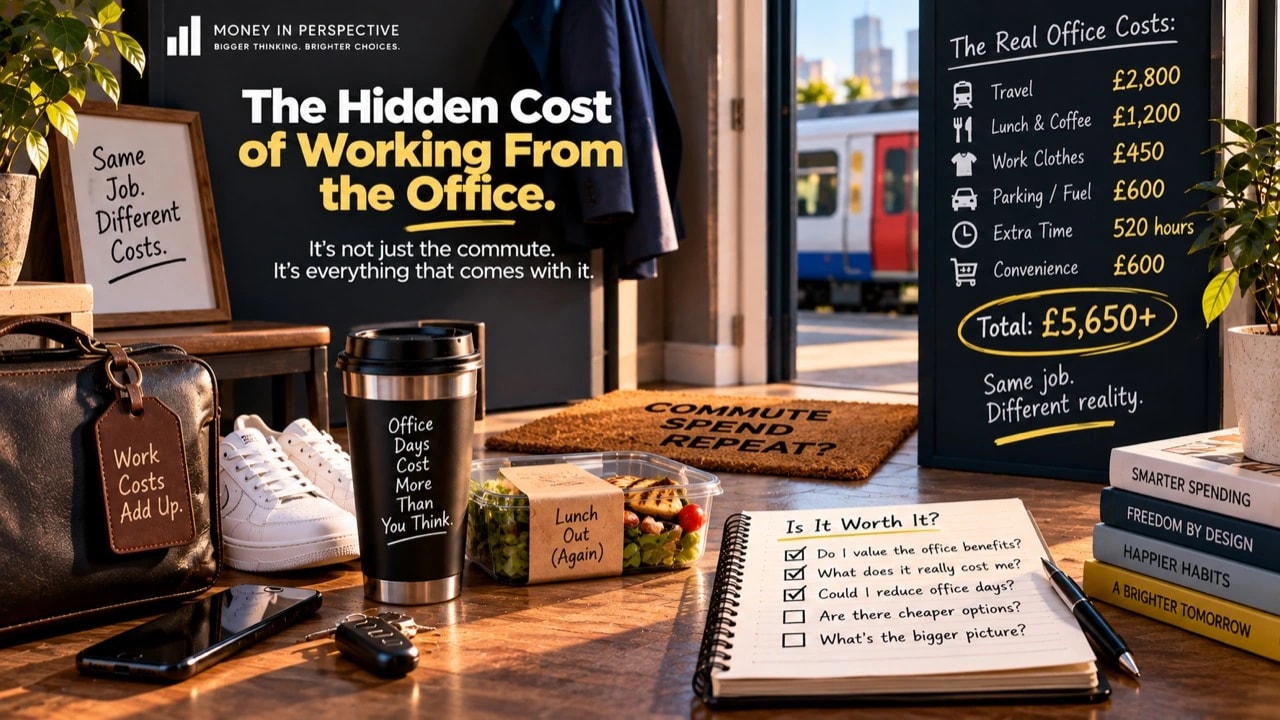
The first cost is usually the commute. A train season ticket, fuel, parking, bus fare or a combination of several can absorb a meaningful part of take-home pay. A person spending £8 a day travelling to work five days a week is spending roughly £160 in a typical working month before holidays. At £15 a day, the number moves closer to £300. Add parking or occasional taxis and the total rises again.
Cars make the calculation less obvious because fuel is only part of the cost. More commuting means more mileage, which can mean more servicing, tyres, repairs and depreciation. None of those arrives as a neat daily charge, so it is easy to treat the commute as “just petrol”. Over a year, the wear created by thousands of additional miles can matter far more than one tank of fuel.
Public transport has its own hidden layer: timing. A cheap train may require leaving much earlier, while a more expensive route saves time. Season tickets may be good value for five office days but poor value for hybrid workers. The right comparison is not simply the cheapest ticket; it is the cost of the pattern you actually use.
Food is another major office expense because the working day creates repeat opportunities to buy it. Breakfast on the way in. Coffee with colleagues. Lunch. A snack in the afternoon. None of these amounts feels particularly dramatic. Across twenty office days, however, a £7 lunch alone is £140. Add two coffees each week and the monthly figure moves again.
This does not mean bringing food from home is always the correct answer. Lunch can be social, useful and enjoyable. The point is to separate the cost of eating from the cost of eating because you are at work. If you would spend £3 on lunch at home and £9 near the office, the office premium is roughly £6. That is the useful number when comparing working patterns.
Clothing can also sit partly inside the cost of employment. Some workplaces are casual enough that nothing changes. Others require shoes, shirts, suits, makeup, haircuts or other presentation costs that would be lower if the person worked mostly from home. Again, much of this spending has value outside work too, so it would be wrong to allocate every pound to the job. But where a role clearly requires a more expensive standard of dress, it belongs somewhere in the calculation.
Childcare can completely change the economics. A longer commute can mean earlier drop-offs and later collections. Some parents need paid wraparound care only because they must physically travel to the workplace. Hybrid work may reduce those hours. A pay rise tied to more office attendance can therefore create a childcare bill that absorbs part of the increase before it reaches the household.
The same is true of care responsibilities more broadly. Looking after relatives, school runs, medical appointments and household logistics all become harder when location and commuting time are fixed. The cost may appear as paid help, taxis or lost flexibility rather than a single direct debit labelled “office”.
Then there is the cost people rarely include because it is not paid in money: time. A one-hour commute each way adds ten hours to a five-day working week. Over forty-six working weeks, that is roughly 460 hours. That is more than nineteen full days spent travelling.
Time does not convert neatly into pounds. Some people read, work or relax on the train and do not view the journey as wasted. Others find commuting exhausting. The important point is that two jobs with identical contracted hours can consume very different amounts of life.
Longer office days can also create secondary spending. If you arrive home late, takeaway becomes more attractive. If mornings are rushed, buying breakfast becomes easier. If you have less time for errands, you may pay for delivery. If the commute is exhausting, the weekend can become the only time available for everything else, increasing the value of convenience services.
These costs are not necessarily caused by a lack of discipline. They are often rational responses to limited time. That is why a cheaper working arrangement can improve finances even without a salary increase: it may remove the conditions that create expensive convenience.
There are also social costs attached to office culture. Team lunches, leaving collections, birthday contributions, after-work drinks and charity events can all be positive parts of working life. They can also create small but repeated expenses that home workers experience less often. Nobody wants to become the colleague who calculates the annualised cost of every birthday card, but the broader pattern is real.
Remote work is not free either. Working from home can increase heating, electricity, broadband usage and equipment costs. Some people need a desk, chair or extra room. Others spend more because they value a larger home with office space. A fair comparison therefore should not pretend that staying home costs nothing.
The point is to compare the incremental costs on both sides.
Suppose office attendance costs £180 a month in travel, £100 more in food, £30 in parking and £40 in miscellaneous spending. That is £350 a month, or £4,200 across a year. Perhaps home working adds £600 a year in utilities and equipment. The difference is still substantial.
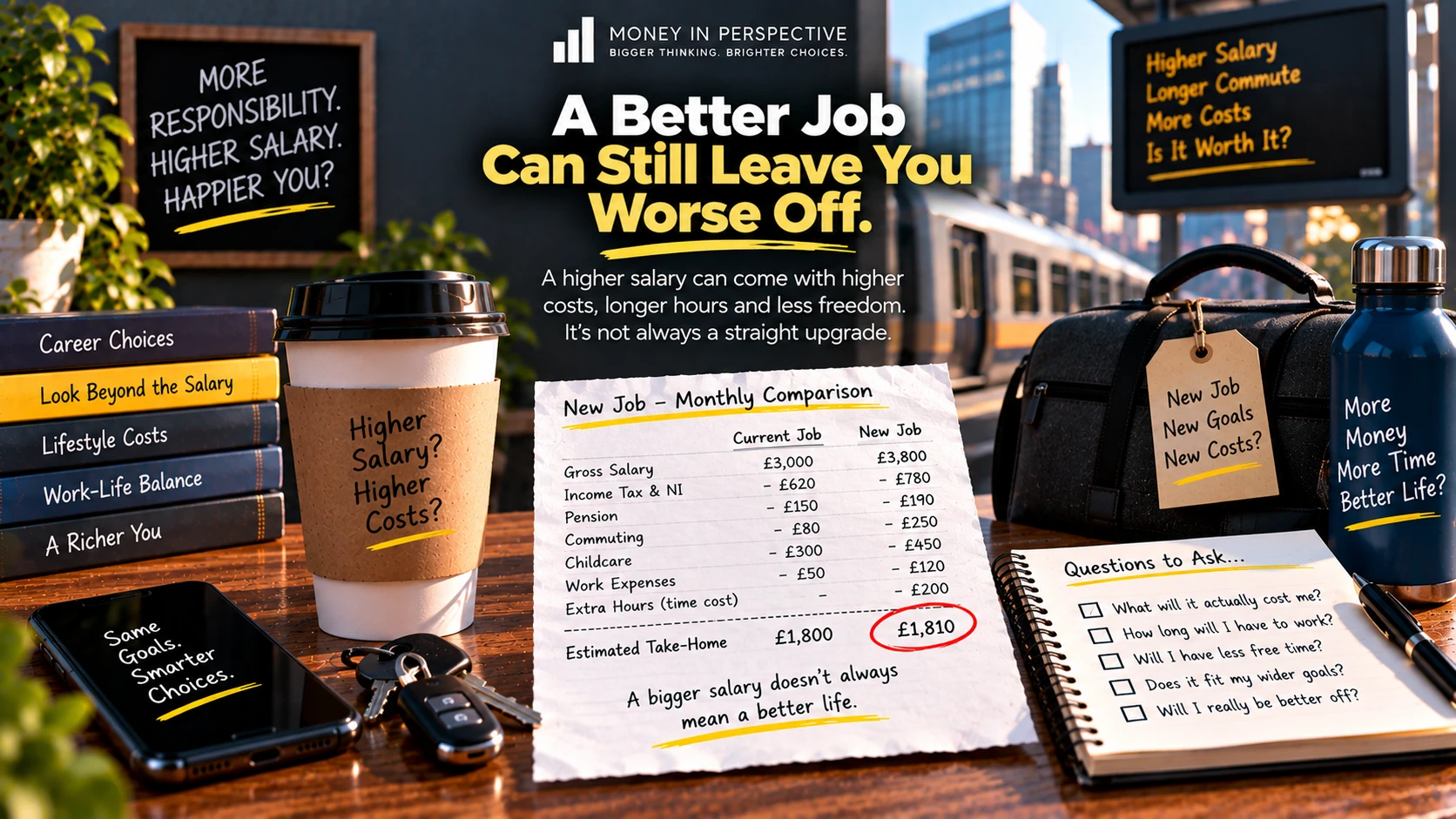
Now imagine a new role offers £5,000 more gross salary but requires five office days instead of two. Once tax and additional commuting costs are considered, the financial improvement may be much smaller than the headline pay rise. The job may still be worth taking because of career progression, enjoyment or long-term opportunity. At least the comparison is now honest.
A useful method is to calculate a personal “cost of going to work”. For one month, record expenses that exist mainly because you travel to the workplace. Do not include your entire food budget or every item of clothing. Include the difference between what you spend on office days and what you would reasonably spend otherwise.
Travel is usually obvious. Then look at food, parking, childcare, convenience, work-specific clothing and other repeat costs. Add them together. The number does not need to be perfect. Its job is to make the invisible visible.
Next, calculate the time. How many hours do you spend commuting each week? Are there regular delays? Do you need to leave early enough that the day begins before your contracted hours? Again, do not force the time into a monetary value unless that helps you. Simply put it beside the financial number.
This information is useful when negotiating too. A request for more office attendance is not just a cultural change. For some employees, it is a reduction in effective compensation because they now spend more money and time to perform the same job. Employers may have good reasons for requiring attendance, but employees are equally reasonable to consider the personal cost.
It is also useful when deciding where to live. A cheaper house further from work can become expensive once several years of travel are included. A more expensive home near a station or workplace may reduce transport costs and return hours every week. Housing and commuting should sometimes be evaluated together rather than as separate decisions.
The same principle applies to choosing between driving and public transport. The cheapest cash option is not always the cheapest overall once time, reliability, parking and car wear are included. Sometimes paying more for a faster journey is good value. Sometimes accepting a longer journey saves enough money to be worth it.
There is no universal ideal. Some people would happily commute an hour for a role they love. Others would accept less salary to walk to work. What matters is recognising that location is part of the compensation package.
Office work can provide benefits that are difficult to value too. Mentoring may happen more naturally. New employees can learn faster. Friendships form. Certain conversations are easier face to face. Being physically visible may matter in some workplaces, fairly or unfairly. These benefits can justify the cost for many people.
That is why the goal is not to prove the office is expensive and home working is better. It is to understand the trade.
If the office costs you £3,000 a year and eight hours a week, ask what you receive in return. Better career prospects? Stronger relationships? More enjoyable work? Clearer boundaries? Access to opportunities? If the answer is yes, the cost may be worthwhile.
If the arrangement mainly creates spending, stress and lost time without delivering much value, that is useful information too.
There is another office cost that becomes clearer only over a full year: the way attendance changes what you need to own. A person travelling five days a week may need a more reliable car, a season ticket, additional work shoes, bags, coats or duplicated chargers and equipment. None of these purchases is automatically wasteful. They simply form part of the infrastructure required to maintain the working pattern.
This matters when comparing hybrid roles because reducing office days can sometimes allow a household to remove an entire cost rather than merely reduce it. A couple may discover they can manage with one car instead of two. A parent may no longer need paid care every afternoon. Someone may be able to move further from an expensive city because the commute happens only twice a week. These are much larger changes than saving a few pounds on lunch.
The reverse can also be true. Working from home full time may require a larger property, better broadband or heating a room all day. Again, the correct answer depends on the household.
That is why annual rather than daily thinking helps. A £12 commuting day sounds small. Across 220 working days, it is £2,640. A £6 lunch premium becomes more than £1,300 at the same frequency. Once annualised, choices that looked trivial become large enough to compare with salary, pension contributions or annual leave.
You do not need to optimise every office day. Bringing lunch, cycling or refusing social events simply to reduce a spreadsheet total can make work less enjoyable. The purpose of measuring the cost is not to remove every pound. It is to decide which parts of office life are valuable enough to keep paying for.
If coffee with colleagues is one of the best parts of the week, keep it. If parking costs £150 a month when a reliable bus would cost £45, perhaps that is worth reviewing. Good money management is selective.
The hidden cost of office work becomes useful only when it helps you make better decisions, not when it turns every working day into an exercise in guilt.
The hidden cost of working from the office is not hidden because anyone is trying to conceal it. It is hidden because it arrives in dozens of ordinary transactions and hours that belong to other categories.
A rail ticket looks like transport. Lunch looks like food. After-school care looks like childcare. The commute looks like time.
Together, they are part of what the job costs you.
Salary tells you what work pays.
A better career decision also asks what work takes back.