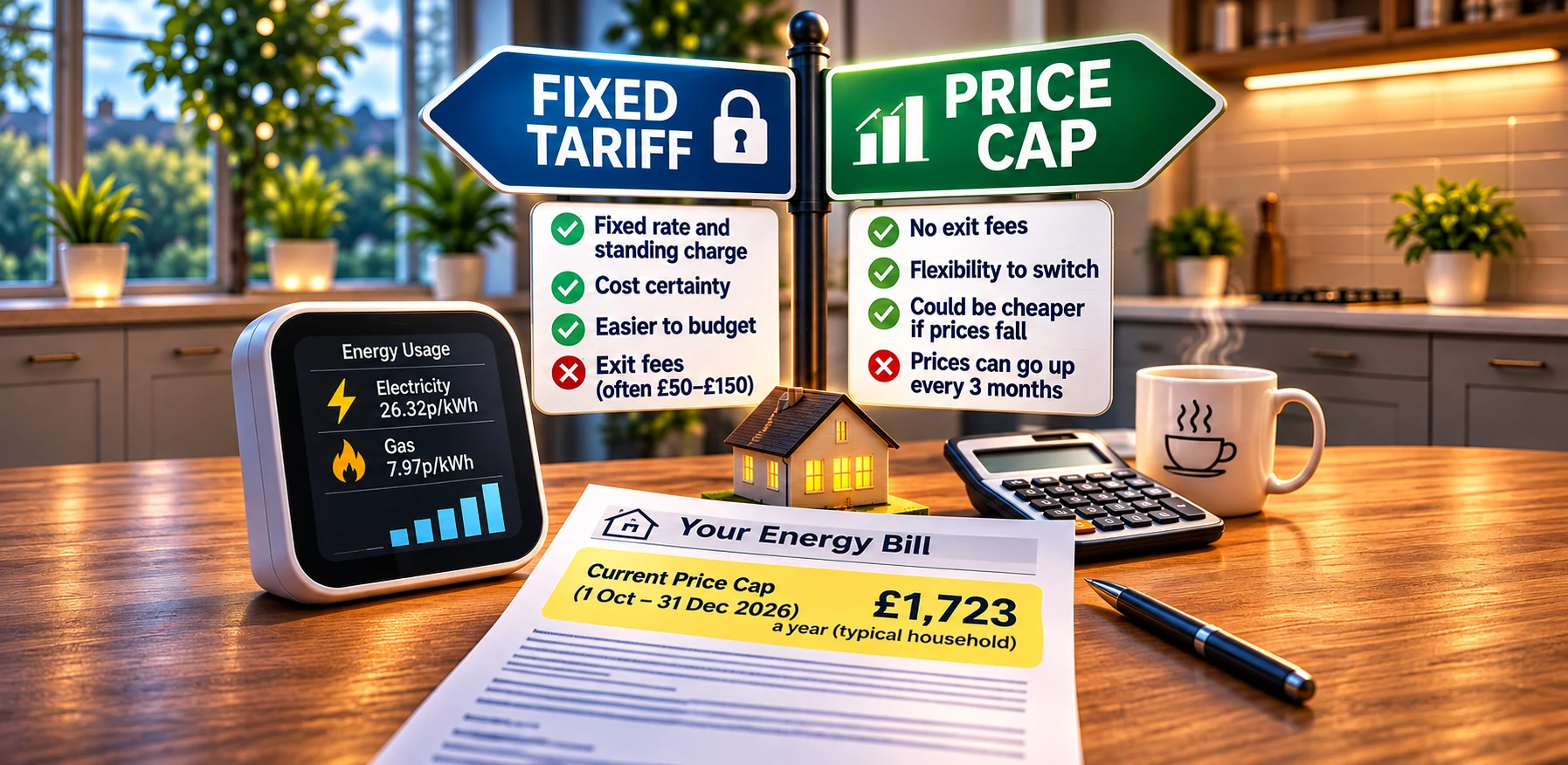
An energy tariff can look like a simple choice between certainty and risk. Fix your prices and you know what you are paying. Stay on the Price Cap and you keep the freedom to benefit if prices fall.
That sounds straightforward until you remember that the Price Cap changes every three months, fixed tariffs can come with exit fees, standing charges vary by region, and the headline £1,723 Price Cap is not a maximum annual bill.
It is an annualised illustration for a typical dual-fuel household. Use more energy and you pay more. Use less and you pay less. Your own bill depends on your usage, region, meter and payment method.
The useful question is not simply, “Is the fixed tariff cheaper than £1,723?” It is: what would this tariff cost for my own usage, and what would need to happen to variable prices before fixing becomes the better decision? That turns an uncertain market call into a comparison you can actually make.
What the current Price Cap figure means
From 1 October to 31 December 2026, Ofgem’s average annualised Price Cap figure is £1,723 for a typical household paying by Direct Debit for gas and electricity in England, Scotland and Wales. The cap limits the unit rates and standing charges suppliers can apply to customers on standard variable tariffs. It does not limit the total bill.
For the current period, Ofgem’s published average Direct Debit rates are 26.32p per kWh for electricity and 7.97p per kWh for gas. The average standing charges are 54.83p a day for electricity and 29.68p a day for gas. The regional rates differ, so these averages are a benchmark rather than a quote.
Ofgem’s current medium-use assumptions are 2,500 kWh of electricity and 9,500 kWh of gas a year. Applying the rounded average rates and charges to those amounts produces a total close to the published £1,723 annualised figure. Small differences are expected because the published rates are rounded and actual cap levels are set by region and payment type.
The distinction matters. A household using 3,500 kWh of electricity does not get a £1,723 bill limit. It pays the applicable unit rate for the energy used, along with standing charges. The Ofgem rates and standing-charge tables let you check the current regional figures.
Standing charges can matter more to a low user
Two homes can be on the same tariff and still have very different annual bills. One might be a small, efficient flat; the other a larger home with more occupants and higher heating use. The standing charges apply each day to both homes, while their unit charges depend on consumption.
For a low-use household, standing charges can make up a larger share of the total. A tariff with a slightly higher unit rate but lower standing charges might therefore be worth comparing. For a high-use home, the unit rates often have more influence. There is no universally cheapest deal without looking at usage and location.
Use annual kWh from a recent bill or supplier account rather than a generic “typical household” estimate. If your home uses 3,600 kWh of electricity, a 1p per kWh difference is worth £36 over a year before any other differences. At 1,600 kWh, the same gap is worth £16. Daily standing-charge differences should be multiplied by 365 and added separately.
Keep gas and electricity calculations separate until the end. Some tariffs have different standing charges, exit fees or contract periods for each fuel. A dual-fuel label does not guarantee that the two parts are equally competitive.
What a fixed tariff actually fixes
A fixed tariff normally holds the unit rate and standing charge at the agreed amounts for the contract period. It does not fix your total monthly bill. If you use more energy, your costs can still rise. Your supplier may also review your Direct Debit if your balance or forecast changes.
The word “fixed” describes the price of each unit and the daily charge, subject to the contract terms. It does not mean you pay the same amount every month regardless of use. That is why comparing estimated annual costs at your own kWh is more useful than comparing a supplier’s suggested monthly payment.
A standard variable tariff behaves differently. The unit rates and standing charges can change when the supplier updates its prices, within the applicable Price Cap rules. Ofgem reviews the cap every three months. A customer on a fixed tariff is not protected by the cap during the fixed term; the agreed contract rates apply instead.
Put the premium for certainty into pounds
Suppose, for illustration, that the current annualised typical-use benchmark is £1,723 and a hypothetical fixed tariff would cost 8% more at the same usage. This is not a live offer or a claim about tariffs currently on sale.
The illustrative fixed cost would be:
£1,723 × 1.08 = £1,860.84 a year
At today’s benchmark, that is £137.84 more. The fix is asking you to pay a premium for certainty. Whether that is worthwhile depends on what happens to variable rates during the contract and how much you value a known unit price.
A rise scenario: when could the fix pay off?
For a comparison beginning on 5 November 2026, there are 57 days until the current cap period ends on 31 December, followed by 308 days in the remaining twelve-month comparison. Suppose, purely to demonstrate the arithmetic, that variable prices rise by 20% from January and stay at that higher level for those 308 days. This is an illustrative scenario, not an energy-market forecast; it deliberately holds the hypothetical rate steady even though Ofgem reviews the cap every three months. Ofgem is due to announce the January-to-March 2027 cap on 25 November 2026.
A 20% increase would make the annualised figure:
£1,723 × 1.20 = £2,067.60
Weighting 57 days at the current level and 308 days at the higher level gives:
(£1,723 × 57 ÷ 365) + (£2,067.60 × 308 ÷ 365) = £2,013.79
Against the hypothetical fixed cost of £1,860.84, the fix would be about £152.95 cheaper over that period. The calculation assumes stable usage, no regional changes, no exit fee and a simple pro-rata annual comparison. It shows how a more expensive rate today could win if later variable prices were sufficiently higher.
A fall scenario: what if prices move the other way?
Now assume variable prices fall by 10% from January and stay at that lower level for the remaining 308 days. Again, this is only an illustration; it is not a prediction.
The lower annualised figure would be:
£1,723 × 90% = £1,550.70
The weighted twelve-month cost would be:
(£1,723 × 57 ÷ 365) + (£1,550.70 × 308 ÷ 365) = £1,577.61
Under this scenario, the same fixed tariff at £1,860.84 would cost about £283.23 more. The tariff did not change; the assumed future outcome did.
Neither scenario tells you which outcome is likely. The point is to see the trade-off and identify the additional cost you are willing to accept for certainty. If you would be comfortable paying the premium even if prices fall, a fix may still fit your household better. If the premium would stretch your budget, keeping the option to switch may matter more.
Certainty has value, even if it is not the cheapest outcome
Households do not have to choose the option that turns out to be cheapest in hindsight. Knowing that your unit rates will not change for a set period can make the budget easier to manage. That predictability may be valuable when there is little room for a winter bill increase.
This is not a reason to accept any fixed deal. Compare the rate premium, contract length, exit terms and your household’s ability to handle a change in variable prices. Certainty has value, but you should know what you are paying for it.
Exit fees put a price on changing your mind
A customer on a standard variable tariff can usually switch without an exit fee. A fixed contract may charge one if you leave early. Citizens Advice explains that when 50 days or more remain, you might have to pay an exit fee; with 49 days or less, you can generally switch without one. Check your own agreement and supplier before acting.
For a simple illustration, assume a fixed tariff has a £75 exit fee for electricity and £75 for gas. That would be £150 to leave both parts early. These amounts are assumptions, not a standard industry charge.
If a new tariff would save £20 a month for the remaining six months, the gross saving is £120. Paying £150 to switch would leave the household £30 worse off. If the saving were £40 a month for those six months, the £240 gross saving would leave £90 after the assumed fee. The right comparison is the expected saving over the time you would remain on the new deal, less any exit charge and other relevant costs.
The length of a fix matters too. An 18- or 24-month deal protects rates for longer, but can leave you paying above the market if prices fall. A long contract with a small or no exit fee is different from one that is expensive to leave. Read duration and exit terms together.
Compare the tariff with your postcode and payment method
Ofgem’s headline cap figure is an average across England, Scotland and Wales. Unit rates and standing charges vary by region. They also differ by payment method and meter type. Someone paying by standard credit or using a prepayment meter should not assume the Direct Debit average describes their own current deal.
When comparing a fixed tariff with the cap, keep the payment method consistent unless changing it is part of your decision. If the comparison changes both tariff and payment method, separate the effects so you know where any difference comes from. A national average can help explain the market; your postcode and bill determine your actual numbers.
Electricity VAT is a temporary factor in the current rates
The current October-to-December cap rates reflect the temporary zero rate of VAT on qualifying domestic electricity supplies in Great Britain. The original relief began on 1 October 2026. The government later extended it through 30 June 2027. Gas remains subject to 5% VAT on qualifying domestic supply.
That is relevant when comparing rates across periods. Do not project today’s electricity rate into a full future year as if the tax treatment were permanent. The published £1,723 figure applies to the current cap period and reflects the relief; future cap calculations and tariff bills will depend on the rules and rates that apply then. HMRC’s current fuel and power VAT notice records the extension. Ofgem’s tables may describe the original end date, so use the later HMRC update for the current VAT period.
A tracker or time-of-use tariff is another option
The choice is not always a fixed deal or a standard variable tariff. Tracker tariffs can change more frequently, sometimes in line with wholesale prices. Time-of-use tariffs charge different rates at different times of day.
An electric vehicle owner able to charge overnight may benefit from a lower off-peak rate. A household with storage heating may already use a multi-rate meter. Someone who uses most electricity during peak hours, or wants a straightforward bill, may find a dynamic deal less suitable.
These tariffs can reward flexibility, but a complex tariff is not automatically cheaper. Check how often rates can change, how prices are set, whether there is a maximum rate, and whether the tariff works with your meter and routine. If you cannot reliably move usage to lower-price periods, do not build your savings estimate around doing so.
Build a comparison from your own energy use
Before accepting a fixed deal, collect five details: annual electricity kWh, annual gas kWh, each fuel’s unit rate, each standing charge, and the contract length and exit fee. Check the figures for your postcode and payment method. Then calculate the annual cost at your own usage, including 365 days of standing charges.
Compare that result with your current tariff and the published cap rates. If a deal changes both rates and payment terms, record the difference. If electricity and gas end on different dates, calculate each fuel over its own period. Include any exit fee you would have to pay to leave your existing deal.
After that, test two scenarios: what if variable rates rise, and what if they fall? You do not need to predict the market. You need to understand how large a change would make you regret fixing, and whether the downside fits your budget. A realistic household budget can help you see whether a higher bill would displace essentials or simply reduce a discretionary margin. When looking for room in that budget, the guide to prioritising bigger recurring costs puts small daily spending in perspective beside larger household bills.
The break-even question is more useful than “Which is best?”
Suppose, as an illustration, your current tariff would cost £1,750 a year at your household’s usage and a fixed deal would cost £1,900. The fixed tariff costs £150 more at today’s rates. Ask how much variable prices would need to rise, and for how long, before that premium is recovered.
That break-even point is more useful than labelling a tariff good or bad. If a small increase would make the fix competitive, certainty may appeal. If prices would have to rise substantially before you break even, you are paying a larger premium for stability. Include any exit fee in the calculation, because it affects how much flexibility you really have.
Do not base the choice on a headline forecast
Energy-market forecasts can help describe uncertainty, but they are not guarantees. Wholesale prices move; network, policy and supplier costs can change; taxes and government support can change too. Ofgem sets the cap every three months.
At the time this article was prepared, Ofgem had not yet announced the cap for January to March 2027. Its published timetable gives 25 November 2026 as the announcement date. That is close enough to make current rates useful for a present comparison, but it is not a reason to write future prices as fact. Any rise or fall used in the worked examples above is deliberately hypothetical.
Waiting is also a choice. You may remain exposed to variable rates while hoping a more attractive fix appears. That can be reasonable if you understand the risk and could manage a rise. It is not risk-free simply because you have not signed a new contract.
Two neighbours can sensibly choose differently
One household may use a lot of gas, have little monthly headroom and place high value on stable rates. Another may have solar panels, a battery, an electric vehicle and the ability to use power when it is cheaper. The first might choose a straightforward fix; the second may prefer a tariff tied to the hours they use energy.
Neither choice is automatically right for everyone. A tariff should fit how the household uses energy and how much uncertainty it can carry. Compare realistic behaviour rather than an ideal routine you may not follow.
Fixing is not about beating the market
Trying to pick the tariff that turns out cheapest over the next year means predicting future energy prices. Most households cannot do that reliably, and they do not need to.
Instead, check whether the fixed deal is acceptable at today’s rates, how much certainty is worth to you, how expensive it would be to leave, and how large a price change would alter your decision. The Price Cap gives flexibility but leaves you exposed to quarterly rate changes. A fix holds its agreed rates but can cost more if variable prices fall. A tracker can follow changing prices more quickly in either direction.
The right tariff is not necessarily the one that sounds safest or most sophisticated. It is the one whose costs and risks you understand, at rates that work for your household’s actual energy use. The cheapest answer depends on what happens next. The sensible answer depends on whether you can live with that uncertainty.