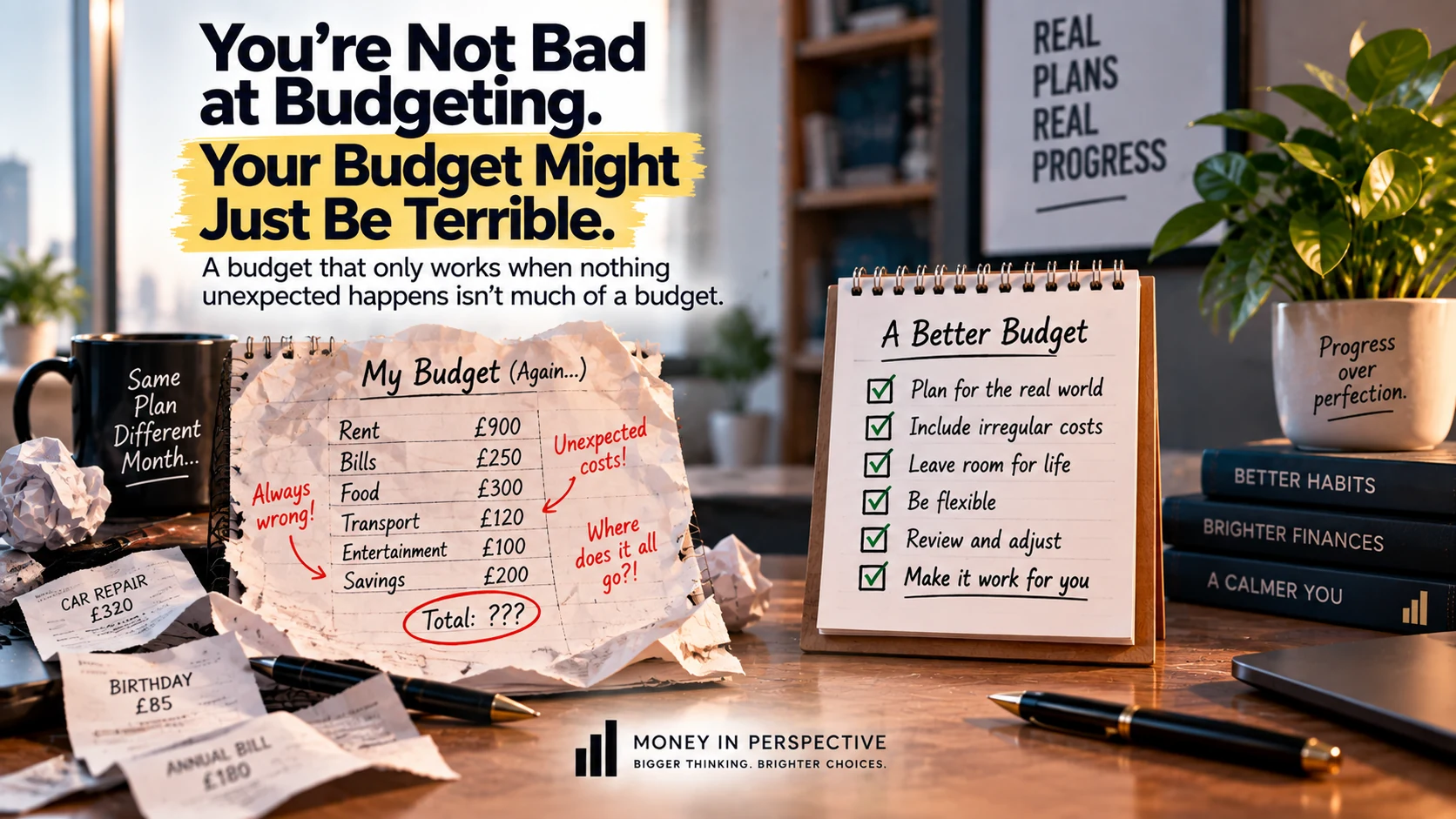
A lot of people decide they are bad at budgeting after one fairly predictable experience.
They create a budget.
The budget looks sensible.
For about twelve days, everything goes well.
Then life happens.
A birthday appears. The car needs something. The food shop costs more than expected. Someone suggests dinner. A subscription renews. The budget is broken, so the entire exercise starts to feel pointless.
The conclusion is usually personal.
“I’m just bad with budgets.”
Sometimes that is not the problem.
Sometimes the budget was terrible.
Many budgets fail because they are built around an imaginary version of life in which every month is identical, nobody gets invited anywhere, nothing breaks, Christmas comes as a surprise and human beings are perfectly happy spending nothing on enjoyment.
That is not budgeting. It is wishful thinking with categories.
A useful budget should describe the life you are actually likely to live. If it only works during an unusually quiet month, it is not a good plan.
The first problem is that many budgets are too optimistic.
Suppose you normally spend £450 a month on groceries. You decide £300 would be better, so £300 becomes the new budget.
Nothing has changed about the household. Same number of people. Same eating habits. Same shops. Same schedule.
The number changed because £300 looks financially attractive.
That is not automatically a plan to reduce spending. It is simply a lower number.
For a budget cut to work, something in behaviour usually needs to change. Different shops. Better meal planning. Fewer takeaways included in the grocery category. Less waste. Different brands. More cooking.
Without a behavioural change, the old spending pattern normally wins.
This is why a good budget often starts with observation rather than restriction.
Look at the last two or three months.
What did you actually spend on food, transport, socialising, subscriptions and other normal categories?
Those numbers are not a moral judgement. They are evidence.
If restaurants averaged £180 a month, a £30 budget is unlikely to survive unless you genuinely intend to change your social life. Perhaps £120 is a more realistic first target.
A budget should stretch behaviour where useful, not depend on fantasy.
The second major problem is irregular expenses.
Monthly budgets are attractive because income and bills often arrive monthly. Unfortunately, life is not organised into twelve equal financial boxes.
Car insurance.
Christmas.
Birthdays.
Annual memberships.
School costs.
Holidays.
Home repairs.
Professional fees.
Clothing.
Dental treatment.
These costs may not happen every month, but they are still part of normal life.
If they are excluded from the budget, they do not disappear. They simply arrive looking like emergencies.
One of the strongest budgeting habits is to convert irregular costs into monthly amounts.
If Christmas normally costs £600, save £50 a month.
If car insurance is £720 a year, think of it as £60 a month even if you pay annually.
If you want a £1,200 holiday next year, save £100 a month.
Now the monthly budget begins to reflect the whole year rather than pretending every non-monthly cost is an unexpected attack.
This is sometimes called using sinking funds, but the name matters less than the principle: future spending should receive money before the bill arrives.
The third problem is excessive detail.
A budget can become so precise that maintaining it feels like a second job.
£23 for coffee.
£17 for snacks.
£42 for entertainment.
£28 for household extras.
£36 for miscellaneous personal spending.
This looks organised, but life does not always respect tiny boundaries. One month has more coffee and fewer snacks. Another has no entertainment but an expensive birthday.
For many people, broader categories work better.
Bills.
Food.
Transport.
Saving and debt goals.
Annual or irregular costs.
Personal and social spending.
That may be enough.
The purpose of a budget is to guide money, not create an administrative hobby.
Another reason budgets fail is that they contain no fun.
Every pound is assigned to responsibility.
Rent.
Utilities.
Food.
Savings.
Debt.
Transport.
Nothing is allocated for the fact that you are a person who occasionally wants to leave the house.
This creates a budget that can only succeed if life becomes permanently boring.
Then a normal social event feels like financial failure.
A better budget deliberately includes discretionary spending. The amount depends on your circumstances, but the category matters.
Money for enjoyment is not money that escaped the budget.
It is part of the budget.
This changes the psychology. If £150 has been allocated for personal spending, using £40 for dinner is not “breaking the plan”. The plan anticipated that you would have a life.
A budget also needs margin.
If every pound of income is committed before the month begins, any variation causes stress.
Utility bill slightly higher?
Problem.
Fuel costs more?
Problem.
Unexpected prescription?
Problem.
A small buffer protects the plan from ordinary uncertainty.
This does not need to be large. Even a modest amount left intentionally unassigned can prevent constant reshuffling.
There is an important difference between a buffer and an emergency fund.
An emergency fund is for larger, genuinely unexpected financial shocks.
A monthly buffer is for normal messiness.
Because normal life is messy.
Budgets also fail when they ignore timing.
You can earn enough for the month overall and still struggle if major bills leave before income arrives. This is a cash-flow problem rather than an affordability problem.
Mapping payment dates can help. Some direct debits may be movable. Keeping a small current-account cushion can reduce the pressure. The budget should understand not only how much money comes in and goes out, but when.
Couples and families face another issue: a budget can fail because only one person believes in it.
A perfect spreadsheet is not much use if two people are spending from the same household money according to completely different assumptions.
Shared budgets need shared rules.
How much can each person spend without discussion?
Which expenses are joint?
What counts as personal?
What happens when one category runs over?
The answers do not need to be strict. They need to be understood.
A budget should also distinguish fixed costs from variable costs.
Fixed costs are harder to change quickly: rent, mortgage, finance agreements, childcare, insurance, subscriptions under contract.
Variable costs can usually move more easily: groceries, eating out, shopping, entertainment.
If the budget is consistently too tight, people often attack small variable spending because it is visible. But the real problem may be large fixed costs.
Cutting £20 of coffee does very little if the household is £500 short every month because housing, car payments and debt commitments consume too much income.
This is why budgeting should occasionally move beyond “where did I overspend?” and ask “is the structure of my life affordable?”
That is a more difficult question, but sometimes it is the correct one.
Another mistake is treating one bad month as proof the system failed.
No budget predicts everything perfectly.
A month containing a wedding, car repair and unexpected travel may exceed the plan.
That does not make budgeting useless.
The question is whether the budget helped.
Did you have money set aside for some of it?
Did you know which categories could be reduced temporarily?
Did the overspend become visible quickly?
A useful budget is not one that never changes. It is one that helps you make decisions when reality differs from the plan.
This is why regular review matters more than perfect forecasting.
Perhaps once a week, check a few major categories.
Are groceries roughly on track?
Has personal spending moved faster than expected?
Is there a large cost coming before the next payday?
This takes minutes if the budget is simple.
Waiting until the final day of the month is less helpful because most of the decisions have already been made.
Technology can help, but it can also create false confidence.
Banking apps can categorise spending automatically. Budgeting apps can connect accounts and display attractive charts.
Useful tools.
But no app can decide what you value.
A category turning red does not explain whether the spending was foolish or important.
You still need judgement.
Sometimes going over budget is the correct decision.
A close friend gets married.
A family emergency requires travel.
An opportunity appears that matters to you.
Financial planning should support life, not prevent you from responding to it.
The budget simply shows the trade-off.
If £200 goes here unexpectedly, where will it come from?
That question is more useful than pretending the purchase can happen without affecting anything else.
The best budgets are also allowed to evolve.
A budget built when you were single may not work after having children.
A plan built for commuting five days a week may be wrong after remote work begins.
Income changes.
Priorities change.
Prices change.
A budget should be updated when life changes rather than treated as a financial constitution written forever.
There is also no universal budgeting method.
Some people thrive with every pound assigned a job.
Others prefer broad spending limits.
Some need separate bank accounts for bills and spending.
Others can manage everything from one account.
Some enjoy detailed tracking.
Others need automation and simplicity or they will stop after a week.
The best system is the one you can still use six months later.
That matters more than whether it looks impressive.
If budgeting has repeatedly failed for you, try reversing the process.
Do not begin by asking how little you should spend.
Begin by asking what your life actually costs.
Take your regular bills.
Add realistic food and transport.
Add monthly amounts for annual and irregular expenses.
Add saving or debt goals.
Add a reasonable amount for enjoyment.
Add some margin.
Now compare the total with income.
If it fits, you have the beginning of a sustainable budget.
If it does not fit, that information is valuable. You can then decide what needs to change.
Perhaps some discretionary spending can fall.
Perhaps subscriptions can go.
Perhaps a car or housing cost needs reviewing.
Perhaps the savings target is temporarily too aggressive.
Perhaps income needs to increase.
What matters is that the gap is now real rather than hidden inside an unrealistic plan.
A budget should make money less stressful.
If yours creates constant guilt, requires daily maintenance and fails every month, there is no medal for continuing to use it.
Change the budget.
The point is not to prove you can obey a spreadsheet.
The point is to create a system where today's spending and tomorrow's priorities can coexist.
You may not be bad at budgeting at all.
You may simply have been trying to live inside a plan that was never designed for your actual life.
There is one final sign of a bad budget: it tells you what happened but does not help you decide what happens next.
If every review ends with “I overspent again,” the system is not giving you enough useful information. Ask why. Was the category unrealistic? Was there an unusual event? Did spending happen early in the month? Was the expense actually worth it? What would you change next month?
A budget should create feedback, not simply a monthly verdict.
That means success is not spending exactly the number written in every category. Success is understanding your money well enough that surprises become less frequent, important goals keep receiving funding and ordinary life can still happen.
If your current budget cannot do that, you do not need more guilt.
You need a better budget.