Saving money has a terrible marketing problem.
Spending gives you something immediately.
A meal.
A new phone.
A holiday.
Clothes.
A night out.
A parcel arriving tomorrow.
Saving gives you a larger number on a screen and asks you to become excited about not using it.
No wonder spending often wins.
The reward from saving is delayed, invisible and uncertain. You give up something enjoyable today in exchange for the possibility that future you will be grateful.
That is financially sensible and emotionally uncompetitive.
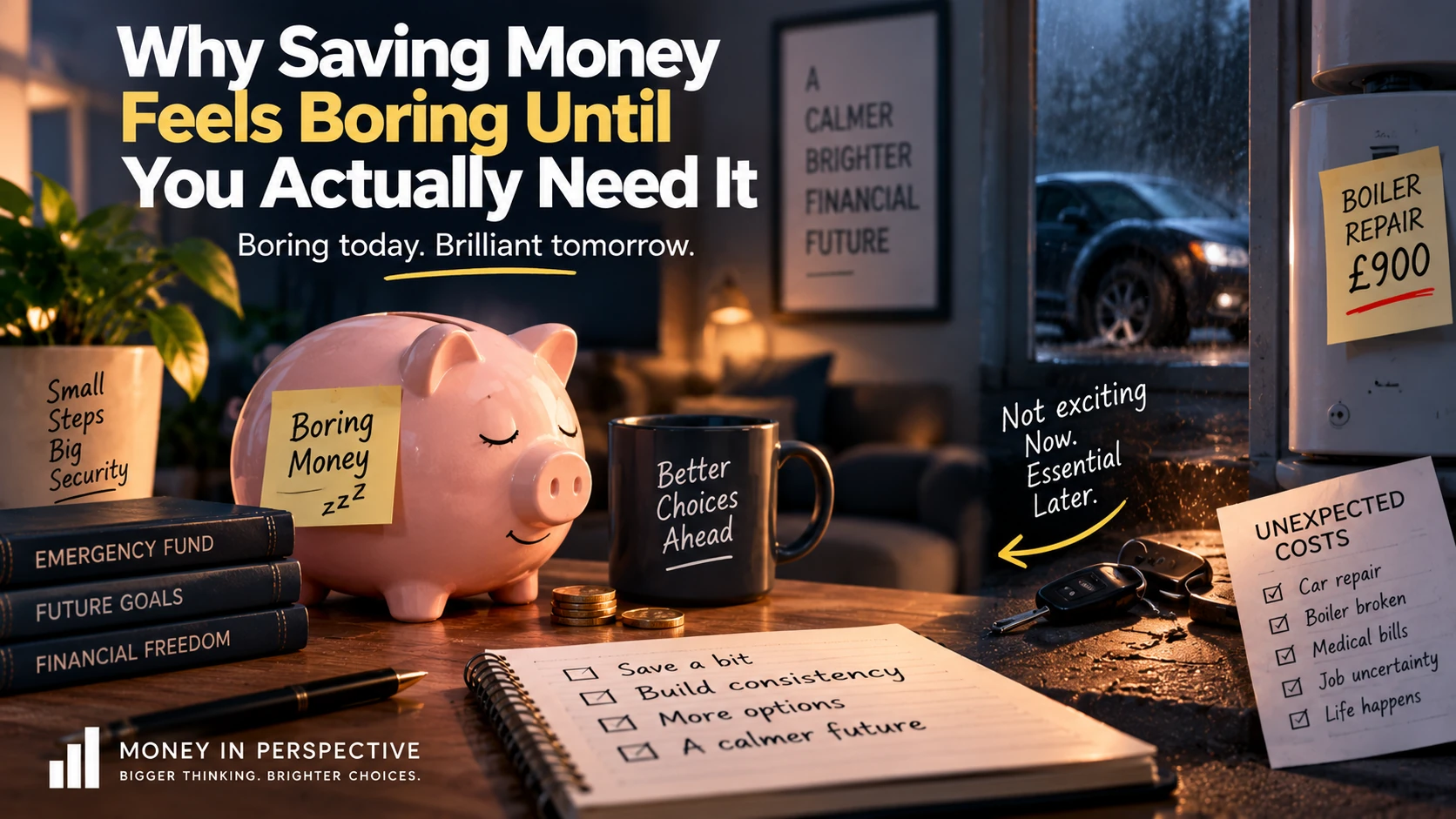
This is why saving can feel boring until the moment you actually need the money.
Then boredom becomes one of the most useful things you ever bought.
Consider an emergency car repair.
Without savings, the problem is not only that the car costs £700 to fix. The repair may need to go on a credit card, overdraft or loan. Now the emergency creates debt, interest and future monthly payments.
With savings, £700 leaves the account.
That is unpleasant.
But the problem largely ends there.
The savings did not produce excitement while they were accumulating. They produced options when something went wrong.
That is the hidden product you are buying when you save: flexibility.
An emergency fund is the clearest example.
It does not generate stories.
Nobody posts photographs of the month when the boiler broke and the replacement was paid for without drama.
Yet that quiet event can matter more financially than many exciting purchases.
Savings turn certain crises into expenses.
That distinction is powerful.
The same applies to job loss.
A person with several months of essential costs saved has more time to search for the right role. They may be less likely to accept the first available job purely because rent is due.
Savings can therefore create career flexibility.
They can allow someone to leave a bad situation.
Take parental leave.
Start a business.
Move home.
Handle a family emergency.
Say no.
Those are not boring outcomes.
The boring part is building the money beforehand.
One reason saving feels unrewarding is that goals are often too vague.
“Save more” is not very motivating.
Save £3,000 so the household can survive an unexpected income interruption is clearer.
Save £5,000 for a wedding.
£2,000 for travel.
£20,000 for a deposit.
The money now has a future use even though it remains in the account today.
Naming savings can make them feel more tangible.
Many banking apps allow separate pots or spaces. Even without that feature, a simple list can divide one account mentally.
Emergency fund.
Holiday.
Car.
Home repairs.
Annual bills.
The total may be the same, but the purpose becomes visible.
This also reduces the temptation to treat all savings as available spending.
If £4,000 in an account contains £2,500 for emergencies and £1,500 for a holiday, buying a £3,000 car upgrade no longer feels like “I have enough saved”.
The money already has jobs.
Automation can help because saving is often hardest when it requires a fresh decision every month.
If money moves automatically on payday, the decision happens once.
What remains becomes the amount available for the month.
This is psychologically easier than waiting until the end of the month to save whatever is left.
There is usually very little left because spending is remarkably talented at expanding into available money.
Paying yourself first is an old idea because it works well for many people.
The amount does not need to be dramatic.
Saving £50 consistently can be more useful than aiming for £300, failing repeatedly and deciding saving is impossible.
A sustainable amount creates a habit.
As income rises or expenses fall, the amount can increase.
Small savings also deserve more respect than they receive.
People sometimes dismiss £20 or £50 because it will not transform their finances quickly.
But savings goals are built from repetition.
£50 a month is £600 a year.
£100 is £1,200.
The progress may look slow from week to week and meaningful from year to year.
This is another reason saving feels boring: the timescale is wrong for modern attention.
Buying happens in seconds.
Saving happens in months and years.
The brain naturally notices the immediate event more strongly.
Progress tracking can help.
If you are building a £5,000 emergency fund, show the percentage.
£1,000 is not “still £4,000 short”.
It is 20% complete.
£2,500 is halfway.
A visible target creates milestones without requiring the money to be spent.
You can celebrate progress without withdrawing it.
There is also value in giving saving an enjoyable counterpart.
A budget that directs every spare pound toward the future can become difficult to sustain.
If nothing is available for today, saving begins to feel like punishment.
This is why a balanced plan often works better.
Save for future goals.
Spend some money deliberately on life now.
The percentages depend on circumstances.
Someone clearing expensive debt or building a basic emergency buffer may temporarily prioritise the future more heavily.
Someone financially secure may choose more current enjoyment.
The principle is that saving should support life, not postpone all of it indefinitely.
There is no prize for dying with the world's most disciplined current account.
The challenge is avoiding the opposite extreme, where future you receives whatever happens to remain after present you finishes spending.
Saving is really a negotiation between versions of yourself.
Today's version wants convenience, enjoyment and experiences.
Future versions want security, choice and the ability to handle larger goals.
Both deserve money.
This framing can make saving feel less like deprivation.
You are not throwing money into a financial black hole.
You are buying something for yourself at a later date.
The emergency fund buys resilience.
The deposit fund buys a home opportunity.
The pension buys future income.
The holiday fund buys travel without debt.
The sinking fund buys a year in which annual bills stop pretending to be surprises.
That is a much richer description than “money I am not allowed to spend”.
Saving can also reduce the cost of life itself.
Cash reserves can help avoid expensive borrowing.
Planned savings for annual insurance may allow you to choose annual payment if it is cheaper than instalments.
A home-maintenance fund can allow a small problem to be fixed before it becomes larger.
Savings can create bargaining power because you are able to act when opportunities appear.
This is sometimes called liquidity: having accessible money available when needed.
It is not glamorous.
It is useful.
There is a distinction between emergency savings and long-term investing too.
Money that may be needed soon generally has a different job from money intended for decades in the future.
Investments can rise and fall. Emergency funds are primarily about access and stability.
The right structure depends on goals, timeframe and individual circumstances, and financial products should be considered carefully.
The broader behavioural point is simple: do not make one pot of money perform every job.
If your emergency fund is invested aggressively and markets fall exactly when you lose your job, the money may not provide the stability you expected.
If all long-term money sits permanently in cash, inflation may reduce purchasing power over many years.
Purpose should shape where money lives.
Saving also changes how purchases feel.
When you have no reserves, a £500 unexpected cost can dominate the month.
When you have £10,000 allocated across sensible buffers, the same cost is irritating but manageable.
The amount did not become smaller.
Your financial system became larger around it.
That is what resilience feels like.
There is another emotional benefit: savings can reduce background anxiety.
Not for everyone, and money cannot solve every source of stress.
But knowing there is room for a broken appliance, a delayed payment or a difficult month can make uncertainty easier to tolerate.
You are not constantly one unexpected bill away from needing credit.
This sense of margin is one of the least visible but most valuable returns on saving.
If saving currently feels impossible, start by looking for structure rather than motivation.
What leaves the account automatically?
What irregular costs keep disrupting the month?
Could a small amount move on payday?
Could one recurring expense be redirected?
Could a pay rise partly fund saving before lifestyle expands?
The goal is to reduce the number of times willpower is required.
Motivation comes and goes.
Systems are boring enough to keep working.
That is a compliment.
There is also a useful distinction between saving because you are afraid to spend and saving because you are choosing future options. The first can make money feel restrictive. The second gives it purpose.
If you notice that every purchase creates guilt even when your finances are healthy, the answer may not be more saving. It may be a clearer plan for what is safe to spend. A good financial system should tell you both how much to keep and how much you can enjoy.
This is why separate pots can be psychologically helpful. Money labelled for holidays is supposed to be spent on holidays. Money labelled for emergencies is supposed to remain boring. Mixing the two can make every decision feel uncertain.
Saving can also become easier when progress is connected to specific freedom. An emergency fund is not merely £5,000. It might represent three months in which rent and bills could still be paid if work stopped. A house deposit is not merely £25,000. It is part of the ability to choose a different kind of home.
These translations make the balance more human.
It is worth reviewing goals once or twice a year too. Perhaps the emergency fund is now large enough. Perhaps a planned purchase no longer matters. Perhaps income has changed and the monthly saving amount should rise or fall.
Automatic saving is powerful, but automatic does not mean permanent. The system should keep reflecting your life.
The same is true once savings become substantial.
Do not assume the goal is simply “more forever”.
Savings should eventually connect to life.
Emergency funds reach a sensible level.
Holiday money gets spent on the holiday.
House deposits become houses.
Investment supports future goals.
Money is a tool, not a scoreboard.
The purpose of saving is not to become emotionally attached to the highest possible balance.
It is to create choices that matter to you.
This is why saving often becomes exciting only in retrospect.
The day you transfer £100 into an account feels uneventful.
The day you can pay for an emergency without borrowing, take time between jobs or book something you deliberately saved for, the earlier deposits suddenly make sense.
They were not doing nothing.
They were waiting.
That is the strange thing about financial security.
When it works well, very little happens.
The bill gets paid.
The repair gets done.
The opportunity is taken.
The emergency remains an inconvenience instead of becoming a financial crisis.
Boring money is often excellent money.
You do not need every pound to entertain you immediately.
Some of it can sit quietly in the background, doing the unglamorous job of making the rest of your life easier to handle.
The best saving plan is one that quietly survives normal months, adapts when circumstances change and is still there when the day comes that the money has something important to do.
You may not enjoy saving every month.
Future you is still likely to be very pleased that you did.