Being “good with money” sounds like a personality trait.
Some people have it.
Some people do not.
The good ones budget naturally, save without effort, avoid debt, understand investments and somehow remember every annual renewal before it charges.
The rest of us apparently stand in supermarkets wondering why the total is higher than expected.
That story is convenient because it turns money management into character.
If you are struggling, perhaps you are simply careless.
If somebody else seems organised, perhaps they are naturally disciplined.
Real life is more complicated.
Being good with money is hard because money decisions are constant, emotional, uncertain and connected to almost every part of life.
It is not one skill.
It is dozens of small skills performed repeatedly.
Budgeting.
Planning.
Delayed gratification.
Risk assessment.
Negotiation.
Understanding contracts.
Ignoring marketing.
Comparing prices.
Managing relationships.
Handling emergencies.
Thinking about a future version of yourself who is impossible to meet today.
No wonder people sometimes get it wrong.
The first problem is that financial decisions often involve competing versions of what is sensible.
Saving for retirement is sensible.
So is enjoying life while you are young enough to do things.
Paying down debt is sensible.
So is maintaining an emergency fund.
Buying a cheaper car is sensible.
So is paying more for something reliable if you drive long distances.
There is rarely one perfect answer.
Good money management often means balancing several good goals with limited income.
That is harder than simply “spend less”.
The second problem is that money is emotional.
A spreadsheet can tell you a purchase is unnecessary.
That does not stop the purchase being connected to comfort, identity, boredom, status, relationships or reward.
People buy expensive cars partly because cars mean something to them.
They spend on weddings because family and expectations matter.
They travel because experiences matter.
They buy gifts because relationships matter.
Trying to manage money while pretending none of those emotions exist usually creates an unrealistic plan.
Being good with money does not mean becoming emotionally neutral.
It means understanding which emotions are worth paying for and which ones repeatedly push you away from your priorities.
Marketing makes this harder.
Modern businesses are extremely good at reducing friction.
One tap.
Free trial.
Monthly payment.
Save your card.
Buy now, pay later.
Same-day delivery.
None of these systems is inherently bad.
They make buying convenient.
They also mean spending requires less thought than ever.
Saving, by contrast, still requires you to give up something today for a future benefit.
One side of the decision is immediate and exciting.
The other is delayed and invisible.
That is not an equal psychological contest.
This is why systems matter more than motivation.
If saving depends on feeling disciplined at the end of every month, it is competing with hundreds of opportunities to spend.
If a standing order moves money on payday, the decision happens once.
Automation is not cheating.
It is good financial design.
The same applies to bills.
Separate accounts.
Automatic payments.
Savings pots.
Calendar reminders.
These tools reduce how many decisions need active willpower.
People who appear “naturally good with money” often have systems doing part of the work.
Income also changes how easy financial discipline feels.
Saving 20% of income is far harder when essentials consume 90% than when essentials consume 50%.
This sounds obvious, but personal finance conversations can ignore it.
Two people may have completely different levels of financial margin.
One earns enough that a mistake is inconvenient.
Another earns so little above essential costs that the same mistake creates debt.
The second person does not necessarily lack discipline.
They have less room for error.
This is why financial advice should distinguish behaviour problems from maths problems.
If income is £2,000 and unavoidable monthly costs are £1,950, no budgeting method can produce £500 of savings.
The numbers do not allow it.
Some costs may eventually be reducible.
Income may be increased.
Support may be available.
But there is no spreadsheet trick that creates money that is not there.
Recognising this can remove unhelpful guilt.
It also allows attention to move toward the changes that actually matter.
On the other hand, higher income does not automatically create good finances.
Lifestyle can expand to consume almost any salary.
A person earning £100,000 can still live paycheque to paycheque if commitments are high enough.
This is why being good with money involves creating margin rather than chasing a particular income number.
The goal is a gap between what comes in and what must go out.
That gap creates flexibility.
It funds savings.
Absorbs emergencies.
Allows choices.
But margin is not created only by cutting coffee.
Large costs matter.
Housing.
Transport.
Childcare.
Debt.
Insurance.
These categories can define the whole budget.
Someone can be extremely careful with small purchases and still struggle because fixed costs are high.
Good money management therefore involves looking at the big picture, not simply policing every £4 transaction.
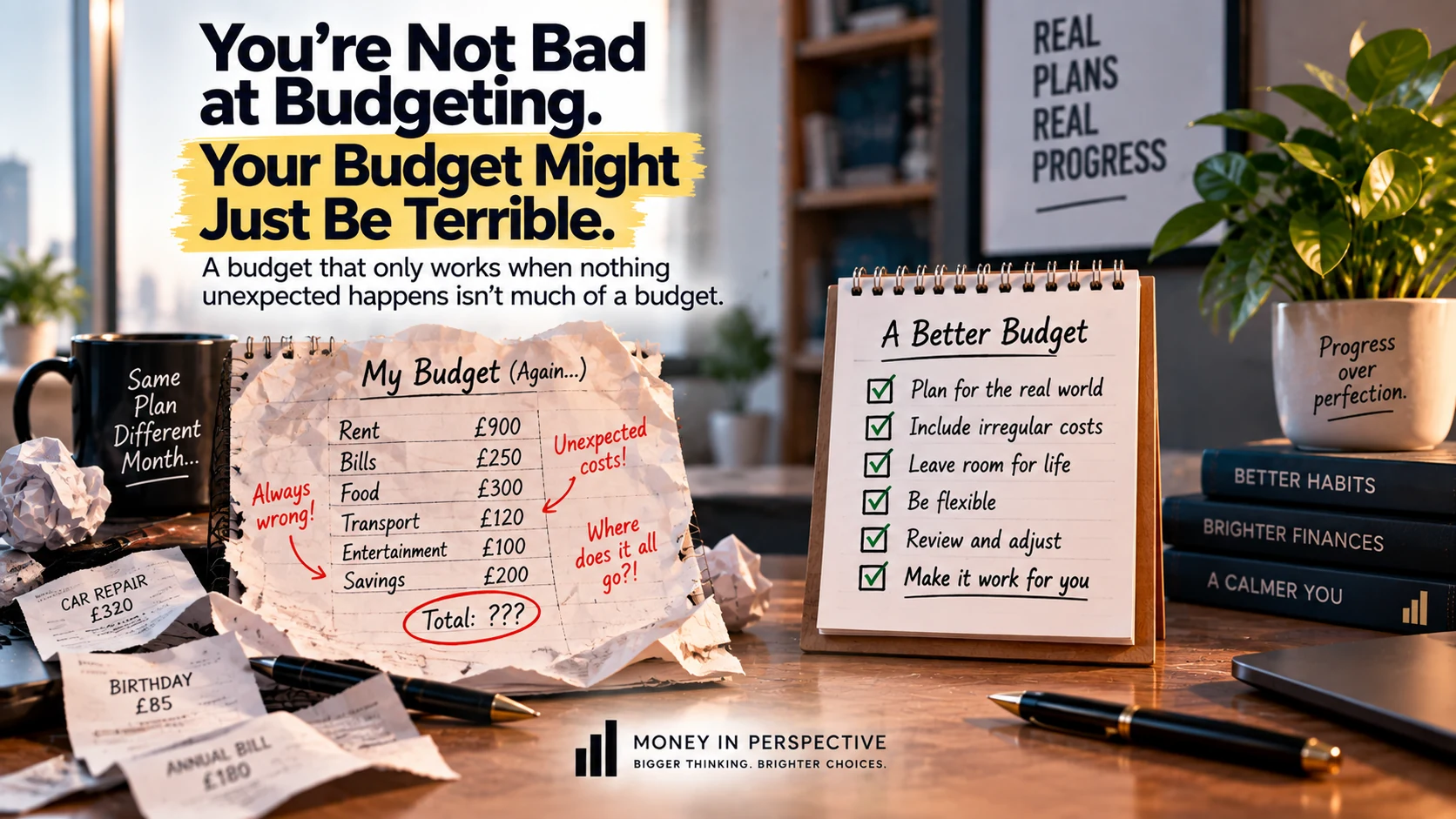
It also requires planning for things that do not happen monthly.
Christmas.
Birthdays.
Car insurance.
Repairs.
Holidays.
School costs.
Annual subscriptions.
These expenses are predictable in the sense that something irregular is always coming.
Yet many budgets treat them like surprise attacks.
A person who repeatedly gets caught by annual bills may conclude they are bad with money.
Often the system is simply too monthly.
Sinking funds help because they spread irregular costs across the year.
If Christmas normally costs £600, saving £50 a month turns December into a planned expense instead of a crisis.
If car costs average £1,200 a year beyond fuel, setting aside £100 a month creates a buffer.
This is not advanced financial intelligence.
It is acknowledging that life runs on more than one timescale.
Debt creates another challenge because good money decisions can conflict.
Should you save or repay debt?
The answer depends on interest rates, emergency needs and individual circumstances.
Expensive debt often deserves urgent attention.
But having zero cash reserves can create a cycle where every unexpected bill goes back onto credit.
Good money management sometimes means solving two problems at once rather than following one absolute rule.
Investing is similar.
People hear that investing is important and feel behind if they are not doing it.
But investing money needed next month can be risky.
Building a basic financial foundation may matter more.
Understanding time horizon, risk and goals is part of being good with money.
That knowledge is learned.
Nobody is born understanding diversification, inflation or compound returns.
The phrase “financial literacy” can make this sound like a school subject you either know or do not.
In reality, people learn in stages.
First current account.
Then bills.
Then credit.
Then savings.
Then pensions.
Then mortgages.
Then investments.
Then perhaps business finances or tax.
Life keeps adding new financial systems.
A person can be excellent at managing household spending and completely confused by pensions.
That does not make them bad with money.
It means they have reached a new topic.
Asking questions is a financial skill.
So is checking before signing.
Contracts are another reason money management is difficult.
Mobile plans.
Insurance.
Loans.
Mortgages.
Car finance.
Energy.
Subscription terms.
Many financial decisions arrive inside documents most people do not enjoy reading.
The headline is simple.
£299 per month.
The true commitment may include interest, fees, mileage limits, cancellation terms or a large final payment.
Being good with money often means slowing down when the seller wants the decision to feel fast.
Total cost.
Contract length.
What happens at the end?
What happens if circumstances change?
These questions are boring.
They are also valuable.
Social pressure complicates money further.
Your friends choose an expensive restaurant.
A colleague upgrades their car.
Family expects a certain kind of celebration.
Children want what classmates have.
You are not making decisions in isolation.
Sometimes spending money maintains relationships and creates joy.
Sometimes social pressure creates commitments you do not really value.
Learning to tell the difference is not easy.
This is why “just say no” is often poor advice.
People are balancing finances with belonging.
A strong financial plan includes social life rather than pretending it does not exist.
That might mean setting a monthly social budget.
Choosing which events matter most.
Suggesting cheaper alternatives.
Saying no occasionally without apologising for having limits.
These are interpersonal skills as much as financial ones.
Comparison makes the problem worse because other people's finances are mostly invisible.
You see the holiday.
Not the credit-card balance.
You see the house.
Not the deposit source.
You see the salary.
Not the childcare costs.
Trying to judge your progress against visible consumption is unreliable.
Good money management requires using your own goals as the scoreboard.
That is harder than it sounds because visible spending gets more social recognition than invisible saving.
Nobody notices the emergency fund.
People notice the new car.
The strongest financial choices can therefore feel boring.
Saving.
Debt repayment.
Pension contributions.
Insurance.
Emergency reserves.
None provides the immediate emotional reward of buying something.
This is another reason being good with money requires patience.
The benefit appears later.
Sometimes much later.
And sometimes the benefit is that nothing dramatic happens.
The boiler breaks and gets repaired.
The job ends and the bills still get paid.
The car needs work and no debt is required.
Financial resilience is often invisible because it turns crises into ordinary expenses.
Mistakes are part of the process too.
People who are good with money still overspend.
They buy things they regret.
Miss renewal dates.
Choose poor investments.
Keep subscriptions too long.
The difference is not perfection.
It is recovery.
Can you notice what happened without turning one mistake into a reason to abandon the whole plan?
A bad month does not make a bad financial life.
This is important because shame is not a particularly useful budgeting tool.
If someone overspends by £200 and responds by avoiding the banking app for three weeks, the problem often gets worse.
If they look at the numbers, adjust the next few weeks and learn from the trigger, the mistake remains small.
Review beats guilt.
This is why regular money check-ins can be powerful.
Not daily obsession.
Perhaps twenty minutes once a week.
What left the account?
What is due next?
Are the main categories on track?
Any unusual costs coming?
The habit keeps problems small.
It also reduces the feeling that finances are something you confront only when something goes wrong.
Good money management should eventually make money less mentally noisy.
Systems run.
Bills are funded.
Savings happen.
You still make choices, but you do not renegotiate the entire financial plan every day.
This is why simplicity matters.
A perfect budget with forty categories that you abandon after two weeks is worse than a five-category system you use for years.
A sophisticated investment plan you do not understand is worse than a simpler approach appropriate to your goals and risk.
Complexity is not evidence of competence.
Consistency is often more important.
It also helps to define what “good with money” means for you.
Is it never buying anything unnecessary?
That is unrealistic.
Is it having enough savings to handle problems?
Avoiding expensive debt?
Funding retirement?
Being able to travel without borrowing?
Owning a home?
Working fewer hours?
Your definition determines the plan.
Without a definition, financial success becomes an endless attempt to accumulate more.
There is always another target.
Another salary.
Another investment balance.
Another house.
Money is a tool.
Being good with it should mean using it well for the life you want, not winning an imaginary competition.
For one person, that means aggressive saving because early retirement matters deeply.
For another, it means moderate saving and more travel now.
Both can be financially responsible if the trade-offs are understood.
This is why rigid rules often fail.
“Never finance a car.”
“Always save 20%.”
“Never buy coffee.”
“Always buy property.”
Rules can be useful starting points.
Real circumstances vary.
Interest rates vary.
Income varies.
Health varies.
Family responsibilities vary.
Good money management involves judgement.
Judgement improves with information and experience.
One of the best signs you are becoming better with money is not that spending disappears.
It is that surprises reduce.
You know roughly what the month costs.
Annual bills are expected.
Large purchases are planned.
You understand your main debts.
You know what you are saving for.
You can spend discretionary money without wondering whether the rent is safe.
That is financial competence in real life.
Not perfection.
Another sign is that you can change the plan.
A budget should adapt when income changes.
Savings goals should change when life changes.
An approach that worked before children may not work afterward.
A plan built around commuting may be wrong after remote work.
Being good with money is not rigidly following old decisions.
It is updating them.
There is also no shame in professional help.
Accountants, financial advisers, debt charities, mortgage brokers and other specialists exist because money becomes complicated.
The right source depends on the question and the person's circumstances.
Seeking appropriate advice is not evidence that you failed to understand money.
It is often exactly what good decision-making looks like.
Ultimately, the idea that some people are simply “good with money” can be discouraging because it makes improvement sound like personality change.
You do not need a new personality.
You need a few useful habits.
Know the big numbers.
Create margin where possible.
Automate important goals.
Plan for irregular expenses.
Understand contracts before signing.
Review spending without shame.
Ask questions when something is unclear.
Make room for enjoyment.
Repeat.
That is not glamorous.
It is also not easy.
But it is learnable.
If managing money feels harder than people make it sound, that is because it is harder.
You are making hundreds of decisions across an uncertain life with limited resources and constant opportunities to spend.
Struggling occasionally does not prove you are bad with money.
It proves you are managing money in the real world.
The goal is not to become flawless.
It is to build a system strong enough that you do not need to be.