Payday has a particular kind of energy.
The account balance changes.
Bills have not all left yet.
Last month's financial mistakes are temporarily hidden beneath fresh income.
Suddenly the takeaway looks reasonable.
The shopping basket feels harmless.
Dinner out can wait no longer.
After several days of being careful, payday can feel like the moment normal life resumes.
That is precisely why the first few days after being paid can be some of the most expensive days of the month.
The problem is not celebrating payday.
The problem is behaving as though the new balance is spare money.
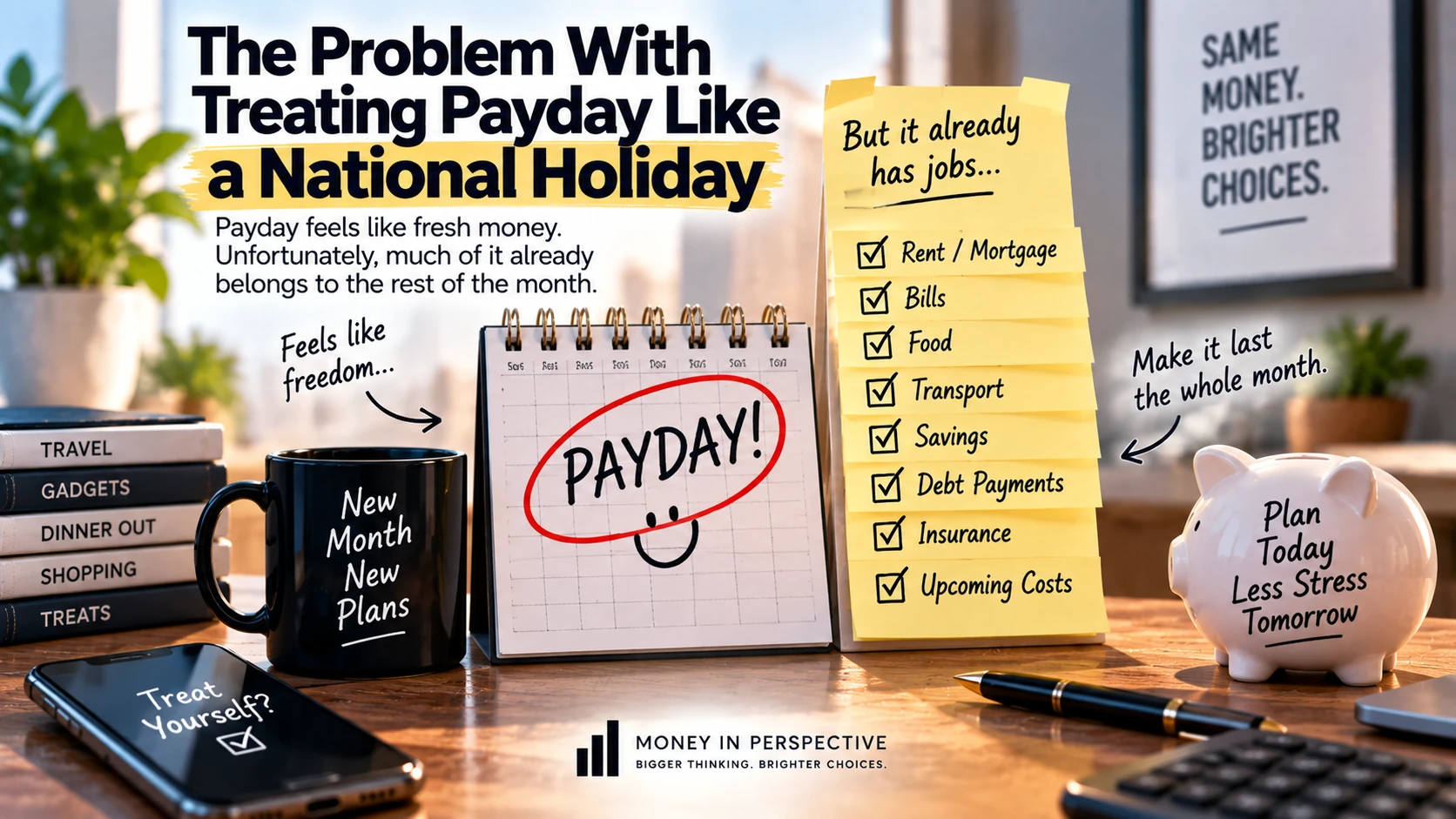
Your bank account on payday contains several different kinds of money disguised as one number.
Rent or mortgage money.
Utility money.
Food money.
Transport money.
Debt repayments.
Savings.
Annual costs that need funding.
And only then discretionary money.
Until those jobs are separated, the full balance can create a false sense of wealth.
Imagine being paid £2,500.
The banking app shows £2,500.
Psychologically, that can feel like having £2,500.
But suppose £1,600 is already committed to bills and essential costs.
Perhaps £300 should go toward annual expenses and savings.
The genuinely flexible amount is much smaller.
Nothing is wrong with the balance.
The problem is interpreting gross monthly income as spending capacity.
This is similar to a business confusing revenue with profit.
The money passed through the account.
It is not all available.
Payday spending is also influenced by scarcity.
Toward the end of the month, people often become more cautious.
You delay purchases.
Use what is already at home.
Say no to things.
Then payday arrives and the restriction disappears.
The result can be a rebound.
After feeling deprived, spending becomes a reward.
This is why extremely strict budgets can create an unusual cycle:
overspend after payday,
become cautious later,
reach payday feeling restricted,
overspend again.
The month contains abundance followed by scarcity, even when income itself is stable.
A more balanced spending plan can reduce this.
Instead of treating discretionary money as available immediately, divide it across the month.
Suppose you have £400 after bills, savings and other commitments.
You might think of that as roughly £100 per week.
This does not mean every week must be identical.
It simply provides pacing.
Spending £220 during the first weekend now has a visible consequence.
Only £180 remains for the rest of the month.
Without the weekly frame, £220 may look modest beside the fresh account balance.
Separating accounts can help too.
One account receives income and pays bills.
Another contains discretionary spending.
Savings move elsewhere automatically.
Now the spending account shows a more honest number.
You do not need to mentally subtract rent every time you open the banking app because the bill money is no longer pretending to be shopping money.
This system is not necessary for everyone.
Some people manage perfectly well from one account.
The principle is what matters: make committed money less visually available.
Automation is powerful here.
If savings and important goals rely on whatever remains at the end of the month, payday spending receives first access.
Usually it wins.
Moving money shortly after income arrives changes the order.
Emergency savings.
Investment.
Holiday fund.
Annual bills.
Debt overpayments.
Whatever your goals are, fund them before discretionary spending expands.
This is not about paying yourself first because future money is morally superior to present enjoyment.
It is about preventing every goal from competing with thousands of tiny purchasing decisions.
A standing order makes one decision.
Leaving the money available requires you to remake that decision every day.
Payday can also encourage large purchases because the timing feels safe.
You have wanted something for weeks.
The balance finally looks strong.
You buy it immediately.
The purchase may be perfectly affordable.
A useful habit is still to wait twenty-four or forty-eight hours for non-essential larger purchases, especially when the desire peaks because money has just arrived.
If you still want it after the payday feeling fades, buy it.
This separates genuine desire from the temporary confidence of a larger balance.
There is also a social side.
Payday weekends are often naturally expensive.
People are paid around similar times.
Plans appear.
Restaurants.
Drinks.
Shopping.
The phrase “I've just been paid” becomes permission.
Again, enjoying your income is not a problem.
The useful change is deciding before payday how much of it is available for celebration.
Perhaps £100 is intentionally reserved for the weekend.
Spend it without guilt.
The budget anticipated the fun.
What creates trouble is an open-ended celebration followed by three weeks of repair.
A good financial month should not require punishment in week four because week one was exciting.
Another reason payday feels richer is that many expenses are delayed.
Direct debits may leave several days later.
Credit cards may be due mid-month.
The account therefore looks healthiest immediately after income arrives, even though future commitments are already real.
This creates a timing illusion.
A calendar of major payment dates can help.
If £900 will leave next Tuesday, your balance today should mentally already be £900 lower.
Again, separate bills accounts solve much of this automatically.
Annual costs create an even bigger trap.
Car insurance.
Christmas.
Birthdays.
Holidays.
Repairs.
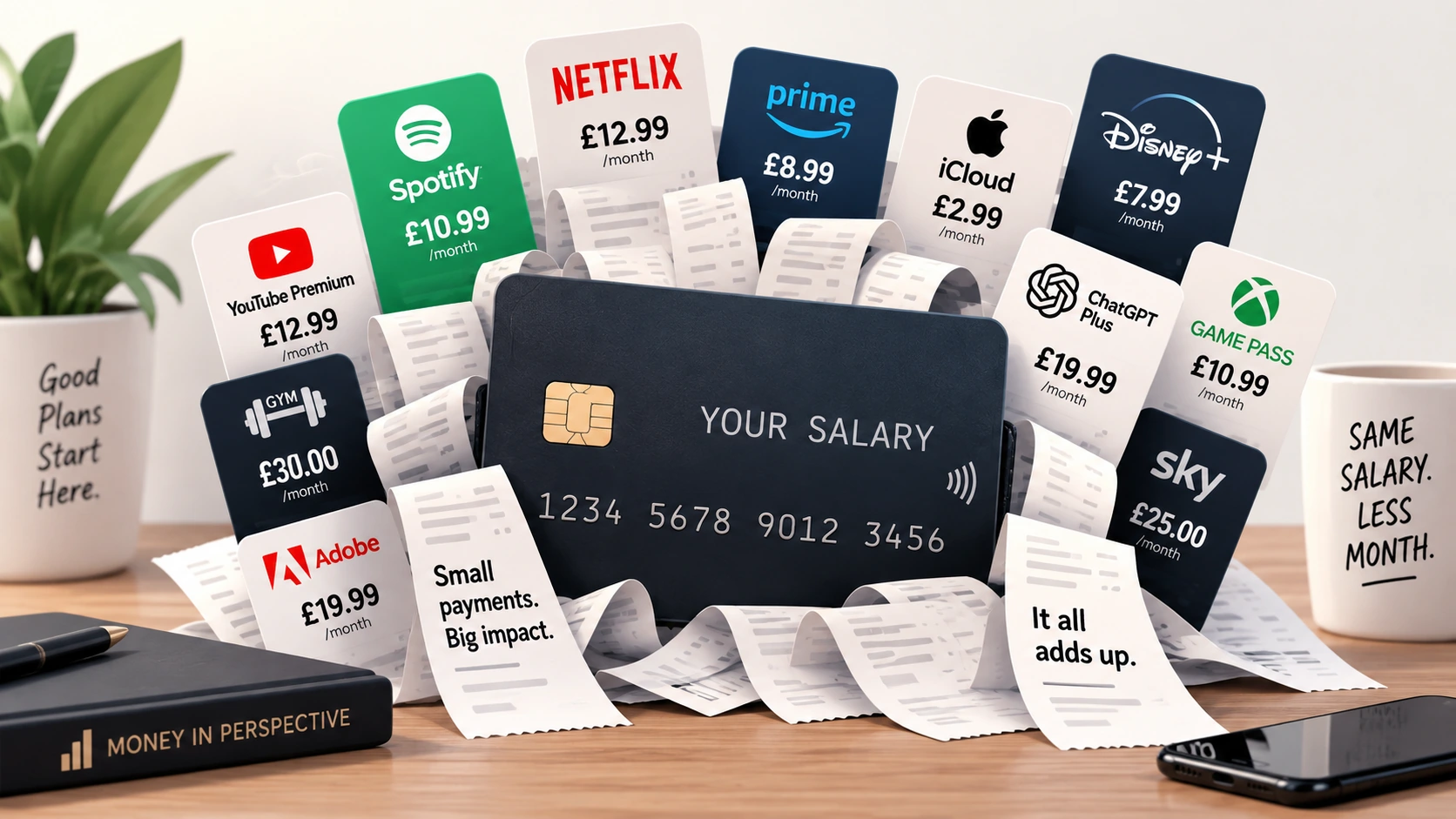
Subscriptions.
These may not leave during the current month, so payday gives no visual reminder.
If no money is reserved for them, future payday will have to absorb them.
That is how apparently comfortable incomes become repeatedly disrupted by “unexpected” costs that happen every year.
Sinking funds turn them into monthly commitments.
Save one-twelfth of predictable annual expenses each month.
The account balance after payday becomes slightly smaller.
Future life becomes much easier.
This can initially make budgeting feel worse because money disappears into pots without anything happening.
That is exactly the point.
The bill is being paid gradually before it arrives.
Payday behaviour can also reveal whether the budget is too restrictive.
If you repeatedly feel a strong need to spend immediately after being paid, ask why.
Have you allocated zero money for enjoyment?
Are you postponing every non-essential purchase until payday?
Is the household genuinely short of money?
Or has payday simply become a learned cue for spending?
Different causes need different solutions.
If income is genuinely insufficient for essential costs, rearranging bank accounts will not solve the underlying problem.
The household may need to reduce large expenses, increase income, restructure debt or seek appropriate support.
Budgeting can organise money.
It cannot create income that does not exist.
If the issue is behavioural, however, small structural changes can work very well.
One is a payday routine.
When income arrives:
check the amount,
make sure bills are funded,
move savings and annual-cost money,
confirm discretionary amount,
then spend.
This takes a few minutes.
It turns payday from a shopping signal into an allocation signal.
You can still celebrate afterward.
There is no reason the routine must feel miserable.
A planned payday treat can be part of it.
Takeaway.
Meal out.
Small purchase.
The difference is that celebration is a category rather than a financial event that takes over the whole weekend.
Another useful idea is to stop using account balance as your primary spending signal.
A balance tells you how much money exists in the account.
It does not tell you how much is safe to spend.
A budgeting app, separate spending balance or simple note can provide the second number.
For example:
Bank balance: £2,350.
Safe discretionary amount until next payday: £310.
The second number is much more useful when deciding whether to buy something.
Credit cards can complicate payday further.
If previous spending is paid after payday, part of the new salary is already funding last month's lifestyle.
This can create the sensation that money disappears immediately.
The answer is not necessarily avoiding credit cards entirely.
Used responsibly and paid in full, they can provide useful protections and rewards.
The issue is understanding that the card balance is already spent money.
Do not celebrate payday using money that needs to pay for last month's celebration.
There is also a psychological benefit to carrying money forward.
Many people unconsciously treat each payday as a reset.
Anything left from last month feels available because the new month has begun.
Instead, consider allowing surplus to accumulate.
If £80 remains before payday, it does not need to be spent because another salary is coming.
Move it to savings.
Leave it as a buffer.
Use it toward a goal.
This changes the mindset from monthly consumption to financial progress.
The account begins to build rather than repeatedly returning close to zero.
That margin can become one of the most valuable financial assets.
A month starts with more than the salary alone.
Unexpected costs become easier.
You feel less dependent on the precise timing of payday.
Eventually, payday becomes less emotionally dramatic because you were not running out beforehand.
That is a sign of resilience.
Look at what happens immediately after payday too.
For one or two months, note what happens during the first seventy-two hours after income arrives.
You may find that a disproportionate amount of discretionary spending happens immediately: online orders, meals out, larger food shops and purchases that were postponed at the end of the previous month.
That information can help without requiring a stricter budget.
One simple adjustment is to create a twenty-four-hour payday pause for non-essential purchases above a chosen amount.
Bills can still be paid.
Planned spending can still happen.
The pause applies only to things that suddenly feel attractive because the account balance is high.
Another option is to move discretionary money weekly rather than monthly.
Instead of placing £400 into the spending account on payday, transfer £100 each week.
The total allowance has not changed.
Only the timing has.
This can reduce the feeling that the first weekend has access to the whole month.
Payday can also be a useful time to review progress rather than only consumption.
Check whether the emergency fund increased, debt fell, or an annual-cost pot moved closer to its target.
That gives the day another source of reward.
The financial system begins to associate being paid with becoming more secure, not only with becoming temporarily richer.
It is important not to make the routine so rigid that payday becomes depressing.
If you enjoy a meal out or a small purchase when salary arrives, include it deliberately.
A planned £40 celebration is completely different from several days of spending with no idea what the total will become.
The goal is not to remove the emotional lift of payday.
It is to make sure the lift lasts longer than the first weekend.
A calm month is usually more valuable than a spectacular first three days followed by twenty-seven days of wondering where the money went.
The goal is not to make payday boring.
Income is worth appreciating.
You worked for it.
It should improve your life.
The trick is to remember that money can improve life in more than one way.
Some should pay for today.
Some should pay for next week.
Some should make future problems easier.
Treating payday like a national holiday gives all of those jobs the same instruction:
spend quickly while the balance looks good.
A better system gives each pound a destination first.
Then enjoy the part that is actually yours to enjoy.
You may discover payday becomes less exciting.
That is not necessarily a loss.
It can mean the rest of the month becomes much calmer.
And financial calm is a fairly good thing to buy with a salary.