Boredom is rarely listed as a household expense.
It should probably get more attention.
When people think about costly habits, they usually imagine obvious categories: eating out, holidays, shopping, subscriptions, cars.
Boredom sits underneath many of them without appearing on the bank statement.
You have nothing planned.
You open a shopping app.
You scroll.
A product catches your attention.
You buy it.
Or you go out because staying in feels dull.
Coffee turns into lunch.
Lunch turns into browsing shops.
Browsing turns into a purchase.
The spending did not begin with a need.
It began with a gap in the day.
This is one reason boredom can be surprisingly expensive.
It creates a problem that money can solve immediately: make this moment more interesting.
Modern consumer life is extremely good at supplying answers.
Streaming.
Gaming.
Takeaway.
Online shopping.
Delivery apps.
Social media advertising.
Tickets.
Travel.
All can turn an empty hour into something more stimulating.
None of those things is bad.
Entertainment is a perfectly valid use of money.
The issue is when spending becomes the automatic response to having nothing else to do.
Online shopping is perhaps the clearest example because browsing itself is entertainment.
You do not need to want anything before opening the app.
The products provide the ideas.
Scroll long enough and eventually something will feel useful, attractive or cheap enough to justify.
This reverses the normal buying process.
Instead of noticing a need and searching for a product, you see products until one creates a need.
Boredom makes that process easier because the search is already providing stimulation.
The anticipation of a purchase can be enjoyable too.
Choose.
Compare.
Order.
Track the parcel.
Open it.
The product creates several small moments of interest before its practical value is ever tested.
That is why unused items can accumulate even when nobody thinks of themselves as a big shopper.
The purchase may have been doing two jobs.
Buying the object.
And relieving boredom.
Once the second job is understood, the behaviour makes more sense.
Food delivery can work similarly.
You are not particularly hungry.
The evening feels flat.
Opening the app creates options.
Pizza.
Burgers.
Dessert.
Suddenly dinner becomes an event.
The food is not only nutrition.
It changes the mood of the evening.
Again, that can be enjoyable and worthwhile.
The problem is frequency.
A £30 takeaway used as occasional entertainment is one thing.
A £30 takeaway every time the evening feels boring becomes more than £1,500 a year.
The money may not be buying meals so much as a repeated change of atmosphere.
Going out can also be boredom spending.
A walk around town becomes coffee.
A shopping centre becomes an afternoon.
A drive becomes fuel, parking and food.
People often spend because commercial spaces are designed around things to do.
If there is nowhere else obvious to go, spending becomes part of the activity.
This is especially true in bad weather, when free outdoor options become less attractive.
Families can feel this strongly.
Keeping children entertained can become expensive because so many activities are priced per person.
Cinema.
Soft play.
Bowling.
Theme parks.
Restaurants.
Indoor attractions.
None is unreasonable.
But a household that treats every empty weekend as something that needs to be purchased can end up with a large entertainment bill.
The useful question is not “How do we stop doing fun things?”
It is “Does every unplanned day need a paid solution?”
Often the answer is no.
Free or already-paid-for options can provide just as much value.
Park.
Library.
Walk.
Film at home.
Board game.
Cooking.
Visit family.
Use the memberships you already pay for.
The point is not that these are morally superior because they are cheap.
It is that boredom narrows attention toward the quickest available stimulation, and commercial options are very good at appearing first.
Social media amplifies this.
You are bored, so you scroll.
The feed contains people travelling, eating out, buying clothes, renovating homes and testing products.
Now boredom becomes comparison.
Your quiet afternoon looks even quieter beside everybody else's highlight reel.
A purchase or outing can start to feel like a way of joining life again.
This is one reason social media advertising is effective.
It reaches people at a moment when they are already seeking stimulation.
The product is not interrupting something important.
It is the interesting thing.
Recognising this does not require deleting every app.
It does suggest that boredom and shopping deserve some distance.
If scrolling frequently leads to purchases, remove shopping apps from the first screen.
Unsubscribe from promotional notifications.
Do not store payment details on the sites where impulse spending is strongest.
Add small friction.
You are not forbidding the purchase.
You are making sure interest survives longer than the boredom that created it.
A waiting list works well here.
See something you want.
Save it.
Wait forty-eight hours.
If you still want it, consider buying it.
Boredom purchases often lose their energy quickly because the product was tied to the moment.
By the next day, you may barely remember why it looked essential.
This is one of the cheapest tests in personal finance.
No spreadsheet.
No complicated budget.
Just time.
Boredom also makes upgrades tempting.
Your current phone works.
You watch reviews because you are interested in technology.
An hour later, the new model feels necessary.
The same happens with cars, home products, gaming equipment and hobbies.
Research can create desire even when the original goal was simply entertainment.
This is why hobbies around products can become expensive.
There is nothing wrong with loving watches, cameras, trainers or technology.
The important distinction is whether collecting is an intentional hobby with a budget or browsing is quietly generating purchases.
If shopping itself is the hobby, give it financial boundaries like any other hobby.
Perhaps a set monthly amount is available for new items.
Now boredom can still lead to discovery without allowing every discovery to become a transaction.
There is another form of boredom spending at work.
The afternoon slows down.
You buy coffee.
Then a snack.
Perhaps browse shops online.
Office workers may spend small amounts partly because purchases break the day into pieces.
A five-minute walk for coffee is not only about caffeine.
It creates movement and a change of scene.
This suggests a better response than simply banning the coffee.
What else could provide the break?
Walk around the building.
Bring a drink you enjoy.
Talk to someone.
Step outside.
If the coffee itself is the pleasure, keep buying it.
If the real value was leaving the desk for ten minutes, you may have cheaper alternatives.
This distinction matters because cutting the purchase without replacing the function often fails.
The boredom remains.
Eventually another spending habit fills the gap.
Good budgeting works better when it understands why money is being spent.
This is true of evenings too.
If takeaway provides a sense of occasion, perhaps create other occasions.
Cook something different.
Invite friends over.
Watch a film deliberately rather than scrolling through options.
Plan a game night.
The exact activity matters less than creating something to look forward to.
Boredom thrives on unstructured time.
A little structure can reduce spending without making life more restrictive.
That sounds paradoxical.
But planned leisure is often more satisfying than repeatedly buying stimulation in the moment.
You can spend more deliberately too.
Instead of four forgettable £25 outings created by boredom, perhaps you would rather spend £100 on one experience you genuinely care about.
Same money.
Much stronger memory.
This is one of the broader lessons of personal finance: reducing spending is not always about keeping the cash.
Sometimes it is about redirecting it toward higher-value enjoyment.
Boredom can be particularly expensive after pay rises.
When income is tight, empty time may still be filled cheaply because the budget imposes limits.
When income rises, every small entertainment decision becomes easier to approve.
Taxi.
Meal out.
Shopping.
Another subscription.
Lifestyle expands because there is room.
This is why protecting some unstructured free time from spending can be useful even when you can afford more.
Affordability does not automatically create value.
Boredom is also connected to subscription accumulation.
A new streaming service solves tonight's entertainment problem.
A game subscription solves another.
An app promises endless content.
Soon the household pays for several services but still feels there is nothing to watch.
This is a useful reminder that more options do not always solve boredom.
Sometimes they create decision fatigue.
Before adding another subscription, use what you already have.
If the current services genuinely no longer provide value, cancel one before adding another.
This “one in, one out” rule keeps entertainment spending visible.
There is also a deeper point: boredom is not necessarily a problem that must always be solved immediately.
Modern life offers constant stimulation, so a quiet hour can feel uncomfortable.
But boredom can create creativity, rest and reflection when it is allowed to exist.
You do not need to turn every empty moment into content or consumption.
That does not mean sitting in a blank room to save money.
It means becoming slightly more comfortable with not purchasing stimulation the second the day slows down.
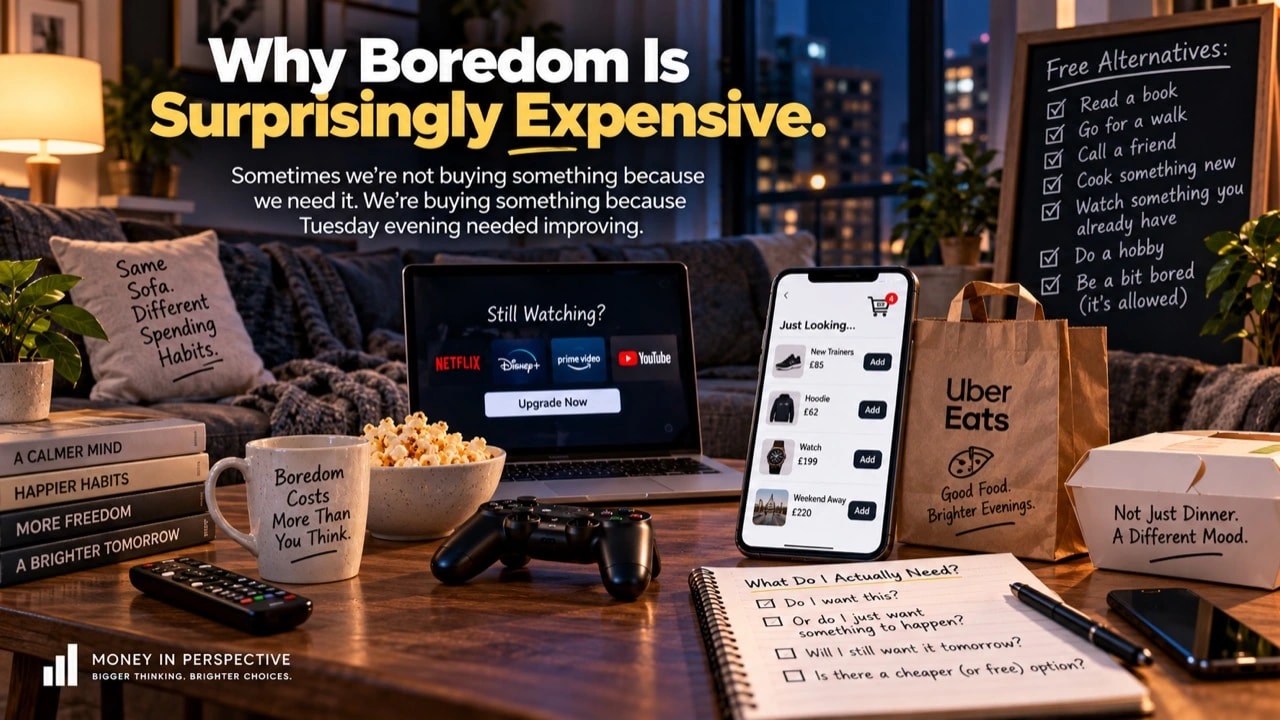
A practical exercise is to create a boredom list.
Write down ten things you genuinely enjoy that are free or already paid for.
Walk.
Read.
Gym membership already paid.
Cook.
Call someone.
Play a game you already own.
Watch a film from an existing service.
Work on a hobby.
Visit somewhere local.
Do nothing deliberately.
When boredom arrives, the list provides alternatives before the shopping app does.
This is especially useful for families.
Having a short list of low-cost weekend activities reduces the pressure to invent entertainment under time pressure.
The list does not replace paid experiences.
It balances them.
You can still go bowling, travel, eat out and buy things.
Those experiences often provide excellent value.
The goal is simply to stop treating every empty space in the calendar as a spending opportunity.
It can also help to track what boredom spending actually costs for one month.
Do not judge it.
Mark purchases that happened mainly because you were bored, browsing or looking for something to do.
The total may be tiny.
Great.
Or you may discover a surprisingly large number.
Now decide whether the money produced enough enjoyment.
If £250 of boredom spending created almost no memorable value, you have identified a category that can shrink without making life worse.
That is an unusually good saving opportunity.
There is no virtue in being busy every second.
There is also no virtue in making life dull to protect the bank account.
The aim is more interesting: become better at choosing what deserves your money.
Paid entertainment can be wonderful.
Shopping can be fun.
Takeaway can transform a tired evening.
A spontaneous day out can become a great memory.
Those purchases are not failures.
The problem is when spending is doing nothing more than filling silence.
Boredom is expensive because it makes almost any product look like a solution.
Once you recognise the pattern, you can ask a better question:
Am I buying this because I want the thing, or because I want something to happen?
Sometimes the answer will still be “buy it.”
Other times, you may realise what you need is not a parcel.
You just need a plan for the afternoon.
That distinction becomes especially useful when the same category keeps appearing.
If boredom repeatedly produces shopping, takeaway or paid outings, the solution is not stronger guilt.
It is designing better defaults for empty time.
A small list of satisfying alternatives can save money almost accidentally because it gives attention somewhere else to go.
The best outcome is not spending nothing.
It is reaching the end of the month and realising that more of your entertainment budget went toward things you actively chose, rather than things you bought simply because nothing else was happening.