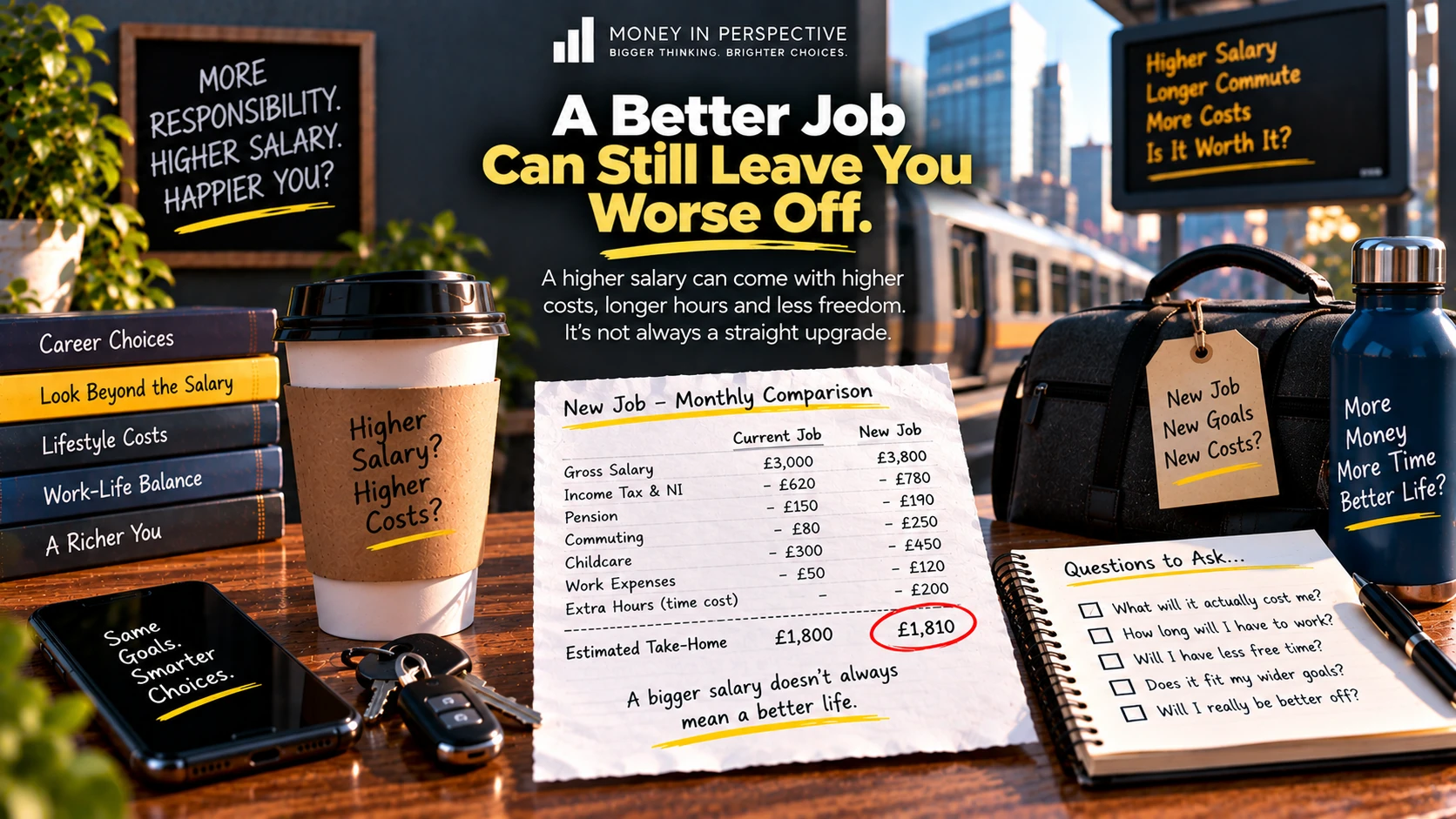

A company car can look like the obvious winner in a job offer. Someone else buys or leases the vehicle, you avoid finding a deposit, and the monthly cost can appear to be little more than the tax shown on your payslip. A cash allowance can feel less exciting. It arrives as extra salary, loses some of its shine to tax and National Insurance, and then leaves you responsible for finding, funding, insuring and maintaining a car.
But the better offer is not really “company car versus cash”. It is one employment package versus another. The result depends on the car’s list price and emissions, your tax position, the allowance, business mileage and what the employer covers. It also depends on whether you would otherwise buy an expensive new car or keep a modest used one.
An electric company car can be extraordinarily tax-efficient. A higher-emission petrol model can be much less attractive. A generous allowance can be valuable if you already own a suitable vehicle, or disappear quickly if you finance a car that costs more than the allowance puts into your bank account. The monthly figure on the offer letter is only the beginning.
The two offers are taxed differently
A cash car allowance is normally additional employment income. Income Tax applies through payroll, and employee National Insurance generally matters too. Qualifying business mileage can change the NI treatment of some allowances, which we return to below. Student-loan and pension deductions may also affect what you receive.
A company car available for private use is generally taxed as a benefit in kind. Broadly, the calculation starts with the car’s tax list price, including relevant accessories, and applies a percentage based on emissions and, for certain plug-in hybrids, electric range. It is not simply the employer’s monthly lease payment. GOV.UK explains the company-car tax calculation.
For 2026/27, a zero-emission car has an appropriate percentage of 4%. A petrol car emitting 140–144g/km uses 34%, as shown in HMRC’s company-car percentage tables. Two cars can therefore have the same £40,000 list price and produce very different taxable benefits.
There is one important qualification when the employer offers cash instead. Optional remuneration rules can require a comparison with the cash given up. Cars emitting no more than 75g/km are excluded from that comparison; for higher-emission cars, the larger of the amount foregone and the modified normal benefit generally matters. HMRC sets out the cash-alternative rules. Our examples account for this distinction.
A £45,000 salary and a £6,000 cash allowance
Consider an illustrative employee in England, Wales or Northern Ireland earning £45,000. Assume the standard Personal Allowance, National Insurance category A, no student loan, no pension adjustment and no other taxable benefits. The allowance is fully subject to employee NI in this example, with no qualifying business-mileage adjustment. All figures describe a full tax year and use simplified annual calculations.
The employer offers either a £6,000 annual allowance or a zero-emission company car with a £40,000 tax list price. The £45,000 base salary stays the same under either option: there is no additional salary deduction or employee car contribution. That last assumption is essential when comparing this example with a salary-sacrifice quotation.
With cash, gross earnings rise to £51,000. The 2026/27 standard Personal Allowance is £12,570 and the basic-rate band is £37,700, putting the higher-rate threshold at £50,270 for this employee. Category A employee NI is 8% between the Primary Threshold and Upper Earnings Limit, then 2% above it. HMRC publishes the tax and NI thresholds together.
The first £5,270 of the allowance remains in the basic-rate band; the remaining £730 enters higher-rate tax. The incremental calculation is:
| Deduction from the £6,000 allowance | Annual calculation | Amount |
|---|---|---|
| Basic-rate Income Tax | £5,270 × 20% | £1,054.00 |
| Higher-rate Income Tax | £730 × 40% | £292.00 |
| Employee NI within the main band | £5,270 × 8% | £421.60 |
| Employee NI above the upper limit | £730 × 2% | £14.60 |
| Total additional deductions | £1,782.20 |
Additional Income Tax is £1,346 and employee NI is £436.20. The result is £6,000 − £1,346 − £436.20 = £4,217.80 a year, or approximately £351.48 a month. Actual payroll NI uses pay-period thresholds and rounding, so this is an annualised comparison rather than a promised payslip figure.
The allowance sounded like £500 a month. Before pension or student-loan effects, the spendable amount in this example is closer to £351. Our take-home pay tool can help explore the cash-pay side; it does not calculate the company-car benefit itself.
Now compare the electric company car
The £40,000 zero-emission car produces a taxable benefit of £40,000 × 4% = £1,600. Added to the £45,000 salary, this remains within the basic-rate band. The employee’s Income Tax cost is therefore £1,600 × 20% = £320 a year, or approximately £26.67 a month.
The low-emission exclusion means the £6,000 cash alternative does not replace the £1,600 benefit in this calculation. The ordinary company-car benefit itself does not attract employee Class 1 NI; the employer normally pays Class 1A NI instead. HMRC explains what employers report and pay.
We now have two very different-looking numbers:
| Option | Employee position |
|---|---|
| £6,000 cash allowance | £351.48 monthly net cash |
| £40,000 electric company car | £26.67 monthly Income Tax cost |
The EV appears exceptionally attractive, but these numbers measure different things. The cash employee receives money and must provide a vehicle. The company-car employee receives use of a vehicle, possibly with insurance, servicing, maintenance and tyres included. Choosing the car also means giving up the net cash allowance. The £27 tax bill is not the full economic cost of that choice.
Change the car and the answer can flip
Keep the salary and £40,000 list price, but choose a petrol car emitting 140g/km. At 34%, the taxable benefit becomes £40,000 × 34% = £13,600. With no employee contributions or other adjustments, this also exceeds the £6,000 cash alternative, so the optional remuneration comparison does not increase the benefit in this example.
Part of the benefit now pushes the employee into higher-rate tax. The first £5,270 costs £5,270 × 20% = £1,054; the remaining £8,330 costs £8,330 × 40% = £3,332. Total employee Income Tax is £4,386 a year, or £365.50 a month.
Suddenly the same scheme looks different. Cash provides roughly £351 a month after the stated deductions, while the petrol company car creates around £366 a month of tax. That does not automatically make cash better: privately obtaining and running the same car could cost much more. It does show why asking a colleague whether the scheme is “good” tells you little without knowing which vehicle they selected.
The list price matters more than the discount
An employer may negotiate an excellent fleet discount without reducing the figure used for the employee’s benefit calculation. The relevant tax list price and taxable accessories matter, alongside emissions, availability and any qualifying employee contributions. The employer’s internal lease cost is not enough to calculate your tax bill.
Ask for the actual P11D/list-price figure, the appropriate percentage and a clear description of what the scheme includes. Check employee contributions separately: a quoted tax figure may exclude them. Insurance, servicing and tyres should be confirmed in the terms rather than assumed from the phrase “company car”.
That is the same broader lesson as looking beyond the monthly car payment. A convenient monthly number can be accurate while leaving out much of the decision.
Cash gives you freedom, but also every bill
The strongest argument for cash is flexibility. You may already own a suitable vehicle outright. If the employer offers £6,000 a year, you do not have to sign a £500-a-month finance agreement in response. Check the employer’s vehicle requirements and business-insurance conditions, but do not mistake the gross allowance for a spending instruction.
Using our example, approximately £4,218 survives Income Tax and employee NI. Suppose the existing car costs £3,000 a year in insurance, servicing, maintenance, tyres and depreciation, excluding fuel. That leaves about £1,218 of the allowance after those assumed costs.
The comparison becomes less comfortable if you interpret “£500 monthly allowance” as “I can afford a £500 monthly car”. Your net allowance is around £351, and finance is only one bill. For a full economic comparison, include depreciation and finance interest without also counting the whole purchase price or loan principal as an annual cost. For a cash-flow budget, separately check the actual payments and any deposit or final payment you must fund.
This distinction matters because ownership creates both an asset and obligations. A car you already own is not free to run, but neither should its entire original purchase price be charged again against this year’s allowance.
Business mileage can change the answer
For employees using their own car or van for qualifying business journeys, the 2026/27 approved Income Tax mileage rates are 55p for the first 10,000 business miles and 25p thereafter. These are the updated rates, not the older 45p figure. HMRC’s mileage guidance explains the approved amounts.
Employers may pay less. If they do, you may be able to claim tax relief on the qualifying shortfall, not reimbursement of the entire shortfall from HMRC. Ordinary commuting does not become business travel simply because you need a car to reach work. GOV.UK explains mileage-relief eligibility.
There is also a separate NI rule. Relevant motoring expenditure can include a car allowance as well as mileage payments, and qualifying business miles can support a deduction from NI earnings at a flat 55p per mile. The treatment depends on the arrangement and payments already made; it is not an extra universal allowance on top of every reimbursement. Ask payroll to check your position. HMRC explains this distinction in its mileage-rate change guidance.
Company-car reimbursement is different. From 1 September 2026, the advisory electricity rates are 7p a mile for home charging and 15p for public charging; petrol and diesel rates vary by engine size. HMRC’s advisory fuel rates are reviewed quarterly and apply to company cars, rather than replacing the own-car mileage rates.
Someone driving 15,000 business miles should therefore inspect the reimbursement policy much more closely than someone driving 500. Reimbursements are not pure profit: the own-car rate helps cover vehicle costs as well as fuel. Include the associated fuel, wear and depreciation before deciding how much better off the mileage arrangement leaves you.
“Free fuel” can be surprisingly expensive
An employer-provided fuel card can be useful, but private petrol or diesel in a company car can create a separate taxable fuel benefit unless the private fuel is properly made good. The charge is not simply the amount spent at the pump. That makes the value particularly dependent on how much private fuel you actually use.
For 2026/27, the car-fuel benefit multiplier is £29,200. Applied to the 34% petrol car, this gives £29,200 × 34% = £9,928 of taxable fuel benefit. If the whole benefit falls at 20%, the tax is £1,985.60; at 40%, it is £3,971.20.
Those are separate tax-band illustrations. Our £45,000 employee with the £13,600 petrol-car benefit is already in the higher-rate band, so the additional fuel benefit would cost £3,971.20 under the stated assumptions. It would be misleading to apply 20% merely because their cash salary started below the higher-rate threshold.
Electricity is different: HMRC confirms it is not fuel for the car-fuel benefit charge. That does not mean charging is costless to the household. Check who pays at home and on the road, and what the scheme reimburses.
Salary sacrifice needs its own comparison
Some employers provide cars through salary sacrifice, where contractual salary is reduced in exchange for the benefit. This is different from our example, in which £45,000 of base pay remains intact. A salary-sacrifice quotation needs both the net pay given up and the benefit tax included in its total employee cost.
The low-emission exception to optional remuneration rules helps explain the appeal of electric-car schemes. But the £26.67 monthly benefit tax in our example must never be presented as the total cost of a scheme that also deducts hundreds of pounds from salary.
Salary sacrifice can affect pension arrangements and earnings-related statutory payments, depending on the scheme and how the employer calculates them. HMRC explains the effects of salary sacrifice. Request a personalised before-and-after illustration and read the early-exit terms, rather than relying solely on a promotional tax-saving percentage.
Cash can also affect more than tax and NI. Student-loan deductions may rise; pensionable pay depends on the scheme; and the Personal Allowance tapers when adjusted net income exceeds £100,000. Scottish employment Income Tax bands differ from those used here. A company-car benefit can itself affect your wider tax position, so the comparison needs both complete packages.
These interactions are why understanding your student-loan repayment rules matters when assessing extra pay. There is no universal net value for a £6,000 allowance.
What happens if you leave the employer?
If the employer or leasing provider owns the car, leaving the job normally means returning it, subject to the scheme terms. When it is the household’s only vehicle, a career change can quickly become a transport problem. Salary-sacrifice schemes may also have early-termination provisions that deserve careful reading before you sign.
With a privately owned or financed car, the vehicle usually stays with you, but so does any finance commitment. If the next employer offers no allowance, the payment does not politely disappear. The risks sit in different places: one option ties access to a car to the job; the other can leave you funding a commitment after the allowance stops.
This belongs in the wider question of whether a better job leaves you better off. Benefits have value, but the household needs to understand how dependent that value is on keeping the employment arrangement.
What would you actually drive without the offer?
Suppose the choice is our £6,000 allowance or £40,000 EV. Would you genuinely obtain a £40,000 car privately? If you would happily drive a £15,000 used car, comparing the company EV only with privately financing an identical new vehicle answers the wrong question.
Cash gives you the option to choose less car. That can be financially valuable. The reverse also applies: if you would privately lease something expensive anyway, the low-tax company vehicle may replace a substantial personal cost.
Getting inexpensive access to an expensive vehicle you never wanted is not automatically better than receiving flexible cash. A benefit is valuable partly because of what it replaces in your actual life, not simply because the brochure has a large number on its front page.
Put the annual outcomes side by side
Start with four numbers: the net annual allowance, the employee tax and contributions for the company car, the annual cost of the private vehicle you would really choose, and reimbursement under each option. Include fuel or charging and anything excluded by the employer. Compare like periods and avoid mixing a one-off deposit with a recurring annual cost without explaining the treatment.
Return to the employee whose allowance nets £4,217.80 and whose existing car costs an illustrative £3,000 a year, including depreciation but excluding fuel. Assume the company EV covers insurance, servicing, maintenance and tyres, with no employee contributions. Set fuel, charging and mileage reimbursement aside for this limited comparison:
| Annual position relative to base pay | Cash and existing car | Company EV |
|---|---|---|
| Net allowance received | £4,217.80 | £0 |
| Assumed own-car costs | −£3,000.00 | £0 |
| Company-car Income Tax | £0 | −£320.00 |
| Net annual position | £1,217.80 | −£320.00 |
On these assumptions, cash leaves the household £1,537.80 a year better off after the listed costs. That is a measurable difference, not a claim that the vehicles or experiences are equivalent. The EV option supplies a newer £40,000 car and transfers much of the maintenance responsibility and ownership risk to the employer.
The employee must decide whether that difference is worth paying for what the EV provides. Change the private-car cost, employee contributions, mileage or charging bill and the result changes. The comparison becomes useful precisely when those assumptions are visible.
Electric cars have a strong tax advantage, but rates move
At the 2026/27 4% percentage, a £50,000 zero-emission company car creates £2,000 of taxable benefit. If it all falls within one band, that means £400 a year at 20% or £800 at 40%. It can be extremely competitive when it replaces a new car the employee would otherwise fund privately.
However, the rate is not fixed for the life of a contract. The government has set a 5% zero-emission percentage for 2027/28 in its published company-car tax changes. A multi-year quotation needs the expected tax in each year, together with its other terms, rather than multiplying this year’s monthly tax by the whole contract.
Cash remains worth considering when you own a suitable car, prefer buying used and keeping vehicles for years, or do not particularly value the models on offer. The company car can be excellent value when it replaces substantial costs you would incur anyway. Neither conclusion requires pretending the other option is foolish.
The better offer leaves you better off after the car
Company-car decisions are often reduced to tax because tax is relatively easy to calculate. The real question is broader: what position does each option leave you in once you have the transport you actually need?
With cash, calculate what reaches your bank account and subtract the real cost of your chosen vehicle, accounting for business reimbursement. With the company car, include benefit tax, employee contributions, salary foregone where relevant, private fuel or charging and anything excluded. Then consider ownership, convenience, vehicle quality, employment risk and what happens when you leave.
A £6,000 allowance is not £6,000 of spendable car budget. A £40,000 company car is not a £40,000 gift. And an EV costing £27 a month in tax is not automatically better than £351 a month of net cash. They are different offers, and the smart decision is the one that leaves you in the better position after the car is dealt with.
Rules checked on 9 October 2026. Examples are illustrative annual comparisons, not individual payroll quotations or personal tax advice.