
Travel insurance is one of those purchases that feels easiest to question when everything goes well. You pay for a policy, spend a week abroad, come home without needing a doctor, missing a flight or losing a suitcase, and the insurance appears to have done absolutely nothing.
That can make the next trip tempting. You already have a UK Global Health Insurance Card. The airline has rules for delays and cancellations. Your credit card may offer some protection on purchases. The holiday itself might only have cost £700. Spending another £30, £50 or £80 on insurance can start to feel like paying for a problem you do not expect to have.
The difficulty is that travel insurance is designed for the version of the holiday where something goes badly wrong. A delayed bag is irritating. A cancelled trip can be expensive. A serious illness abroad can become a five-figure or even six-figure problem, particularly once medical transport is involved.
The Foreign, Commonwealth & Development Office gives uninsured incident examples of £25,000 or more for a broken leg in Spain, £80,000 or more following a quad-bike accident in Greece, and £150,000 or more for a stomach bug or infection treated in a US hospital. These examples include treatment and possible or required evacuation or repatriation; they are not typical hospital prices or bills to add together. See the FCDO’s published examples.
That changes the question. The decision is not simply whether you think you will claim. It is whether the financial consequence of the wrong kind of incident is one you are willing and able to carry yourself.
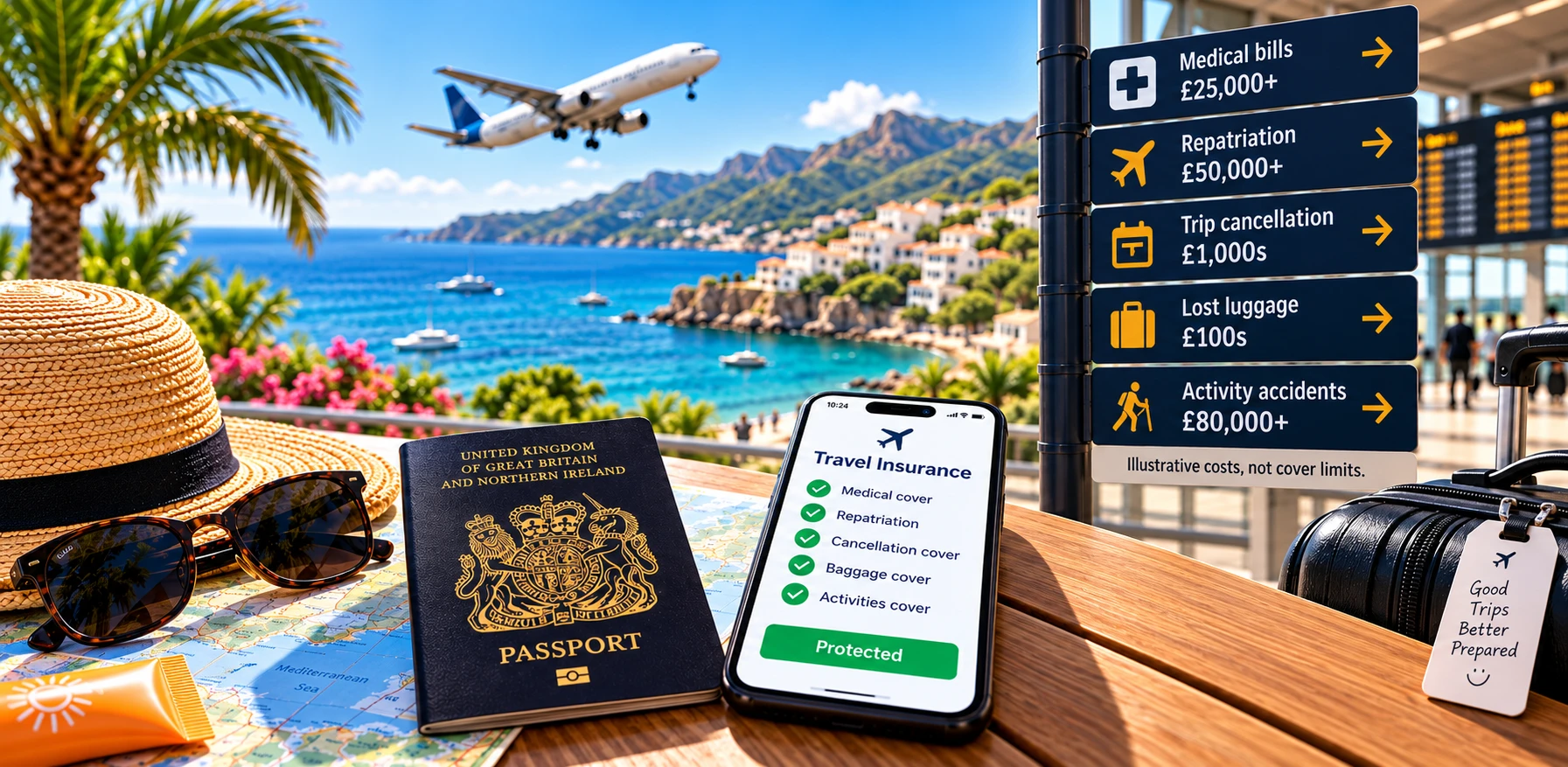
The artwork illustrates possible financial exposures, not typical costs, minimum charges or policy limits. Its £50,000+ repatriation figure is an illustrative scenario, not a quoted tariff. Costs can overlap, and cover depends on the policy.
A GHIC is valuable, but it is not travel insurance
The UK Global Health Insurance Card is free and genuinely useful for eligible travellers. In countries where it is valid, it provides access to medically necessary state healthcare on local terms. Treatment may be free or involve charges a resident would also pay. Check eligibility and destinations rather than assuming that the word “Global” means it works everywhere.
That can include emergency care and necessary treatment for pre-existing conditions. The healthcare provider decides what cannot reasonably wait until you return home, and some treatments need arranging in advance. The NHS explains what the card covers.
But a GHIC or EHIC is not a substitute for travel insurance. It does not cover private healthcare or the cost of bringing you home. A nearby private hospital and a state facility may present very different bills, even in the same resort. NHSBSA explicitly excludes repatriation and recommends insurance alongside the card.
That last distinction can matter more than the original hospital bill. If you cannot safely use your booked flight, getting home may require an escort or specialist transport. Your insurer should arrange covered medical repatriation; without cover, arranging and paying for it becomes your responsibility. The FCDO’s hospitalisation guidance explains the practical steps. A free health card and a travel policy therefore solve different problems.
The cheap holiday can create the expensive risk
Suppose two people book a four-night European break for £650 each. One spends another £35 on suitable insurance; the other decides the trip is cheap enough to self-insure. These prices, and the other policy premiums in this article, are illustrative examples rather than current quotations or promises of available cover.
If both trips go perfectly, the uninsured traveller has kept £35. Now imagine that traveller falls badly and needs surgery, several nights in hospital and help getting home. The premium saving did not cause the accident, but the decision changed who carries the financial consequences of a covered event.
This is what makes insurance comparisons slightly strange. A claim-free holiday tells you little about whether the decision was sensible beforehand. The purpose is to transfer potentially unaffordable risks, not to make every ordinary holiday cheaper or to recover the premium through small claims.
A £40 policy on an £800 holiday costs £40 ÷ £800 × 100 = 5% of the trip price. That can feel expensive. Yet the value of the cover depends on the risks transferred, the limits and the conditions, not just the cost of the flights and hotel. As with the extras that turn a £400 holiday into £1,100, the advertised trip price is only part of the financial picture.
Cancellation cover matters before you leave home
Travel insurance belongs in the booking decision, not just the packing list. The Department for Transport recommends arranging suitable cover at booking or as soon afterwards as possible, because problems can arise before departure. Its air-passenger guide explains the timing and policy checks.
Imagine the following prepaid costs:
| Prepaid cost | Illustrative amount |
|---|---|
| Flights | £900 |
| Hotel | £1,200 |
| Transfers and activities | £300 |
| Total prepaid | £2,400 |
Three weeks before departure, a close family member becomes seriously ill. If the circumstances meet your policy’s cancellation conditions, appropriate cover already in force may help. If you planned to buy insurance at the airport, you cannot normally insure a loss that has already become known.
The £2,400 is the starting exposure, not an automatic insurance payment. Refunds from suppliers, policy limits, the excess and the definition of an insured cancellation reason all matter. A cancellation limit expressed per person also needs interpreting differently from one expressed per booking. Check when cancellation cover actually starts, particularly when selecting the start date for an annual policy.
Delaying insurance can therefore reduce its usefulness even if the eventual premium is unchanged. Buying early is not a substitute for checking the terms, but buying late cannot rewind the event you wanted covered.
Paying by credit card does not replace a travel policy
Credit-card protection, ATOL and airline passenger rights are useful, but each has a particular job. Treating them as one enormous safety net can leave an expensive gap exactly where you thought you were protected.
Section 75 can make a creditor jointly liable for qualifying breaches of contract or misrepresentation. Broadly, the cash price of the relevant goods or services must be more than £100 and no more than £30,000, and the required contractual relationship must exist. Booking through an intermediary can complicate that relationship. The Financial Ombudsman Service explains Section 75 and chargeback.
ATOL provides financial protection for qualifying flight-inclusive bookings when the protected travel business fails. Check your ATOL Certificate rather than assuming every flight purchase qualifies. The Civil Aviation Authority’s ATOL guidance says explicitly that this is not travel insurance.
Airline rights may provide assistance, refunds or compensation in relevant disruption circumstances. None of these arrangements is a general promise to fund emergency surgery abroad. Equally, where a refund is available from a supplier, insurance does not normally let you recover the same loss twice. Tell the insurer about other recoveries and follow the claims process.
The United States shows why medical cover deserves attention
The FCDO describes US medical treatment as expensive and says there are no special healthcare arrangements for British visitors. Some hospitals may request a deposit from non-residents. Its USA health guidance recommends adequate cover and accessible funds for treatment and repatriation.
That is why a cheap premium does not make a small medical limit adequate. A hypothetical policy offering only £5,000 of medical cover would provide little reassurance against a much larger bill. The relevant questions are what treatment is covered, the overall limit, any exclusions and how assistance is arranged.
Check the destination classification too. Two policies described as worldwide can treat the United States differently. The policy must include the countries you actually visit, and any relevant stopovers, rather than merely sounding international.
Medical and repatriation cover deserve more attention than a £6 difference in premium. It is also worth saving the emergency assistance number somewhere accessible if your phone is lost or you cannot use it yourself.
Pre-existing conditions are not an optional detail
Insurance depends on accurate information. Answer medical screening questions carefully, including questions about physical or mental health conditions, investigations, medication and pending treatment. The FCDO warns that failing to declare relevant conditions can put cover at risk; do not assume that something without a final diagnosis is irrelevant.
A standard policy might cost £40 while a medical declaration produces a higher quotation. At that point it can feel as though honesty is being penalised. But the alternative may be a cheaper policy that does not respond when you need it. Saving £25 is poor value if it undermines a valid £20,000 claim.
The consequences of an incorrect answer depend on the circumstances and applicable rules; not every innocent mistake automatically defeats every claim. If you are unsure what a question means, ask the insurer and keep its answer. The Financial Ombudsman Service explains medical-condition disputes in travel insurance.
Health changes after purchase need attention too. Read what the policy requires you to report before travelling and obtain confirmation of any revised cover. Buying a policy once is not a guarantee that it still matches changed circumstances months later.
Activities can change the policy without changing the holiday
Imagine booking a beach holiday and deciding on day three to go quad biking. The activity takes two hours, but it can transform the risk you need covered. Sports, vehicle use and adventure activities may require specific cover, and some activities may be excluded altogether.
Travel Aware describes a British tourist whose insurer refused a £23,000 medical bill after a motorbike accident. The policy covered vehicles only up to 50cc, while the bike involved was 125cc. Read the official case example. Having some vehicle cover was not enough for the vehicle actually used.
Check the activity, engine size where relevant, licence requirements and other conditions before participating. Do not assume that an activity is covered because it is widely sold to tourists or offered by the hotel. The policy you bought for the holiday you imagined on day one may not fit the holiday you improvise later.
That is a useful reason to investigate likely activities before comparing premiums. A specialist add-on can be part of the true holiday budget, just as equipment hire and transport are.
Excess is the part you agree to pay yourself
A policy can advertise impressive limits while leaving smaller losses largely with you. Suppose a valid baggage claim is assessed at £350 and one £100 excess applies. The illustrative payment would be £350 − £100 = £250, assuming no other limit or deduction affects it.
The word “assessed” matters. The amount you paid for an item is not necessarily the amount a policy will pay, and single-item limits, valuables limits and evidence requirements may apply. The headline baggage limit does not answer every question about a particular lost object.
Some policies apply excesses per person, per section or per claim. A single incident could involve more than one deduction, depending on the terms. The Financial Ombudsman Service explains policy excesses and limits.
For a major medical claim, an affordable excess may be a manageable part of the risk. For £180 sunglasses, it can make the likely recovery small. This does not make an excess inherently unfair; it means you should decide which smaller losses you can comfortably carry yourself.
Single-trip, annual or family cover?
One holiday may suit a single-trip policy. Several holidays may make annual multi-trip cover more economical or convenient. But “annual” describes the policy period, not permission to take one uninterrupted twelve-month trip.
Consider illustrative prices of £32 for a single trip and £58 for an annual policy. Three comparable single-trip premiums would total 3 × £32 = £96, making the annual price £38 lower. That saving matters only if the annual policy covers all three trips, travellers, destinations and activities with suitable limits.
Check the maximum length of each trip, any total time-away restriction and whether travel must start and end in the UK. Longer stays may need specialist cover. MoneyHelper explains the main travel-insurance options and exclusions.
Family policies need the same care. One person may have a condition to declare, another may be skiing, and an older teenager may travel separately. Check who counts as a family member and whether independent trips are covered. A low price per person means little if one person’s actual circumstances fall outside the contract.
Baggage is probably not the biggest reason to buy insurance
Lost luggage is easy to picture. Medical evacuation is less familiar, but the financial consequences can be far larger. That can make it sensible to assess medical and repatriation protection before choosing between £2,000 and £3,000 of baggage cover.
If a suitcase is delayed or lost, notify the airline promptly and follow its reporting and evidence requirements. Depending on the circumstances, airline obligations and insurance may both be relevant, but they are not an opportunity for double recovery. Keep receipts for reasonable essential replacements rather than assuming every purchase will be reimbursed.
A delayed suitcase can spoil a holiday. A major uninsured medical bill can affect finances long after the suitcase would have been forgotten. The comparison is about the scale of the risk, not whether one inconvenience is more annoying at the time.
Insurance does not cover every bad holiday event
The opposite mistake is to buy a policy and assume every unpleasant event must now be claimable. Known events, destination advice, alcohol-related circumstances and particular activities can all raise coverage questions. The wording and facts matter; a disappointing holiday is not itself an insured event.
Check current destination advice when booking and again before departure. The FCDO warns that travelling against its advice can invalidate cover. Do not assume a policy includes cancellation merely because advice changes: ask what the particular contract provides.
There is also a practical difference between being insured and having immediate access to cash. You may need to pay costs upfront and seek reimbursement. In an emergency, get urgent help first, then contact the insurer’s assistance service as soon as possible and follow its authorisation procedures. Keep policy details, medical documents and receipts accessible to someone travelling with you.
A worked decision: £38 policy versus self-insuring
Consider an illustrative traveller booking a £1,500 holiday. A policy costs £38 and meets their needs for medical treatment, repatriation, cancellation, baggage and planned activities. They have read the limits, answered screening questions accurately and checked when the protection begins.
Skipping the policy means keeping £38 in exchange for personally carrying the risks it would otherwise cover. Those risks could include non-refundable trip costs following an insured cancellation reason, certain baggage losses and much larger medical or transport expenses.
We cannot calculate expected value from the premium and trip price alone. We would need probabilities, likely losses and the details of the cover. Nor should we claim the premium is the maximum possible downside of buying insurance. Excesses, exclusions, costs above limits and uncovered losses can still leave the insured traveller with a bill.
What is known upfront is the £38 premium. Suitable insurance transfers specified risks within a contract; it does not make all risk disappear. The argument for buying it is strongest where the remaining covered exposure would be difficult or impossible to absorb yourself.
When self-insuring can make more sense
Not every travel-related loss needs separate insurance. You might decide against extra gadget cover for an inexpensive old phone, or accept a larger excess because you can comfortably fund a smaller claim. That is a different decision from carrying the whole risk of medical treatment and repatriation.
You may already have cover through a packaged bank account, credit-card benefit or employment arrangement. Inspect it before buying another policy. Check insured people, age restrictions, destination area, trip duration, medical screening, activities and cancellation limits. A benefit you have never read is not yet a reliable travel plan.
The task is to compare suitable protection, not collect policies. Our guide to deciding which travel upgrades are worth paying for applies the same principle: spend on the feature you actually need, rather than the reassuring label.
Buy the policy for the holiday you are taking
Price-comparison tables make premiums easy to rank. They make exclusions much less prominent. An £18 policy that excludes your activity or provides insufficient cancellation cover is not automatically better value than a £36 policy that meets those needs.
Start with the trip: where you are going, how long you will stay, what you have prepaid, who is travelling and what you will do. Include medical declarations, cruises, vehicle use and relevant transit countries. Then identify suitable cover and compare prices among policies that meet that requirement.
For an eligible traveller visiting a participating country, a GHIC and insurance can work together. The card provides its specific healthcare entitlement; the policy can cover other risks, subject to its terms. They overlap in some practical situations but are not interchangeable. Check where your card is valid and apply through the official free service.
That is also why an all-inclusive holiday should not be read as an all-risks holiday. The booking describes what the supplier provides. Your protection against illness, cancellation and other losses needs its own examination.
A claim-free holiday is a good outcome
The value of insurance is not proved by making a claim. It lies in transferring financial risks you did not want to carry yourself. Coming home safely does not retrospectively make that decision foolish, any more than a quiet year makes a household emergency fund pointless.
A £40 policy can feel like wasted money after an uneventful trip. It can look very different beside a potentially unaffordable medical bill. The useful question is which costs you could comfortably pay yourself if the wrong thing happened, and whether the policy really addresses the rest.
You may be happy to replace toiletries or absorb a £100 excess. You may be much less comfortable arranging medical repatriation from another country. That is where suitable travel insurance earns its place in the holiday budget: not because every trip goes wrong, but because occasionally one does.
Guidance checked on 25 October 2026. Premiums and worked budgets are illustrative, not product quotations. This article provides general information; read the policy wording and confirm cover for your circumstances.