Sports fandom used to sound financially simple.
Buy a ticket if you wanted to attend.
Turn on the television if the match was being shown.
Perhaps buy a shirt.
Modern fandom is more complicated.
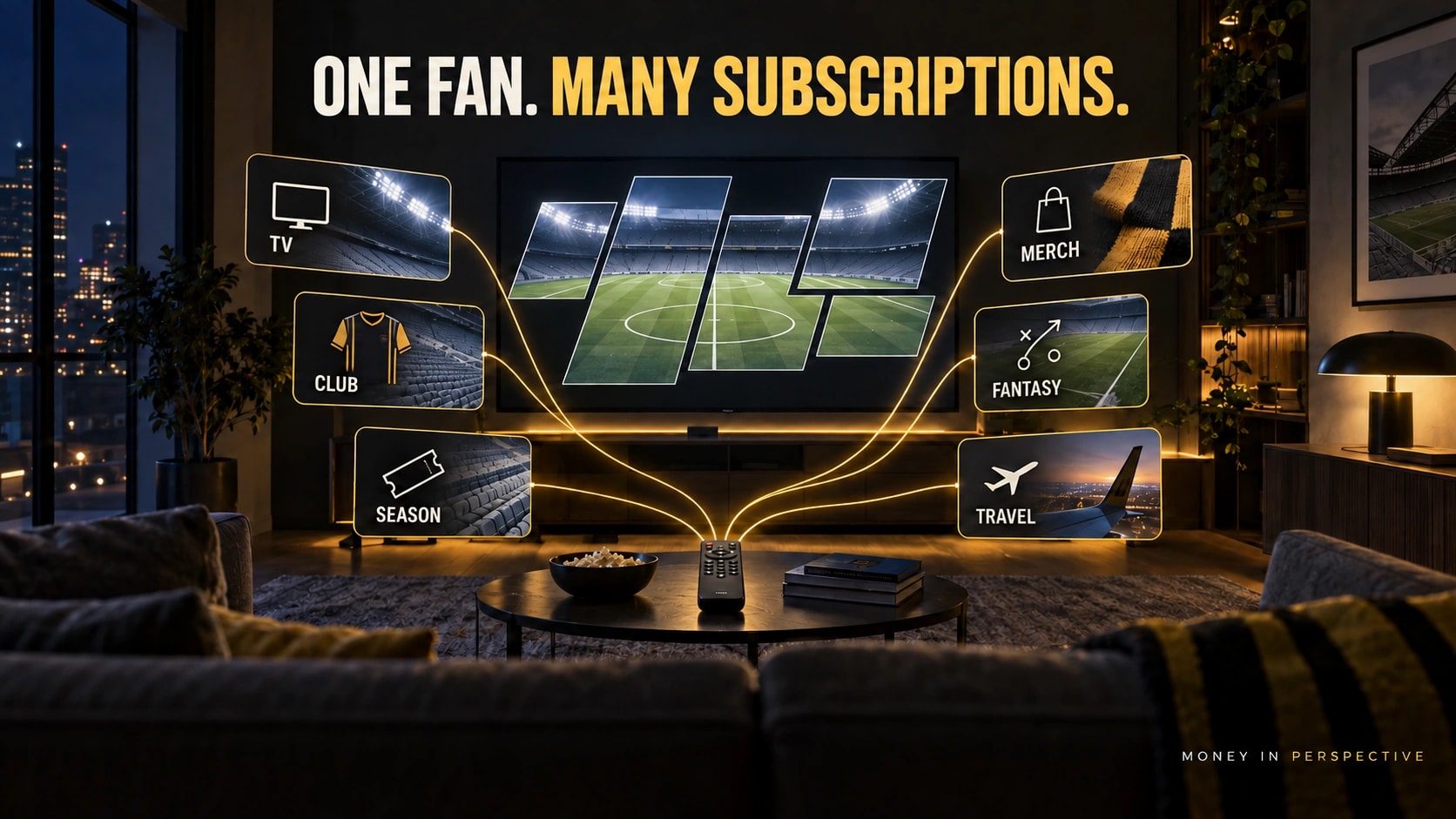
Today, supporting a sport or team can involve a collection of recurring payments that look remarkably similar to a subscription bundle.
Television package.
Streaming service.
Club membership.
Season ticket.
Premium sports app.
Fantasy platform.
Merchandise.
Away travel.
Digital content.
The sport may have a season.
The payments often do not.
Broadcasting is the most obvious part.
A football supporter may need access to several services depending on which competitions they want to watch.
Domestic league coverage may sit with one broadcaster.
European competition somewhere else.
Cup matches can move again.
Other sports are fragmented in similar ways.
The result is that a fan can pay several monthly subscriptions without receiving access to every event they care about.
This is unusual compared with many entertainment categories.
If you subscribe to one film service, you know you are buying only that library.
Sports fans often feel they are buying access to a team, yet broadcasting rights are divided across competitions and territories.
That emotional expectation can make the fragmentation particularly frustrating.
Monthly pricing softens the effect.
£25 here.
£15 there.
Another package bundled with broadband.
The total can become significant before anybody calculates it annually.
Suppose a household spends £60 per month on sports-heavy television packages.
That is £720 each year.
If the main reason for keeping those packages is sport, £720 belongs in the sports budget just as much as match tickets do.
This does not mean the subscriptions are poor value.
A dedicated fan may watch hundreds of hours.
Cost per hour can be extremely low.
The point is to recognise the complete cost.
Club membership adds another layer.
At high-demand football clubs, membership can provide ticket priority or access.
In practice, some supporters pay annually before they are even eligible to purchase certain tickets.
It is almost a subscription to the opportunity to spend more money.
That sounds cynical, but memberships can also provide real benefits.
Discounts.
Content.
Priority.
Events.
The useful question is whether you actually use them.
Season tickets are the original sports subscription.
Pay once or through instalments and receive access across a season.
For regular supporters, they can provide excellent value compared with buying individual matches.
They also create a recurring annual expectation.
Renewal comes around.
The seat has history.
Friends sit nearby.
Declining can feel much harder than cancelling an ordinary service.
This emotional continuity is part of what makes sports spending unique.
A television subscription is a product.
A season ticket can feel like part of identity.
That makes purely financial evaluation difficult.
Merchandise now behaves like a content schedule too.
Football clubs may release home, away and third kits every season, plus training ranges, retro collections, special editions and collaborations.
Basketball, American football, Formula 1 and other sports have similar merchandise ecosystems.
The supporter is continually offered new ways to display affiliation.
Again, there is no requirement to buy.
But loyalty creates unusually strong demand.
A fashion brand has to convince you to care about the brand.
Your club already has you.
This allows sports organisations to monetise identity across many categories.
Travel is another recurring component.
Home matches.
Away fixtures.
International events.
Tournaments.
European competitions.
Fans may spend on trains, fuel, hotels and flights throughout the year.
A person who would never describe themselves as a frequent traveller can become one because of sport.
For many supporters, these trips are among the best parts of fandom.
The financial point is that travel belongs in the same ecosystem.
A £30 away ticket may create a £150 day.
A European fixture can become a £500 weekend.
One event at a time, the spending feels special.
Across a season, it becomes a substantial lifestyle category.
Sports apps create smaller subscriptions.
Live scores.
Statistics.
News.
Fantasy tools.
Specialist analysis.
Training services.
Some are free with advertising.
Others offer premium tiers.
A few pounds per month looks trivial compared with tickets and television.
That is exactly why it can survive unnoticed.
The same subscription audit used for other digital spending applies here.
Would you pay for another year today?
If yes, keep it.
If you cannot remember when you last used it, cancel.
The sports-betting industry is also heavily integrated into modern fandom, particularly football.
This deserves separate treatment because betting is not simply another entertainment subscription.
Gambling carries financial risks that are fundamentally different from paying for content or tickets.
Supporting a team does not require betting on it.
Any gambling spending should be treated with appropriate limits and caution rather than normalised as part of what fans are expected to spend.
The broader subscription effect comes from how many services can attach themselves to the same emotional interest.
One person loves football.
That one interest can support:
television subscriptions,
club membership,
season ticket,
travel,
shirt purchases,
sports apps,
magazines,
fantasy services,
and hospitality.
That is an impressive commercial ecosystem built around one passion.
This is not inherently exploitative.
Businesses provide products fans want.
The supporter gets entertainment, community and experiences.
The important thing is that recurring spending is easy to overlook because each company charges independently.
No single provider shows you the total price of being a fan.
You have to calculate it yourself.
An annual sports budget can therefore be surprisingly useful.
List everything linked mainly to sport.
Broadcasting.
Tickets.
Memberships.
Travel.
Merchandise.
Apps.
Hospitality.
Do not worry about perfect precision.
If you buy dinner while attending a match, perhaps you would have eaten anyway.
You do not need to allocate every chip financially to football.
The purpose is to understand the broad scale.
If the annual number is £3,000, you can now ask a meaningful question.
Would I willingly spend £3,000 per year on this hobby?
For a committed fan, the answer may be an immediate yes.
Think about what the sport provides.
Regular entertainment.
Friends.
Family traditions.
Travel.
Conversation.
A sense of belonging.
Anticipation.
Emotional highs.
An unreasonable amount of emotional suffering depending on the team.
Three thousand pounds may compare favourably with another expensive hobby.
The figure does not prove the spending is excessive.
It simply reveals the commitment.
If the number feels high, the next step is not cancelling everything.
Rank the experiences.
What matters most?
Live attendance?
Watching every game?
Away travel?
Merchandise?
Perhaps you discover you happily spend £1,500 attending matches but get almost no value from £500 of overlapping television packages.
Cut the second.
Or perhaps you live far from the team and broadcasting is the entire relationship.
Then television is excellent value while expensive annual membership may be less useful.
A good sports budget protects the parts that create the most enjoyment.
This is better than trying to reduce every category equally.
Subscription rotation can sometimes help with broadcasting.
Where contracts and services permit flexible cancellation, you may not need every service all year.
One competition ends.
Another begins.
A monthly subscription can sometimes be activated only when the content matters.
Check terms carefully because long contracts can remove this flexibility.
The point is to buy access deliberately rather than allowing every service to become permanent.
Merchandise can be treated similarly.
You do not need a new shirt because a new shirt exists.
Buy the designs you genuinely like.
Wait for discounts.
Use second-hand markets appropriately.
Older merchandise can carry more emotional meaning than current releases anyway.
The badge does not expire when the manufacturer releases a new template.
Sport is particularly good at selling urgency.
Limited tickets.
New shirt.
Final.
Derby.
Last chance for membership.
Limited edition.
The urgency is sometimes real.
Events happen once.
That is part of why sport is exciting.
A budget allows you to respond to genuine once-in-a-lifetime opportunities without treating every commercial release as equally urgent.
It can be useful to maintain a sports fund.
Save a small amount monthly.
Then when a cup final, tournament or unexpected away trip appears, money already exists.
This turns irregular sports spending into planned spending.
The alternative is often putting the event on a credit card because “you only get one chance”.
That may be emotionally understandable and financially expensive.
There is another subscription hidden inside sports fandom: attention.
Fans spend hours consuming news, transfer rumours, podcasts, previews and analysis.
Much of it is free financially.
It still shows why sport can support such a large commercial ecosystem.
The audience returns constantly.
Businesses value recurring attention because it can be monetised repeatedly.
Understanding that does not reduce the enjoyment.
It simply makes the relationship clearer.
You can love a sport while being selective about the products built around it.
A fan is not a customer loyalty programme.
You can cancel the app.
Skip the shirt.
Watch fewer games.
Attend more games.
Choose whichever version fits your money and your life.
There is no spending threshold required to prove support.
This matters particularly for younger supporters and families where commercial pressure can feel strong.
Children see players wearing new kits.
Friends may have them.
Streaming and gaming connect merchandise with identity.
Parents can acknowledge that without treating every release as essential.
Set expectations.
Choose gifts deliberately.
Explain trade-offs where age appropriate.
Fandom survives.
The subscription model of sports also explains why small price increases matter.
A television package rises by £5.
Membership increases £10.
Shirt prices rise £5.
Train fares rise.
None looks enormous individually.
Across all components, the annual cost of following sport can increase significantly.
This is another reason to review the total rather than each price in isolation.
Renewal itself can become automatic even when value changes.
Season tickets renew.
Memberships renew.
Broadcast packages roll on.
Apps charge again.
The fan can move from actively choosing each product to simply maintaining a sports infrastructure built over several years.
That makes an annual reset useful.
Before the new season starts, imagine you owned none of the current sports products.
Which ones would you buy again today?
Would you repurchase the television package?
Renew club membership?
Buy the season ticket?
Keep the premium statistics app?
The answer may still be yes to almost everything.
That is fine.
The exercise converts inertia back into choice.
It can also reveal where products overlap.
Perhaps two services provide similar analysis.
Maybe a club membership is no longer useful because ticket-buying habits changed.
Perhaps a streaming service was kept for a competition you barely watched last season.
Sports businesses naturally want fans to remain connected year-round.
Supporters should be equally comfortable deciding which connections still deserve money.
The same principle applies to merchandise.
A shirt purchased once is not technically a subscription, but annual release cycles can make it behave like one.
If the expectation is “new season, new shirt,” the household has created a recurring cost even without a direct debit.
Recognising that pattern makes budgeting easier.
None of this removes the emotion from sport.
In fact, intentional spending often improves it.
When you know the season ticket, away trip or television package fits comfortably within the budget, there is less guilt attached to using it.
The aim is not to turn fandom into a financial optimisation exercise.
It is to stop every commercial part of fandom from renewing itself automatically just because the passion for the sport renews itself.
Being a sports fan is not literally one subscription.
It is increasingly a collection of them.
Some are formal recurring payments.
Others are habits with similar regularity.
The season resets and the spending cycle begins again.
That is not necessarily a problem.
A hobby that gives enormous value deserves a budget.
The goal is simply to remain the person deciding what the hobby costs.
Not the broadcasters.
Not the club shop.
Not the app store.
Not the fixture list.
You.
Sport is emotional.
Your spending can still be intentional.