Football shirts occupy a strange place in clothing.
They are sportswear, fashion, memorabilia and identity at the same time. A plain polyester top might be judged mainly on quality and price. Put a club badge on it, add this season's design and connect it to players, memories and loyalty, and the economics change completely.
That is why football shirts can cost amounts that surprise people who look only at the material.
The supporter is not buying fabric alone.
They are buying an officially licensed product attached to a valuable club, a manufacturer, a season and an emotional connection that businesses understand extremely well.
The first reason shirts are expensive is commercial licensing.
Major clubs have valuable kit partnerships with global sportswear companies. Manufacturers pay for the right to produce and market the shirts, and clubs earn substantial commercial income through these relationships.
The exact arrangements vary and are often commercially complex. The important point for the buyer is that the retail price reflects much more than manufacturing cost.
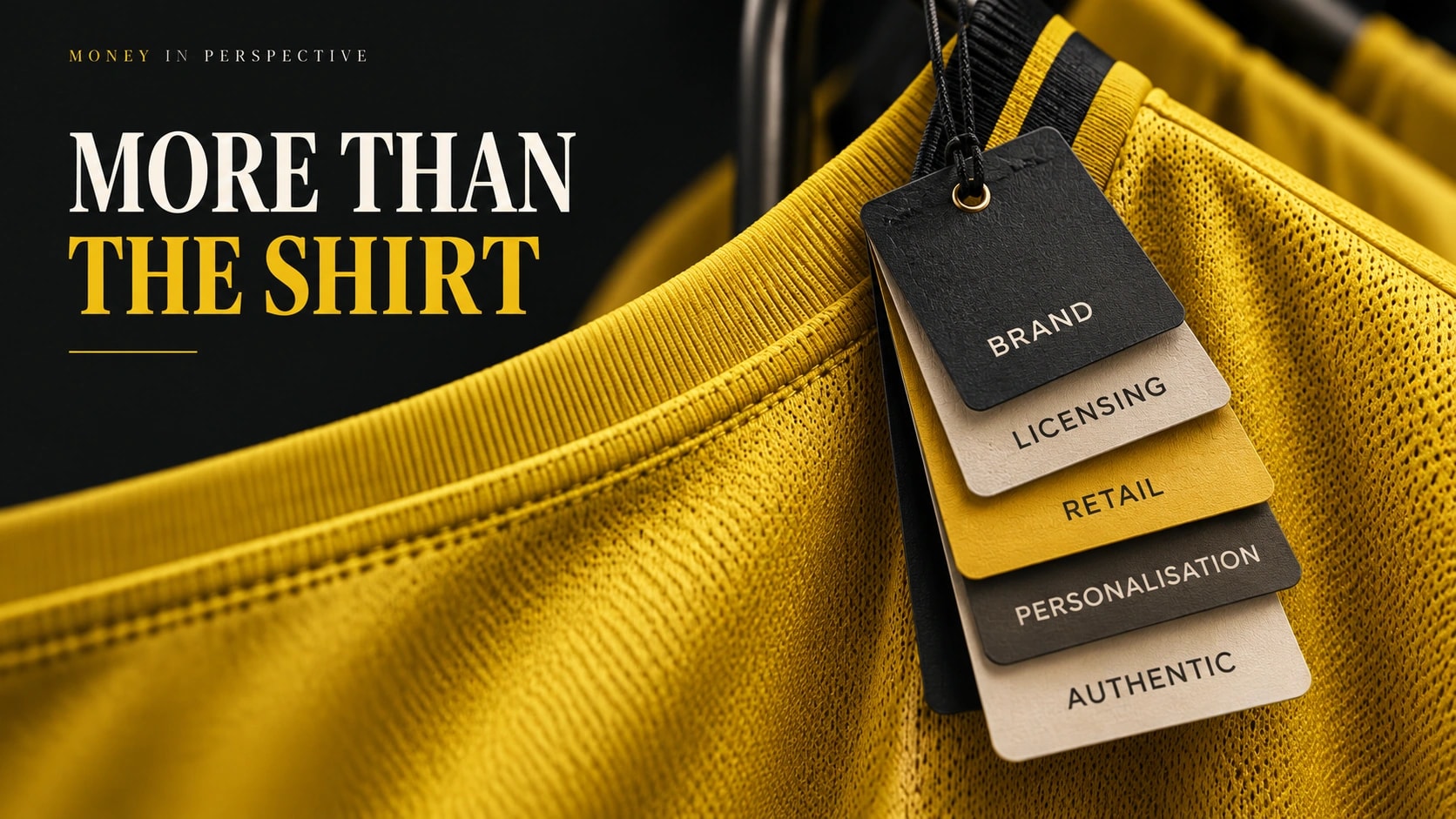
Design, marketing, distribution, licensing, retail margins and the value of the brand all sit inside the product.
This is not unique to football. A designer handbag does not cost what it costs because leather is unusually expensive. A concert T-shirt is not priced purely according to cotton. Brand and association have economic value.
Football simply combines brand loyalty with a product supporters may feel emotionally connected to every season.
The second reason is that there is rarely one shirt anymore.
Home.
Away.
Third.
Goalkeeper.
Training wear.
Pre-match shirt.
Special editions.
Retro collections.
Collaborations.
A supporter can now spend an impressive amount of money without ever leaving one club's clothing range.
This creates a shift from buying “the shirt” to choosing among a constant stream of products.
Annual kit cycles reinforce the pattern.
A perfectly functional shirt can become last season's shirt after roughly a year. It still fits. The badge has not changed. The team can still be supported while wearing it.
Commercially, however, the new design resets attention.
New season.
New players.
New photographs.
New campaign.
The product becomes part of the excitement of starting again.
For adults who enjoy collecting or wearing shirts, that may be worth paying for.
For families, the cycle can be more difficult because children may genuinely care about having the current kit and also physically grow out of older ones.
One season can therefore produce repeated purchases even when the previous shirt is still in excellent condition.
Personalisation raises the price further.
Add a player's name and number, league badges or competition patches and the shirt can move significantly above the base price.
The emotional logic is obvious. A child may not simply want the shirt. They want the shirt associated with a favourite player.
The financial risk is that players transfer, squad numbers change and children change favourites with extraordinary efficiency.
Personalisation can also reduce resale value for some buyers, although famous players or significant seasons can sometimes do the opposite.
Premium versions add another layer.
Many manufacturers offer a standard replica shirt and a more expensive “authentic”, “elite” or player-style version. The premium product may use lighter fabrics, different cuts, ventilation technology or construction closer to what players wear on the pitch.
Objectively, it can be the more technically advanced garment.
That does not automatically make it better for a supporter sitting in the stands or watching at home.
In fact, the standard version may be more comfortable or durable for casual use.
This is where football shirts illustrate a broader spending principle: better specification is not always better value.
If the premium shirt costs much more for features designed around professional athletic performance, ask whether those features matter to your use.
For a collector, authenticity may itself be the value.
For everyone else, the standard version may provide almost the same emotional experience.
Shirt pricing also benefits from demand that is less price-sensitive than ordinary clothing.
A supporter cannot simply switch to another club because its shirt is £20 cheaper.
Brand loyalty is unusually strong.
If you support Arsenal, Liverpool, Manchester United or any other club, a rival club's cheaper shirt is not a substitute in the normal economic sense.
That gives clubs and manufacturers a powerful market.
Again, this does not mean prices can rise without limit. Fans complain, delay purchases, buy older kits or use second-hand markets. But the relationship is very different from choosing between two generic sports tops.
Limited editions and collaborations push the product even further toward fashion and collectability.
Scarcity can increase desire.
A shirt available for a short period feels more urgent because waiting may mean losing the chance to buy it.
This can lead supporters to purchase faster and think less about whether the item will actually be worn.
The same psychology appears with trainers, watches and other collectible products.
Scarcity can be real.
The urgency it creates is still worth noticing.
Retro shirts are an interesting counterpoint because they show that football clothing can gain emotional value as it gets older.
A shirt associated with a memorable season, player or childhood period can become more desirable decades later.
This is one reason some supporters prefer old designs to new ones.
It also proves that buying the latest shirt is not the only way to express support.
The badge still works on a shirt from ten years ago.
In fact, an older shirt may start more conversations because it carries a story.
This creates several ways to reduce the cost of football clothing without giving it up.
One of the simplest is to buy the previous season's shirt after the new kit launches. Retailers often discount older stock because they need space for the new range.
The product may be nearly identical in quality to something that cost much more a few months earlier.
If being current matters less than owning an official shirt, this can be excellent value.
Second-hand markets are another option.
Children's shirts are particularly suitable because many are outgrown while still in good condition. Adults also sell shirts when wardrobes fill or collections change.
Authentication matters for collectible or expensive pieces, and buyers should take sensible care with marketplaces. But used clothing can significantly reduce cost and extend the life of products already manufactured.
Parents can also create family rules around kits.
Perhaps one new shirt per season.
Perhaps shirts are birthday or Christmas presents.
Perhaps children choose home or away rather than automatically receiving both.
Boundaries can remove repeated negotiation without pretending the desire is unreasonable.
Football matters to children socially. A shirt can be part of belonging, not just clothing.
That deserves to be taken seriously even while the budget remains real.
Cost per wear is useful for adults too.
A £90 shirt worn fifty times costs less than £2 per wear.
A £90 shirt bought because it looked good at launch and worn twice costs £45 per wear.
The retail price is identical. The value is completely different.
This is why buying fewer shirts you genuinely love can make more sense than buying every release.
Quality deserves attention as well.
Supporters are reasonable to expect expensive shirts to last. Follow washing instructions, be careful with printed names and sponsors, and avoid unnecessary high heat if the label warns against it.
A shirt that lasts for years produces more value and may retain resale potential.
There is also the question of counterfeit products.
Unofficial shirts can be much cheaper, which explains their appeal. But quality, legality, labour standards and intellectual-property issues can vary significantly, and buyers may receive something very different from official merchandise.
For people who want lower prices, discounted older official shirts or second-hand products can provide alternatives without pretending the products are identical.
The broader financial question is whether football merchandise has become an automatic annual expense.
If every July creates an assumption that a new shirt must be purchased, pause before treating that as part of being a supporter.
Supporting a team is not a subscription to its clothing catalogue.
Buy the shirt because you like the design, want to mark a season, collect kits or know you will wear it.
Those are real reasons.
“Because there is a new one” is weaker.
The same applies to multiple family members. Four new shirts can turn one launch into several hundred pounds of spending. Add personalisation and the total moves again.
There is no need to feel guilty if the family can afford it and everyone values the shirts.
It should simply be recognised as a meaningful leisure purchase rather than a small piece of clothing.
Football clubs operate in a world where commercial revenue matters. Merchandise is part of the business, and supporters understand that their relationship with the club has a commercial side.
Fans can support that business while still being selective customers.
You can love the club and dislike this year's shirt.
You can support the team while wearing an older kit.
You can wait for a discount.
You can decide the premium version is not worth it.
Loyalty does not remove the right to judge value.
The most interesting thing about football shirts is that the price can be simultaneously unreasonable to one person and completely worthwhile to another.
A neutral observer sees polyester and printing.
A supporter sees the club.
A collector sees design history.
A parent sees the thing their child will wear every weekend.
Value is not purely material.
But emotional value is still value you should choose consciously.
There is also a timing advantage in waiting. Shirts often attract the strongest demand immediately after launch, when the club is promoting them heavily and supporters are excited about the new season. A few months later, the emotional urgency may be lower and discounts may begin to appear.
Waiting can therefore answer two questions at once: do you still like the design after the launch excitement fades, and can you buy it for less?
For collectors, the calculation is different. A collector may deliberately buy at launch because condition, size availability or completeness matters. That is a hobby with its own logic. The important thing is not to confuse collecting with ordinary clothing needs.
Fans can also think about a yearly merchandise budget rather than judging every product separately. If you decide in advance that £150 is available for club merchandise, the question becomes which item deserves the money most. One current shirt with personalisation? Two discounted older shirts? A scarf and one shirt? The budget creates a trade-off that the club shop naturally does not.
This is especially useful because merchandise extends beyond shirts. Jackets, training tops, hats, retro ranges and limited collections can all compete for the same money. Without an overall limit, each item can feel like a separate harmless purchase.
A final point is that expensive shirts deserve to be used. Some supporters preserve them carefully, which makes sense for genuine collections. But if the shirt was bought to wear, wear it. Cost per use improves every time it comes out of the wardrobe.
A football shirt is at its best when it becomes associated with matches, holidays, pub conversations, five-a-side games and seasons you remember.
That is a much better return than keeping it pristine simply because it cost a lot.
If a new shirt becomes part of your memories of a great season and is worn for years, the price may feel entirely justified.
If it spends most of its life in a wardrobe before being replaced twelve months later, the economics are weaker.
Football shirts keep getting more expensive because they are not sold as ordinary clothing.
They are sold as pieces of a sport people care deeply about.
That emotional connection is powerful.
Use it to enjoy the shirt.
Just do not let it convince you that every season requires a new one.