Airports are unusual places to spend money because almost everything about the environment changes normal behaviour.
You arrive early.
You are carrying luggage.
You may be tired, hungry, excited or stressed.
You cannot simply leave the terminal and come back later.
Prices are often higher than you would accept elsewhere.
And somehow, buying a coffee, breakfast, snacks, perfume, headphones and a bottle of water can feel like a completely natural part of getting on a plane.
This is why airports are such effective retail environments.
They do not need to force you to spend.
They create conditions where spending becomes unusually easy to justify.
The first advantage airports have is time.
Passengers are encouraged to arrive well before departure.
Security uncertainty makes people cautious.
Nobody wants to miss a flight because they decided to arrive with four minutes to spare.
Once you clear security, you may have an hour or two with very little to do.
Retail loves idle time.
In an ordinary shopping centre, you are often on your way somewhere else.
At an airport, browsing can become the activity.
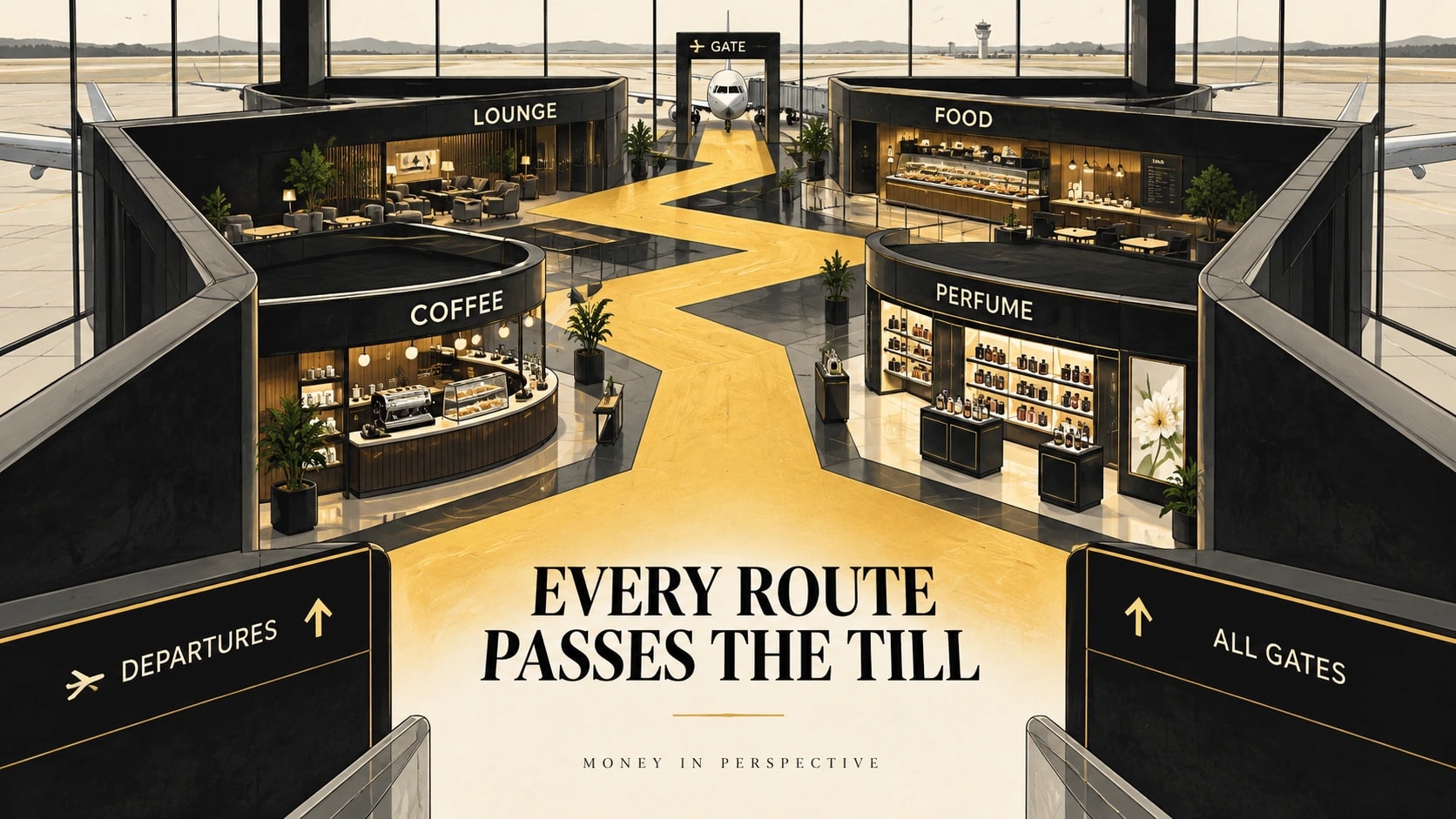
You walk through duty-free because the route is designed that way.
You pass restaurants because you need somewhere to sit.
You notice shops because your gate has not opened.
The longer the wait, the more opportunities there are to spend.
This does not mean airports are manipulating helpless passengers. Shops exist because travellers want them.
The important thing is understanding why purchases that would feel unnecessary elsewhere can suddenly feel reasonable.
Hunger is one of the strongest reasons.
Travel days disrupt routines.
An early flight may mean leaving home before breakfast.
A midday departure can overlap with lunch.
Delays stretch the wait further.
Now the choice is not between an airport meal and a cheaper restaurant down the road.
It is between the options available inside the terminal.
This changes the economics.
A £12 breakfast might feel expensive at home.
At 6:30am after an hour in security, it can feel like the obvious choice.
The same is true of coffee.
Airports are extremely good at meeting tired people immediately after they have completed the stressful part of the journey.
You have taken off your coat, removed electronics, reorganised liquids, queued, scanned everything and finally reached departures.
There is the coffee shop.
The timing is excellent.
One coffee is rarely the problem.
The pattern matters.
Coffee.
Breakfast.
Water.
Snack for the plane.
Another drink while waiting.
A family can spend £40 or £50 before boarding without making one purchase that felt particularly excessive.
Water deserves its own category because security rules can make travellers feel they must buy it after screening.
In many airports, an empty reusable bottle can be carried through and filled at a water station afterward, where facilities are available.
That small habit can avoid repeated bottled-water purchases without creating any inconvenience.
Bringing food can help too, subject to security and destination rules.
A sandwich, snack or children's food from home can reduce the need to buy everything at terminal prices.
This is not about treating the airport like a survival exercise.
If breakfast at the airport is part of your holiday ritual, buy it.
The useful change is deciding what you want to pay airport prices for before hunger makes the decision.
Duty-free retail introduces another powerful idea: the bargain.
The phrase “duty free” sounds like the price should automatically be lower.
Sometimes it genuinely is.
Tax treatment can create savings on certain products and routes.
But not every product is cheaper than it would be online, on the high street or during a promotion elsewhere.
The best defence is simple: know the normal price of expensive things you might buy.
Perfume.
Cosmetics.
Alcohol where relevant.
Electronics.
A large sign saying “travel exclusive” or “duty free” does not tell you the size of the saving.
If you would not know whether £85 is a good price for a fragrance outside the airport, you do not suddenly know inside it.
Airport retail also benefits from holiday psychology.
Once the trip begins, normal spending rules often soften.
You are no longer mentally in an ordinary week.
Money becomes “holiday money”.
A purchase feels attached to the experience rather than the monthly budget.
This can be completely reasonable.
Travel is meant to be enjoyable.
But holiday money can become a category with weak boundaries.
£25 on something small feels less serious because the whole trip already cost hundreds or thousands.
This is a form of relative thinking.
Against a £1,500 holiday, a £30 purchase looks tiny.
Against your normal discretionary budget, it may not.
The airport also creates urgency.
You are there now.
The product is there now.
You may never see it again.
Limited travel editions and terminal-only products lean into this feeling.
Scarcity can make people buy faster because waiting seems risky.
Sometimes the product genuinely is exclusive.
The question is whether exclusivity matters to you enough to justify the purchase.
Premium airport services sell something slightly different: relief.
Fast-track security.
Lounges.
Priority boarding.
Private transfers.
Premium parking.
These products are not necessarily poor value.
They often solve genuine pain points.
The important thing is comparing them with the alternative.
Take lounge access.
Suppose it costs £35.
If you have three hours to wait and would otherwise buy a £15 meal, £6 coffee and £8 drink, the additional cost of the lounge may be small.
You also gain seating, Wi-Fi, quieter space and perhaps a place to work.
For that traveller, the lounge could be excellent value.
Now imagine you have forty minutes before boarding and normally buy nothing.
The same £35 is mostly a luxury.
Still valid if you enjoy it.
Just a different calculation.
Fast-track security works the same way.
At a quiet airport, you may save five minutes.
During peak holiday periods, it can save much longer and reduce stress.
The value depends on the airport, time and traveller.
Priority boarding can also be useful when cabin baggage space matters.
If your seat is already assigned and you have nothing to store overhead, boarding first may provide very little practical benefit.
Airports are very good at turning anxiety into a product.
People worry about queues, luggage, seats and time.
Businesses offer certainty.
There is nothing inherently wrong with this.
Convenience has value.
The useful question is how much the specific certainty is worth.
Forgotten items create another profitable situation.
Travel adaptor.
Charging cable.
Headphones.
Toiletries.
Medication-related accessories.
Sunglasses.
When you realise something is missing at the airport, the purchase becomes urgent and alternatives are limited.
A simple packing checklist can therefore have direct financial value.
Preventing one emergency electronics purchase can save more than weeks of small budgeting efforts.
Children change airport economics dramatically.
Waiting is hard for adults.
It can be much harder for children.
Food, drinks, toys and entertainment become tools for making the journey manageable.
Parents should not feel guilty about spending to reduce stress.
Preparation can simply reduce how often airport retail becomes the only option.
Downloaded films.
Snacks.
Water bottle.
Small activity.
Familiar toy.
These can save both money and arguments.
There is also an interesting effect at the gate.
Once boarding gets close, travellers often buy one final round of things “for the flight”.
Water.
Snack.
Magazine.
Something sweet.
A person who ate thirty minutes earlier can still feel they should prepare for a two-hour flight as though food may become unavailable indefinitely.
Again, the individual amounts are small.
Frequency across several journeys creates the real total.
One useful way to understand airport spending is to create a travel-day budget separate from the holiday budget.
Perhaps you are comfortable spending £25 per person across the outbound airport and journey.
That money can cover coffee, food or whatever improves the day.
Now the spending is intentional.
Without a boundary, the airport can become the first unplanned spending spree of the holiday.
This matters because travel days exist at both ends.
People often remember the outbound airport and forget the return.
The return journey may involve another meal, snacks, transport and shopping, especially if you arrive early because hotel checkout happened hours before the flight.
A £40 airport habit each way is £80 before destination spending is considered.
For a family of four, the numbers can become much larger.
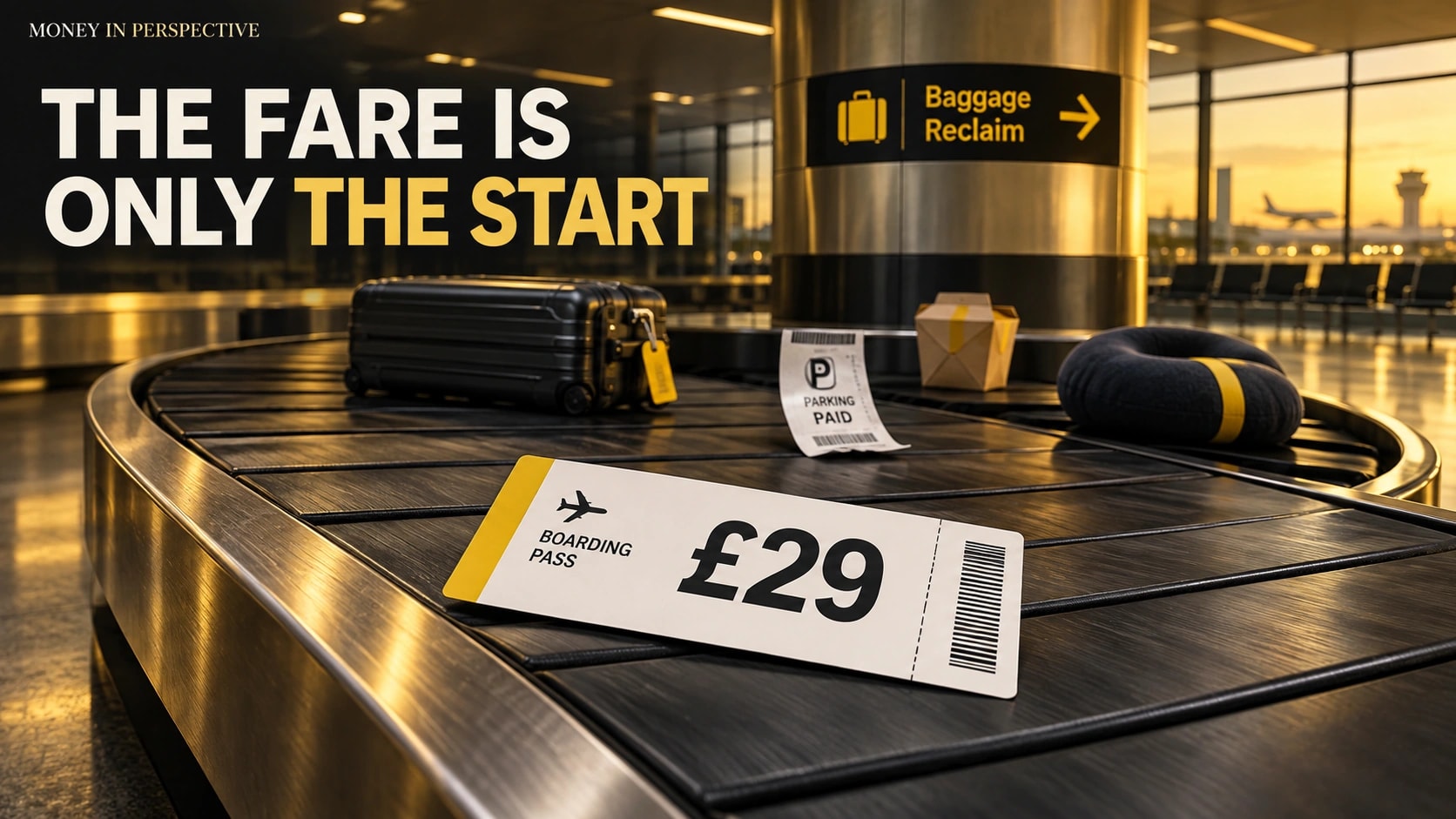
Parking is another major airport cost that starts before the terminal.
Official parking.
Meet-and-greet.
Off-site parking.
Drop-off fees.
Taxi.
Train.
The cheapest flight can be attached to an airport that is expensive to reach.
This is why flight comparisons should include the journey from home to the terminal.
A £30 cheaper ticket can be poor value if parking costs £70 more.
Airport hotels belong in the same comparison.
A very early flight may appear cheap until it requires a £90 hotel the night before.
Sometimes the hotel is still worth it because it buys sleep and reduces stress.
The point is that the cost belongs to the flight choice.
Restaurants and shops are only part of airport spending.
The entire travel infrastructure can monetise convenience.
The strongest defence is not extreme frugality.
It is planning.
Know when you need to arrive.
Know how you will get there.
Bring the things you do not want to buy at airport prices.
Decide whether food is part of the experience.
Check normal prices before buying duty-free products.
Evaluate premium services against what they replace.
This turns airport spending back into choice.
There is no need to avoid every shop.
Browsing can be enjoyable.
A coffee after security may genuinely signal that the holiday has started.
Buying a book for the flight can be excellent value.
The goal is not to make the airport joyless.
It is to understand the environment.
You are early, captive and temporarily outside your normal routine.
That is a powerful combination for retail.
Airports also encourage one more behaviour worth noticing: spending because currency feels temporary. If you are returning home with a small amount of foreign cash, the airport can feel like the place to “use it up”. That can lead to buying something you would never choose if the same value were sitting in your bank account.
The money is still money.
If exchanging it back is impractical or costly, spending it on something useful may be reasonable. But “I need to get rid of this cash” is not the same as “I want this product”.
Likewise, card payments in foreign currency can make prices harder to judge. Know the rough exchange rate and be cautious about payment options where the exchange rate may not be favourable. You do not need to calculate every coffee precisely, but you should know whether the displayed number is roughly £5 or £15.
A short post-trip review can also be useful. Look at what you actually spent between leaving home and boarding, then again on the return. Which purchases improved the journey? Which ones were simply boredom, poor planning or urgency? This gives you a personal airport pattern for next time.
You may discover that lounge access was excellent value but duty-free shopping was forgettable. Or that bringing breakfast saved almost nothing because you genuinely enjoy eating at the airport. The point is not to copy someone else's rules. It is to learn which airport conveniences are worth your money.
Once you know that, the terminal becomes less financially mysterious. It is still designed to sell to you. You simply arrive with a much clearer idea of what you actually want to buy.
The airport is basically designed to help you spend because spending makes waiting easier, hunger easier, anxiety easier and travel more comfortable.
That is why the purchases can be good value.
Just decide which problems you want to pay the airport to solve.
Because the terminal will happily solve all of them.
One transaction at a time.