Cheap flights are one of travel's most persuasive bargains.
£19.99 to another country.
£34.50 return.
£49 if you book today.
The headline price can make an entire trip feel affordable before you have considered anything beyond the seat on the plane.
Sometimes the cheap flight really is cheap.
Low-cost airlines have made travel accessible to millions of people and can provide extraordinary value, especially when you travel light and are flexible.
The problem is that the fare is only one part of the journey.
By the time you add baggage, airport transport, seat selection, parking, food, transfers and inconvenient flight times, the option that looked cheapest on the search results page can become one of the more expensive ways to travel.
This is why flights should be compared door to door, not runway to runway.
Start with baggage.
Many headline fares include only a small personal item.
That may be completely adequate for a short trip.
If you need a larger cabin bag or checked suitcase, the price changes.
Suppose Airline A charges £35 for the flight and £40 each way for the bag you need.
The practical fare is now £115.
Airline B charges £90 but includes the baggage.
The second airline looked £55 more expensive at first.
For your actual journey, it is £25 cheaper.
This is why searching by base fare can be misleading when your requirements are known.
Families feel this even more because baggage charges multiply across passengers.
One suitcase for four people may work.
Several may not.
The important thing is adding the bags you genuinely need before deciding which airline is cheapest.
Seat selection creates another layer.
A solo traveller may be perfectly happy accepting an allocated seat.
A family may want or need to sit together.
Paying £10 or £20 per person each way can add substantially to the booking.
Again, the fee itself is not necessarily unreasonable.
The mistake is comparing a flight where you will pay it with one where you will not.
Then consider the airport.
Low-cost airlines often use secondary airports because charges can be lower.
That is one reason fares can be so attractive.
The airport may also be far from the city in the advertisement.
A flight marketed as serving a famous destination can land an hour or more away.
Now you need a bus, train or taxi.
Suppose the cheaper flight saves £30 but the airport transfer costs £25 more each way.
The saving has already disappeared.
You may also lose two additional hours of the trip.
This matters particularly on short breaks.
If you have only three days, spending half a day on awkward airport transfers has a real opportunity cost.
Time is part of travel value.
A more expensive flight into the main airport may buy you several additional hours in the destination.
How much are those hours worth?
There is no universal answer.
The point is that they deserve consideration.
Your home airport matters too.
People often compare flights from several airports without including the cost of reaching them.
A flight from an airport ninety miles away may be £40 cheaper.
Fuel, parking or rail travel may cost more than the saving.
An early departure can require a taxi because public transport has not started.
A 6am flight might even require an airport hotel the night before.
The £25 flight can therefore create a £90 hotel and £20 transfer.
That does not make the flight a bad choice.
It simply changes the total.
Parking is especially easy to underestimate because it may be booked separately weeks later.
A family finds a bargain fare.
Then airport parking costs £85.
Because the payments happen at different times, the parking does not feel like part of the flight.
Financially, it is part of the journey.
Flight times also affect destination transport.
A plane landing at 11:45pm may arrive after trains and buses stop.
Now a taxi becomes necessary.
A daytime flight costing £35 more might actually be cheaper once the late-night transfer is included.
The same issue applies on the return.
A very early flight home may require a taxi from the hotel or another night near the airport.
When comparing schedules, ask what the time does to the rest of the trip.
Airport food can add another cost.
Budget flights often involve early arrival and waiting.
Coffee.
Breakfast.
Water.
Snack.
A family can spend £40 or more before boarding.
You may have spent some of that money regardless of airline.
The point is that inconvenient schedules create more airport time, which can create more airport spending.
Bring food where appropriate, carry a refillable bottle and decide which airport purchases are genuinely part of the experience you enjoy.
Do not accidentally turn a cheap fare into an expensive morning because nobody ate before leaving home.
Low-cost fares can also be less flexible.
Change fees.
Restricted cancellation.
No checked bag.
Separate charges for extras.
This can be perfectly fine when plans are certain.
If there is a reasonable chance your dates may change, flexibility has value.
A slightly more expensive fare that allows changes may reduce risk.
Read the terms rather than assuming all economy tickets behave the same way.
Connections deserve even more care.
Two separate cheap flights can look dramatically cheaper than a through-ticket.
But separate bookings may leave you responsible if the first delay causes you to miss the second.
You could need a new ticket, accommodation or additional food.
Travel insurance may cover some scenarios depending on the policy, but you should not assume it will rescue every self-connection.
The cheaper itinerary may be worth the risk.
The risk is still part of the comparison.
Currency and payment fees can add small amounts too.
Airlines may price in another currency.
Cards may charge foreign transaction fees.
Some booking platforms offer their own currency conversion.
These costs are usually modest relative to the whole trip, but they reinforce the broader point: the first number is not always the final number.
There is also a behavioural side to cheap fares.
When the flight costs £30, the trip can feel so inexpensive that other spending becomes easier to justify.
“Flights were basically nothing.”
So the hotel upgrades.
Another dinner out.
More activities.
The bargain fare can create psychological room for a more expensive holiday.
That is not necessarily bad.
If saving on flights lets you spend on experiences you value more, that can be excellent budgeting.
The important thing is not confusing cheap transport with a cheap holiday.
The destination itself may be expensive.
A £25 flight to a city with £180 hotels and high restaurant prices can create a more expensive trip than a £120 flight somewhere with affordable accommodation.
Travel should be budgeted as a complete system.
One useful method is to create a true flight cost for each option.
Include:
base fare,
baggage,
seat fees you genuinely plan to pay,
travel to the departure airport,
parking,
destination transfer,
and any hotel or taxi forced by the schedule.
You do not need to include every coffee.
The goal is enough information to compare options fairly.
Then add time.
Departure time.
Arrival time.
Transfer duration.
Total door-to-door journey.
Now the cheapest option may still win.
If so, excellent.
You have found a genuine bargain.
Sometimes the difference is so large that inconvenience is clearly worth it.
A £100 saving for an extra hour of travel might be easy to accept.
A £15 saving for three extra hours and a distant airport probably looks different.
This is also why budget airlines can be exceptional value for certain travellers.
Small backpack.
Flexible dates.
Lives close to the airport.
No need for allocated seats.
Destination served conveniently.
In that case, the advertised fare may remain very close to the real fare.
The business model rewards people who travel simply.
That is not a trick.
It is a pricing structure.
The mistake is buying the cheapest fare while travelling like a passenger who needs every add-on.
Packing strategy can therefore make a real difference.
For a weekend, a personal-item bag may be enough.
Wear the bulkiest clothing.
Choose versatile items.
Do not pack five “just in case” outfits.
Travelling light can reduce fees, speed up the airport and remove baggage-claim waiting.
But there is a point where saving on baggage becomes false economy.
If you leave essentials behind and buy them at the destination, the cheap fare has not helped.
The goal is efficient packing, not competitive minimalism.
Families should calculate baggage as a group.
Four people do not always need four checked bags.
One or two shared suitcases may be enough.
Conversely, trying to force an entire family into tiny bags purely to save money can create stress that is not worth the fee.
Value is not the same as minimum cost.
You should also compare direct versus connecting flights.
A connection may save £80.
It may also add four hours, another airport meal and more fatigue.
For a long holiday, the saving may be worthwhile.
For a two-night break, losing a large part of the trip can be expensive in another sense.
This is why travel time should be treated as part of the product.
Airlines sell transport.
What you actually buy is a chunk of your holiday.
There is no need to become suspicious of every cheap flight.
Some of the best trips begin with fares that seem almost absurdly low.
The useful habit is simply finishing the calculation before celebrating the deal.
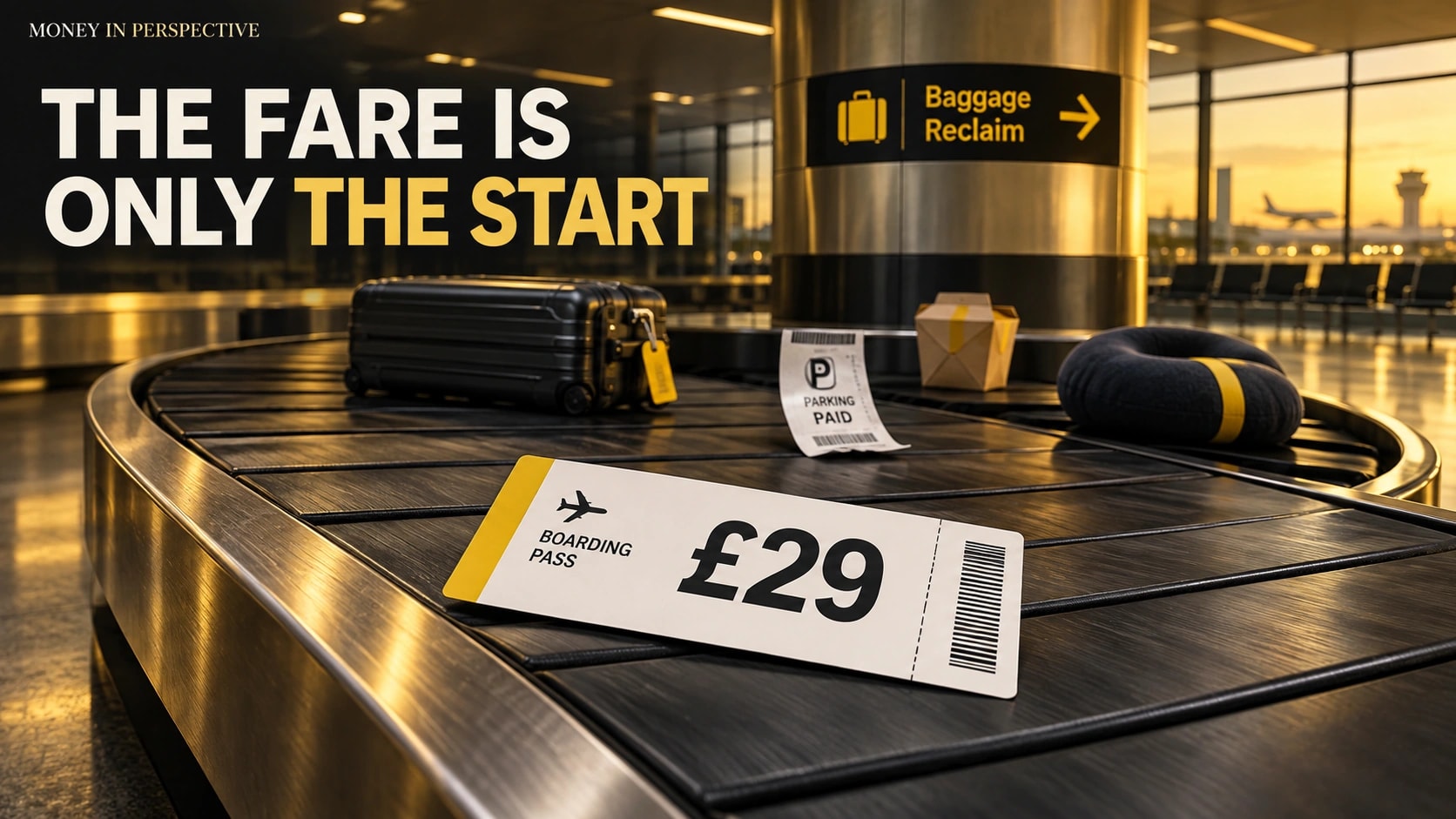
A £29 ticket can still be a £29 ticket if you travel light, use convenient airports and avoid unnecessary extras.
It can also become £150 after baggage, parking and transfers.
Both outcomes are normal.
The difference is knowing which one you are buying.
Cheap flights are not always cheap once you actually travel because travel begins before boarding and continues after landing.
The seat price is one component.
The real question is what it costs to get from your front door to where you actually want to be.
Compare that number.
Then decide which flight is the bargain.
A final place to look is the return journey.
Travellers often optimise the outbound flight carefully and accept whatever works on the way home.
That can produce a late checkout gap, expensive luggage storage, another airport meal or a transfer at an awkward time.
The return deserves the same door-to-door comparison as the outbound leg.
It can also help to put a cash value on convenience before searching.
For example, you might decide that saving two hours of travel is worth paying up to £40 more.
That personal rule prevents endless comparison between a cheap but awkward itinerary and a simpler one.
The number will differ by trip.
On a one-week holiday, you may tolerate more inconvenience.
On a weekend break, time may be worth more.
Finally, remember that bargain hunting itself has a cost.
Spending three evenings trying to save another £12 on the fare may not be the best use of your time.
Once you have found an option that is genuinely good value and fits the trip, booking it can be better than continuing to chase the theoretical cheapest price.
Travel pricing changes constantly.
Perfect timing is impossible.
The useful skill is not finding the absolute lowest fare every time.
It is recognising when a cheap fare is genuinely cheap after the whole journey is included.
That is the comparison that protects both your budget and the limited time you actually travelled there to enjoy.