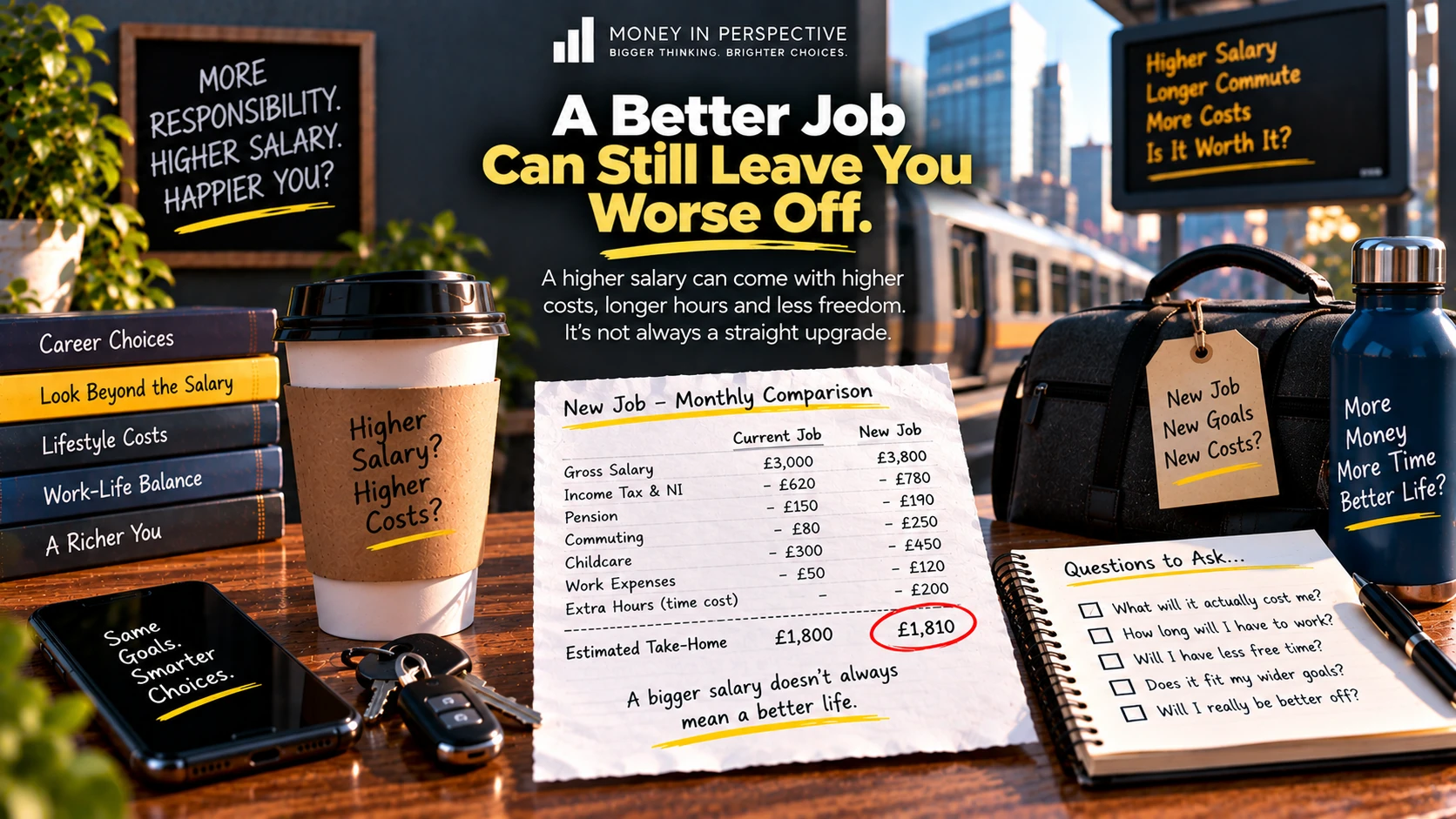

A £50,000 salary and £50,000 of self-employed profit look like the same number. They are not the same financial position.
That difference matters because self-employment is often compared with employment using the most flattering number on each side. An employee says, “I earn £50,000.” A sole trader says, “I made £50,000 profit.” On paper, both appear to be earning the same amount. In practice, one person may also receive paid holiday, employer pension contributions, sick pay, equipment and predictable monthly cash flow. The other has to arrange their own protection and fund the business that produces the income.
The tax calculation is only one part of the comparison. The bigger question is what the income has to cover before it becomes genuinely spendable. That requires a fair comparison: business expenses already deducted in reaching profit must not be deducted a second time, and pension tax relief belongs in the calculation too.
Start with the tax, because that is the easy part
Our illustrative comparison covers the 2026/27 tax year and assumes an employee and a sole trader in England, Wales or Northern Ireland, each with no other income, the standard Personal Allowance and no student-loan deductions. The employee is below State Pension age and pays ordinary category A National Insurance. This is sole trading, not operating through a limited company; Scottish Income Tax bands differ.
The standard Personal Allowance is £12,570 and the basic-rate band is £37,700 after that allowance. Someone with £50,000 of total earnings therefore has £37,430 of taxable income in this example, all within the basic-rate band. HMRC publishes the 2026/27 employee tax and NI thresholds.
For the employee, Income Tax is £50,000 − £12,570 = £37,430, multiplied by 20%, giving £7,486. Employee NI is 8% between the relevant lower and upper thresholds, giving an annualised £37,430 × 8% = £2,994.40. The resulting cash is £50,000 − £7,486 − £2,994.40 = £39,519.60, before pension contributions or other deductions. Actual payroll NI uses pay-period thresholds and rounding, so this is not a promised payslip total.
For the sole trader with £50,000 of taxable profit, Income Tax is also £7,486. Class 4 NI is 6% on profits above £12,570 up to £50,270, then 2% above that upper limit. Here it is £37,430 × 6% = £2,245.80, leaving £50,000 − £7,486 − £2,245.80 = £40,268.20. No separate compulsory Class 2 cash payment is added at this profit level: contributions are treated as paid to protect the NI record. GOV.UK sets out the self-employed NI rules.
| Annual comparison before pension contributions | Employee | Sole trader |
|---|---|---|
| Salary / taxable profit | £50,000.00 | £50,000.00 |
| Income Tax | £7,486.00 | £7,486.00 |
| Employee NI / Class 4 NI | £2,994.40 | £2,245.80 |
| Cash after these deductions | £39,519.60 | £40,268.20 |
The sole trader appears to keep £748.60 more. If we stopped there, self-employment would look marginally better. That would be a very incomplete comparison. Our take-home pay tool can explore employee salary deductions; it does not calculate sole-trader tax.
The employee may be getting paid for time they are not working
Almost all workers are entitled to 5.6 weeks of paid holiday a year. For a regular five-day week, that is 28 days, and bank holidays can count towards the entitlement. GOV.UK explains statutory holiday entitlement. An employee can therefore take qualifying leave and continue receiving pay.
A genuinely self-employed person can also take 5.6 weeks off. The difference is that no client is required to keep paying simply because the owner sits on a beach or spends Christmas trying to remember which day it is. Some businesses continue earning without the owner’s presence, but a freelancer selling their own time needs to price for the gaps.
Remove 5.6 weeks from 52 and roughly 46.4 working weeks remain. To produce £50,000 of annual profit over that period requires £50,000 ÷ 46.4 = £1,077.59 profit per working week. Spreading the same profit over all 52 weeks gives £50,000 ÷ 52 = £961.54.
The difference is a pricing and capacity problem. Paid holiday has economic value even though it does not appear as a separate addition to salary. Equally, if a sole trader already makes £50,000 while taking their desired holiday, that time off is already reflected in the annual result. Deducting a further holiday allowance from the same profit would count it twice.
Sick pay creates another difference
From 6 April 2026, the revised Statutory Sick Pay rules in Great Britain remove waiting days, with payment from the first full qualifying day of sickness. For 2026/27, the weekly amount is the lower of 80% of average weekly earnings and £123.25, subject to eligibility. HMRC explains the calculation.
Many employers provide contractual sick pay above the statutory minimum. A sole trader does not receive SSP from their own business merely because they cannot work. Two weeks without billable work can reduce receipts while rent, software and insurance bills continue arriving with admirable punctuality.
Savings, income-protection insurance or a business that earns without the owner’s direct time can address some of this risk. Those arrangements have costs and conditions. The important comparison is the actual protection available under the employment contract against the protection the business owner would realistically arrange.
Employment is not a guarantee against every interruption either. Statutory sick pay alone would replace only a small part of a £50,000 salary. Read the contract rather than assigning full salary protection to every job by default.
Employer pension contributions are part of the package
Under the usual automatic-enrolment minimum structure, the employer contributes at least 3% of qualifying earnings and total contributions must reach 8%. The standard qualifying-earnings band is £6,240 to £50,270 a year, confirmed in The Pensions Regulator’s 2026/27 thresholds, although schemes can use different contribution arrangements. GOV.UK explains workplace pension contributions.
For our £50,000 employee, qualifying earnings are £50,000 − £6,240 = £43,760. The minimum employer contribution is £43,760 × 3% = £1,312.80. That belongs in the value of the package even though it does not arrive in the employee’s bank account. Some employers contribute considerably more.
There is also an employee contribution to account for. With the employer paying 3%, the remaining 5% is £2,188 gross. In a relief-at-source scheme, a basic-rate taxpayer would usually pay £1,750.40, with £437.60 added as tax relief. The total pension funding would be £3,500.80, including the employer’s contribution.
A sole trader can receive pension tax relief too. To place £1,312.80 into a qualifying relief-at-source pension requires £1,050.24 of personal cash plus £262.56 of basic-rate relief, under our assumptions. HMRC explains pension tax relief. Simply subtracting the full gross contribution from post-tax cash overstates the personal cash cost.
That does not make employer contributions worthless. It means the comparison should give both people the relief to which they are entitled and compare equal amounts reaching their pensions.
Equipment, software and insurance are easy to forget
An employee may receive a laptop, software, professional subscriptions, training and insurance as part of doing the job. A self-employed person normally pays the business costs required to generate their profit. That distinction matters because turnover is not profit.
If a consultant invoices £65,000 and incurs £15,000 of deductible business costs, their taxable profit may be £50,000, subject to the accounting and tax rules. Those £15,000 of costs have already been recognised. Taking them off the £50,000 again would unfairly weaken the self-employed side of the comparison.
There can still be a cash-flow problem. The owner may pay for software before clients settle invoices, or need money for equipment replacement next year. HMRC lists qualifying legal and financial business expenses, but deductibility does not make a cost free.
For a fully deductible £1,000 expense that reduces profit from £50,000 to £49,000 in our example, the combined 20% Income Tax and 6% Class 4 saving is £260. The after-tax cost remains £740. That illustration assumes the entire expense qualifies and the same marginal rates apply throughout; it is not a rule for every purchase or income level.
The employee does not usually spend Sunday evening chasing invoices
An employee normally receives salary on an agreed payroll date. A sole trader can finish the work, issue an invoice and still be wondering where the money is six weeks later. A successful business therefore needs a different relationship with cash reserves.
Under traditional accounting, a sole trader might report £50,000 profit while still being owed £12,000 by customers. The profit can exist before the money reaches the bank. Under cash basis, however, income is generally recorded when received. Cash basis is now the standard method for eligible sole traders and partnerships without corporate partners, although traditional accounting can be chosen. GOV.UK explains the distinction.
It would therefore be misleading to imply that every unpaid invoice is already included in taxable profit. The practical problem remains whichever method applies: an invoice cannot pay the electricity bill until somebody pays it. Our discussion of why revenue is not the same as having money explores that distinction further.
Compare equal pension funding, then look at the cash buffer
Let us make the comparison more complete without counting the same cost twice. Keep the £50,000 salary and £50,000 taxable profit, and assume the employee’s pension uses the minimum qualifying-earnings structure described above. Both people want £3,500.80 to reach their pension during the year.
The employee starts with £39,519.60 after tax and NI, then pays £1,750.40 into their pension. That leaves £37,769.20 of cash. Their payment, tax relief and the employer’s £1,312.80 together provide the pension funding.
The sole trader starts with £40,268.20 and personally pays £2,800.64, with £700.16 of basic-rate relief added. That also puts £3,500.80 into the pension, leaving £37,467.56 of cash. Personal pension contributions do not reduce the trading profit used for Class 4 NI in this calculation.
| Equal annual pension funding | Employee | Sole trader |
|---|---|---|
| Cash after tax and NI | £39,519.60 | £40,268.20 |
| Personal pension payment after basic-rate relief | £1,750.40 | £2,800.64 |
| Total reaching pension, including employer where applicable | £3,500.80 | £3,500.80 |
| Remaining cash | £37,769.20 | £37,467.56 |
The employee now has £301.64 more cash with equal pension funding. This is a narrower and fairer conclusion than assuming all pension saving comes from untaxed money on one side and fully taxed money on the other. Salary sacrifice, different pension terms and other personal circumstances can change the result.
Suppose the sole trader also earmarks an illustrative £2,000 of that remaining cash for future disruption or unexpected bills. Immediately available spending money becomes £35,467.56, but the £2,000 has not vanished: it remains their reserve. This is a saving allocation, not another deductible expense or a universal annual charge. It should not duplicate insurance or equipment costs already included in the £50,000 profit. Employees need emergency savings too; the appropriate amount depends on each household’s risks.
The self-employed person can still come out far ahead
None of this means employment is financially superior. Self-employment can be valuable precisely because income is not capped by an employer’s salary structure. An employee on £50,000 may need a promotion or job change to reach £65,000. A sole trader may improve margins, raise prices, find better clients or create recurring revenue.
They may also gain more control over how and when they work. The point is that £50,000 is not automatically the right target for replacing a £50,000 employment package. A business with the capacity to earn substantially more can make the additional responsibilities worthwhile. A business that only replicates the salary figure needs closer examination.
There is no universal replacement figure because employment packages differ enormously. A defined-benefit pension cannot sensibly be valued by inserting the same 3% employer contribution used in our illustration. A role with full sick pay, generous leave and a realistic bonus also needs its own comparison.
Start with the personal outcome you want: cash for living costs, pension funding and a suitable reserve. Work back to the profit required after allowing for tax, then add operating costs to establish the necessary revenue. Finally, test whether your available billable time can generate it. Do not add holiday value to salary and then reduce capacity for the same holiday without checking for duplication.
Non-billable time is where many new businesses get surprised
A salaried employee can spend an hour in an internal meeting and still get paid. A self-employed consultant can spend an hour preparing proposals and earn nothing unless one converts into work. Bookkeeping, marketing, training and chasing debtors also consume capacity. They are real work even when no invoice follows.
Suppose a freelancer works 40 hours a week but only 28 are billable. For this separate pricing example, use 46 working weeks, allowing six weeks away rather than the earlier 5.6. Annual billable capacity is 46 × 28 = 1,288 hours.
Generating £50,000 before other business costs requires £50,000 ÷ 1,288 = £38.82 per billable hour, rounded. If £10,000 of annual operating costs must also be covered to leave £50,000 profit, required revenue becomes £60,000: £60,000 ÷ 1,288 = £46.58 per billable hour, rounded.
These are planning averages before VAT where applicable, not guaranteed achievable prices. Bad debts, cancellations and unexpected downtime can reduce the paid hours further. The point is why dividing an old salary by 52 weeks and 40 hours gives such an unreliable freelance rate. Pricing must cover the hours clients buy and the hours needed to keep the business functioning.
Self-employment can create tax timing pressure too
Employees generally pay Income Tax and NI through payroll as they earn. Sole traders normally settle their liabilities through Self Assessment, where payments on account can make the first substantial January bill particularly demanding.
Payments on account generally include Income Tax and Class 4 NI, with instalments due on 31 January and 31 July. Each is normally half the previous year’s relevant liability. Exceptions include a previous bill below £1,000 or more than 80% of the tax having been paid outside Self Assessment. HMRC explains payments on account and balancing payments.
Using the earlier £50,000 sole-trader example before pension relief, the Income Tax and Class 4 bill is £7,486 + £2,245.80 = £9,731.80. If no advance payments have been made and payments on account apply, the first January payment could combine that bill with £4,865.90 towards the next year: £14,597.70 altogether. A further £4,865.90 would normally be due in July, with later reconciliation against actual liability.
That is an illustration of timing, not an extra 50% tax charge. Pension relief, earlier payments and other circumstances can alter the amount. A good self-employed budget sets aside tax money throughout the year. Waiting until January to see what is left is not a tax strategy.
Compare the actual lives, not an idealised package
Paid leave, pension contributions and employment protections can feel invisible until circumstances change. Self-employment lets you arrange your own protection, but choosing that freedom does not make the employer’s safety net valueless. Conversely, an employee may incur commuting, parking or childcare costs that a flexible home-based business could reduce.
The comparison is therefore not one-way. Do not add every imaginable benefit to employment while assuming self-employment offers none. Use the employment contract you actually have and the business you could realistically run. A company car, for example, deserves its own comparison with a cash allowance, rather than being valued at its showroom price.
Business ownership also transfers responsibility. The employer usually carries the risk of quiet months and unpaid customers. A sole trader carries that risk personally, but may keep more of the upside when the business performs well. Neither side can be captured by the tax calculation alone.
A better comparison uses three numbers
The first number is the employee package: salary, employer pension funding, realistic bonus and benefits you genuinely value. The second is required self-employed profit, after business expenses but before personal tax and pension decisions. The third is required business revenue, which adds the operating costs needed to produce that profit.
For example, someone replacing a £50,000 salary might choose a planning target of £58,000 self-employed profit. With £12,000 operating costs, required revenue would be £70,000. Those latter figures are illustrative targets, not a calculated equivalent to our earlier employment package. At £58,000, some profit enters higher-rate Income Tax under our assumptions, so the personal outcome needs recalculating.
These three numbers should not be treated as interchangeable. Revenue pays business bills; profit is what remains before the owner’s personal liabilities; spendable cash is narrower again. Test the target against realistic prices, billable capacity and payment delays, then check what is left for the household.
A £50,000 salary buys predictability as well as income
Employment bundles several arrangements into one figure: payroll, regular payment, paid holiday and potentially pension and sick-pay benefits. Self-employment separates those responsibilities. That creates opportunity because the owner can capture more of the value they create, but also makes them responsible for arrangements an employer previously handled invisibly.
A £50,000 salary and £50,000 self-employed profit can therefore sit in roughly the same income neighbourhood while supporting very different financial lives. The right comparison recognises tax relief, avoids counting costs twice and gives flexibility as much thought as security.
If you are considering the jump, do not ask only whether you can replace your salary. Ask whether the business can replace the whole package you actually need, with enough room for the months that do not go to plan. That is the number that matters.
Rules checked on 21 October 2026. Figures are illustrative annual comparisons, not personalised tax or employment advice.